


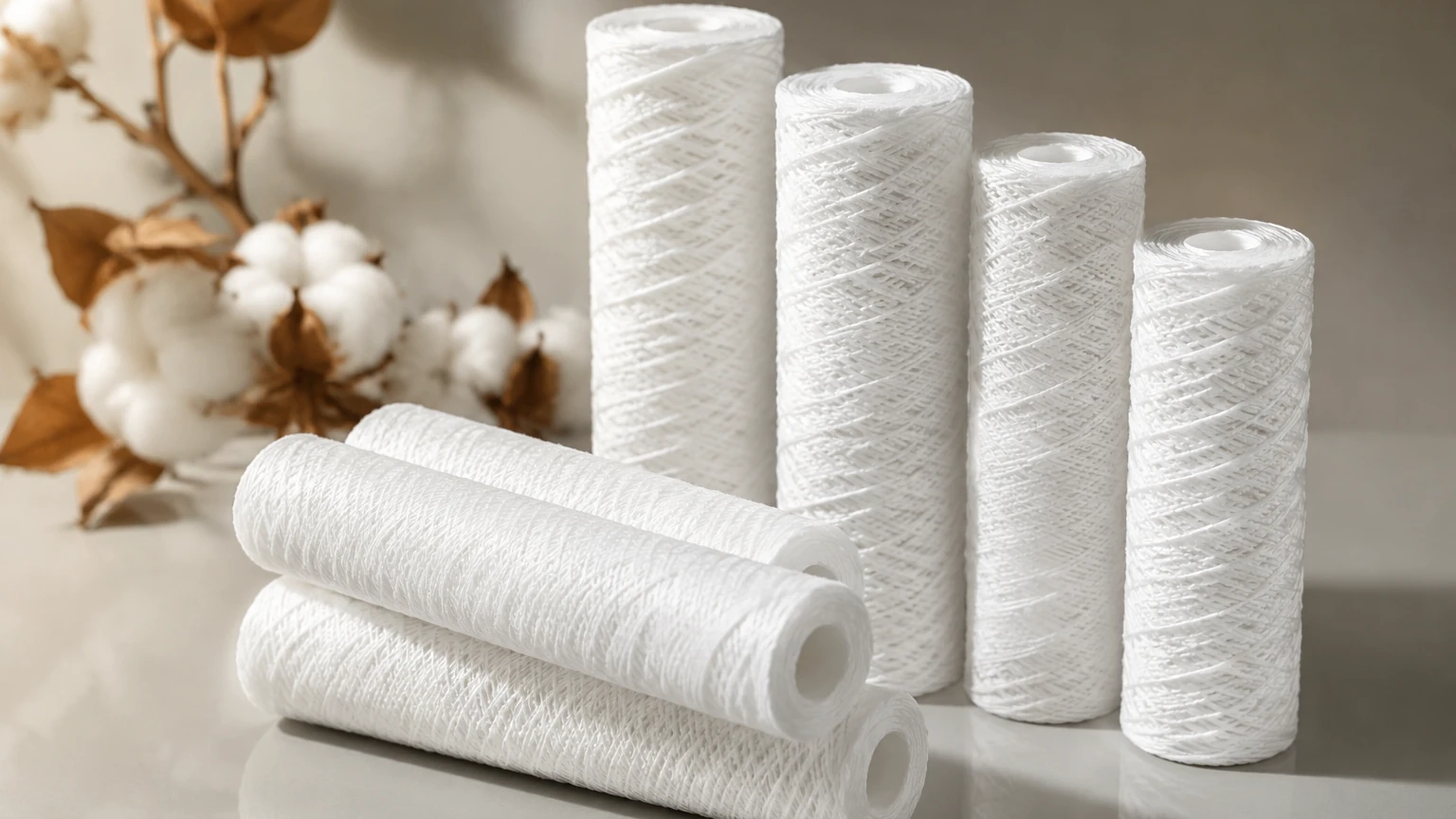
Cotton String Wound Filter Cartridge
In the landscape of industrial liquid process filtration, the cotton string wound filter cartridge remains a cornerstone technology for depth filtration. These components are engineered to remove suspended solids, sediment, and particulate matter from various fluid streams by utilizing a winding process that creates a tortuous path for contaminants. Unlike surface filters, which capture particles on a single plane, string wound cartridges utilize the entire thickness of the filter media, offering high dirt-holding capacity and a progressive filtration effect. For engineering and procurement teams, understanding the technical nuances of material selection, winding precision, and core compatibility is essential for optimizing process efficiency and protecting downstream equipment.
Understanding the Construction of String Wound Filters
The performance of a cotton string wound filter cartridge is fundamentally defined by its manufacturing process. The cartridge is produced by winding continuous yarn around a perforated central core. This winding is performed in a specific geometric pattern—often a diamond shape—that creates tapered passages.
The Principle of Graded Density
One of the primary advantages of this construction is the achievement of graded density. By adjusting the winding tension and the spacing of the yarn during production, manufacturers can ensure that the filter is tighter near the core and more open at the outer surface. This allows larger particles to be trapped in the outer layers while finer particles are captured deeper within the matrix. This mechanism prevents the surface from blinding prematurely, which is a common failure mode in non-depth media.
Core Material Selection
The central core provides the structural integrity necessary to withstand differential pressure. While polypropylene cores are common for low-temperature applications, industrial processes involving high temperatures or aggressive solvents require metal cores. As a specialist in precision metal components, Kaifil emphasizes the use of stainless steel (SS304 or SS316) cores to prevent core collapse and ensure compatibility with high-viscosity fluids. For more information on high-performance filtration components, you can visit the Main Page.
Material Characteristics: Bleached vs. Natural Cotton
Cotton is selected as a filter medium due to its excellent compatibility with oils, alcohols, and organic solvents. However, not all cotton yarn is processed equally. Engineers must distinguish between natural (unbleached) and bleached cotton based on the specific requirements of the application.
Natural Cotton
Natural cotton contains residual oils and waxes inherent to the plant fiber. These natural surfactants can sometimes cause foaming in aqueous solutions during the initial startup phase. Consequently, natural cotton is typically reserved for non-potable water applications, lubricating oils, and industrial solvent filtration where minor foaming or organic extractables are not detrimental to the end product.
Bleached Cotton
Bleached cotton undergoes a purification process to remove natural oils and waxes, meeting higher standards for purity. This material is often required in food and beverage processing, pharmaceutical pre-filtration, and electronics manufacturing. Bleached cotton is generally considered "FDA Grade," making it suitable for potable water and consumable liquids. It provides a cleaner effluent and eliminates the risk of surfactant-induced foaming.
Performance Metrics: Micron Ratings and Dirt-Holding Capacity
When specifying a cotton string wound filter cartridge, technical professionals must evaluate the micron rating and how it relates to the expected flow rate and pressure drop.
1. Nominal vs. Absolute Ratings: String wound cartridges are typically nominal filters. This means they are designed to trap a high percentage of particles at a specific micron size but may allow a small fraction of those particles to pass through. For applications requiring 99.9% efficiency, a secondary stage of absolute-rated filtration (such as a stainless steel mesh or pleated cartridge) is often recommended.
2. Micron Range: These cartridges are available in a wide range of ratings, typically from 0.5 microns up to 150 microns. The choice depends on the particle size distribution of the influent.
3. Dirt-Holding Capacity: Because the entire depth of the yarn is utilized, these filters can hold a significant mass of contaminants before reaching the terminal pressure drop. This translates to longer service intervals and reduced labor costs for filter change-outs.
Engineering Considerations for Industrial Applications
Selecting the right filter involves more than just matching a micron rating; it requires an analysis of the operating environment.
Temperature and Chemical Compatibility
Cotton fibers are stable at higher temperatures than synthetic fibers like polypropylene. A cotton string wound filter cartridge can typically operate at temperatures up to 250°F (121°C) when paired with a stainless steel core. This makes them ideal for hot oil filtration and high-temperature process water. However, cotton should be avoided in applications involving strong acids or strong alkalis, as these can degrade the cellulose structure of the fiber.
Flow Rate and Differential Pressure
Every filter media introduces a resistance to flow, known as clean pressure drop ($ΔP$). As the filter loads with contaminants, the $ΔP$ increases. Engineers should size the filtration system so that the initial pressure drop is less than 2-3 PSI. The "terminal" or "change-out" pressure drop for most string wound cartridges is between 20 and 30 PSI. Exceeding this limit can lead to media migration or "unloading," where the pressure forces trapped particles through the media and back into the process stream.
Comparing Cotton String Wound Cartridges with Alternative Technologies
In the B2B sector, choosing between different filtration technologies is a matter of balancing cost, performance, and durability.
* Melt-Blown Cartridges: These are often made of polypropylene and offer good chemical resistance but lack the high-temperature capability of cotton. They are also more prone to core bypass if not manufactured with an internal support structure.
* Stainless Steel Wire Mesh Filters: For the most demanding environments, stainless steel mesh filters—a core product line for Kaifil—offer permanent, cleanable solutions. While the initial investment for a stainless steel filter is higher than a disposable cotton cartridge, the total cost of ownership is often lower in high-volume or high-temperature applications where disposable filters would require frequent replacement. To explore these durable alternatives, refer to the Main Page.
* Pleated Filters: These offer much higher surface area and absolute filtration ratings but are more susceptible to surface blinding if the fluid has a high concentration of deformable solids or gelatinous contaminants.
Common Risks and Quality Assurance in Filter Selection
Not all string wound cartridges are manufactured to the same quality standards. Technical buyers should be aware of several common risks:
Media Migration
Lower-quality cartridges may use short-staple fibers that can shed into the effluent. This is known as media migration. In sensitive applications, such as pharmaceutical or microelectronics, this can contaminate the final product. Specifying high-quality, continuous-filament yarn or ensuring a post-filtration stage can mitigate this risk.
Winding Consistency
If the winding tension is inconsistent, the filter may develop "channels" where the fluid takes the path of least resistance. This leads to bypass, where unfiltered liquid reaches the downstream side of the system. A well-manufactured cotton string wound filter cartridge will have a uniform appearance and a rigid structure that does not compress easily under hand pressure.
Core Bypass
If the cartridge is not seated correctly in the filter housing, or if the end-cap seals are inadequate, fluid will bypass the filter media entirely. Ensuring the cartridge length matches the housing requirements and using appropriate gaskets (Buna-N, EPDM, or Viton) is critical for system integrity.
Total Cost of Ownership and Replacement Cycles
While the unit price of a cotton string wound filter cartridge is relatively low, the total cost of ownership (TCO) includes the cost of downtime, labor for change-outs, and disposal of used cartridges. In processes with high solids loading, the frequency of replacement can become a significant operational burden.
To optimize the replacement cycle, many facilities implement a multi-stage filtration strategy. By using a coarse (e.g., 50-micron) string wound filter as a pre-filter, they protect more expensive, fine-micron downstream filters. This sacrificial layer approach extends the life of the entire system and ensures that the final filtration stage operates at peak efficiency.
Conclusion
The cotton string wound filter cartridge remains a reliable and versatile tool for industrial depth filtration, particularly where temperature and organic solvent compatibility are concerns. By carefully selecting the core material, cotton type, and micron rating, engineers can achieve effective particulate removal and protect critical process equipment. When the application demands even higher levels of durability or cleanability, transitioning to precision metal filtration solutions is the logical next step for many industrial operators. For a comprehensive look at customized filtration engineering and high-performance metal components, visit the Main Page.
