


Stainless Steel Filters Strainers
In industrial fluid processing, the integrity of downstream equipment and the purity of the final product depend heavily on the efficiency of mechanical separation. Stainless steel filters strainers represent the primary line of defense against particulate contamination in sectors ranging from chemical processing to food and beverage production. Unlike disposable synthetic media, stainless steel components offer high mechanical strength, thermal stability, and the ability to be cleaned and reused, making them a cornerstone of sustainable industrial filtration.
Selecting the appropriate filtration or straining solution requires a deep understanding of fluid dynamics, material science, and the specific requirements of the application. This guide examines the technical nuances of stainless steel filters strainers, providing engineers and purchasing teams with the factual basis needed to specify the right components for their systems.
Understanding the Technical Distinction: Filters vs. Strainers
While the terms are often used interchangeably in casual conversation, engineers must distinguish between a filter and a strainer based on their function and the size of the particles they are designed to remove.
Strainers are generally used to remove larger, macroscopic particles from a process stream. Their primary role is often the protection of sensitive downstream equipment such as pumps, valves, and flow meters. Most strainers operate in the range of 40 microns and above. Because they target larger debris, they typically exhibit a lower pressure drop across the element and can handle higher flow velocities.
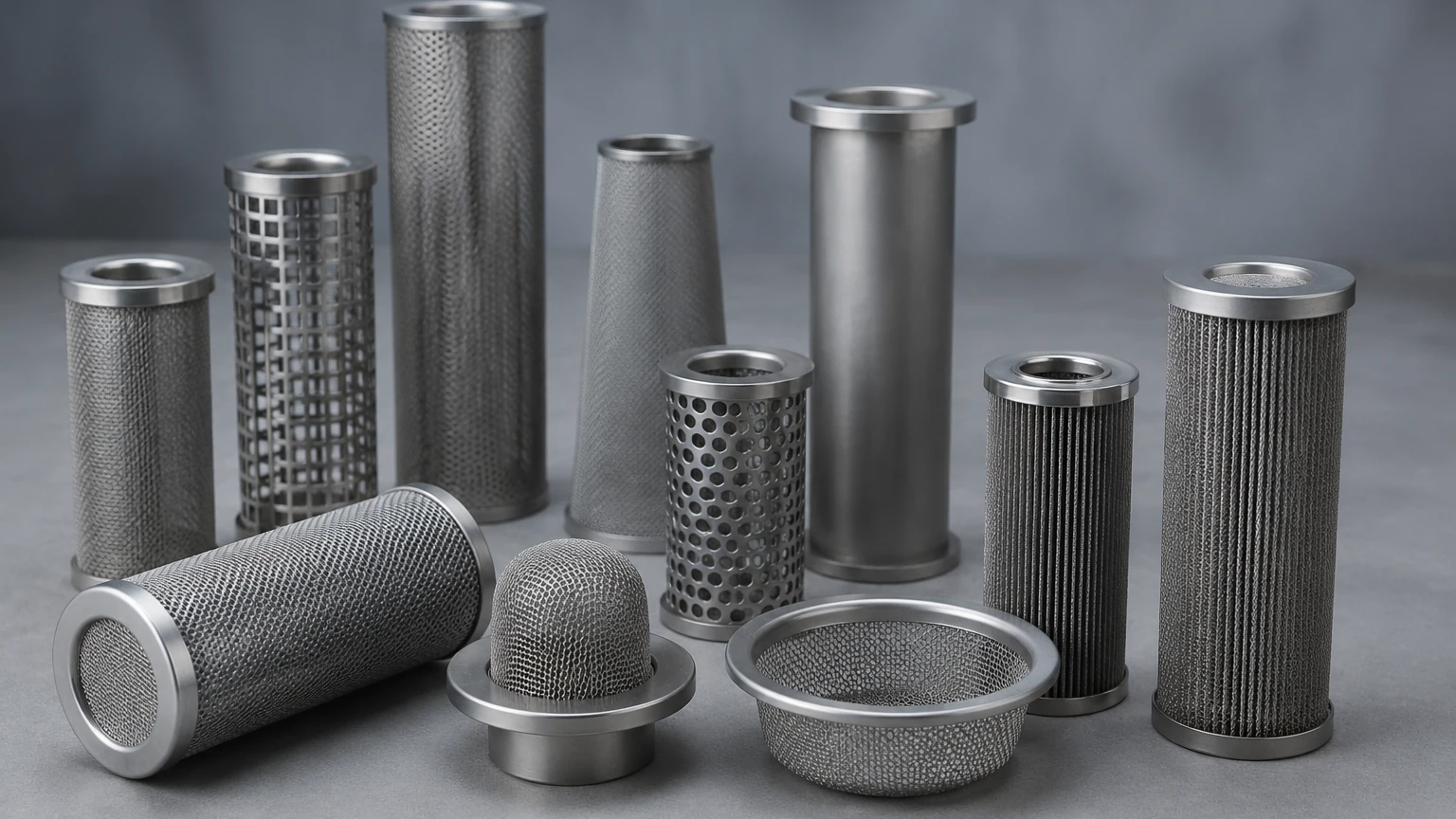
Filters, conversely, are designed for the removal of finer particulates, often down to the sub-micron level. They are utilized when the goal is to achieve a specific level of fluid purity or to protect high-precision components like fuel injectors or chromatography columns. Stainless steel filters often utilize multi-layered wire mesh or sintered metal structures to achieve high-efficiency capture of fine solids.
For a comprehensive overview of available configurations and technical specifications for both categories, engineers can consult the Main Page of the Kaifil technical resource center.
Material Selection: 304 vs. 316L Stainless Steel
The performance of stainless steel filters strainers is fundamentally tied to the grade of alloy used. While many stainless steels exist, 304 and 316L are the industry standards for filtration applications.
* Grade 304 Stainless Steel: This is the most common grade, offering excellent mechanical properties and good corrosion resistance for general industrial use. It is suitable for water treatment, hydraulic oils, and non-corrosive chemical applications. However, it is susceptible to pitting and crevice corrosion in environments with high chloride concentrations.
* Grade 316L Stainless Steel: The addition of molybdenum and a lower carbon content (the "L" designation) significantly enhances corrosion resistance, particularly against chlorides and acidic solutions. 316L is the preferred choice for marine environments, pharmaceutical manufacturing, and the food and beverage industry, where aggressive cleaning agents (CIP – Clean-in-Place) are frequently used.
Beyond the alloy grade, surface finish is a critical consideration. In pharmaceutical and food applications, electropolishing is often required to minimize surface roughness, preventing bacterial adhesion and ensuring the filter can be thoroughly sterilized.
Engineering Considerations for Custom Mesh and Sintered Designs
When specifying stainless steel filters strainers, the internal structure of the media determines the filtration efficiency and the mechanical limits of the component. Customization allows engineers to balance three competing factors: filtration accuracy, flow rate, and structural integrity.
Wire Mesh Weave Types
Industrial wire mesh is available in several weave patterns, each offering different performance characteristics:
* Plain Weave: The simplest form, where each warp wire crosses over and under each weft wire. It provides high flow rates but is generally limited to coarser filtration tasks.
* Dutch Weave: This utilizes a heavier warp wire and a finer weft wire, resulting in a dense, strong mesh with smaller openings. It is ideal for high-pressure applications where fine filtration is required.
* Twilled Weave: Allows for the use of thicker wires in a given mesh count, increasing the strength and durability of the filter element.
Sintered Metal Media
For extreme environments, sintered metal filters provide unmatched durability. Sintering involves bonding multiple layers of wire mesh or metal powder through a high-temperature heat treatment process without melting the material. This creates a porous, monolithic structure that can withstand high differential pressures and extreme thermal cycling without the risk of media migration.
Performance Evaluation and Sizing Criteria
Incorrectly sizing stainless steel filters strainers can lead to premature clogging, excessive energy consumption due to high pressure drops, or equipment failure. The following parameters must be evaluated during the design phase:
1. Micron Rating (Nominal vs. Absolute): A nominal rating indicates the filter's ability to retain a percentage of particles of a certain size (e.g., 90% of 10-micron particles). An absolute rating defines the size of the largest spherical particle that can pass through the media under specific test conditions. For critical applications, absolute ratings are mandatory.
2. Flow Rate and Pressure Drop (ΔP): The initial pressure drop across a clean filter should be minimized to allow for a longer service life before the terminal pressure drop is reached. Sizing should account for the fluid's viscosity; higher viscosity fluids require larger surface areas to maintain the same flow rate at an acceptable ΔP.
3. Effective Filtration Area (EFA): Increasing the EFA through pleating or multi-cylinder designs allows for higher dirt-holding capacity. This directly impacts the replacement or cleaning cycle, reducing the total cost of ownership.
Maintenance, Cleaning, and Replacement Cycles
One of the primary advantages of stainless steel filters strainers is their cleanability. Unlike polymer-based filters that must be discarded once fouled, stainless steel elements can be restored through various methods, depending on the nature of the contaminant.
* Backwashing: Reversing the flow of the fluid to dislodge particles from the surface of the media. This is often automated in continuous process systems.
* Ultrasonic Cleaning: Using high-frequency sound waves in a cleaning solvent to remove fine particulates embedded deep within the mesh or sintered structure.
* Chemical Cleaning: Utilizing acids, alkalis, or surfactants to dissolve organic or inorganic scaling. It is vital to ensure the cleaning agents are compatible with the specific grade of stainless steel (e.g., avoiding high concentrations of hydrochloric acid on 304/316).
Engineers should monitor the differential pressure across the filter. A sudden spike in ΔP usually indicates a high concentration of contaminants, while a sudden drop may indicate a breach in the filter media. Establishing a regular maintenance schedule based on these readings is essential for preventing bypass and ensuring process consistency.
Industrial Applications and Selection Advice
The versatility of stainless steel filters strainers makes them applicable across a wide spectrum of demanding environments.
In chemical processing, these components must resist aggressive solvents and high temperatures. Sintered mesh is often preferred here due to its resistance to mechanical fatigue. In the food and beverage industry, the focus shifts to hygienic design. Filters must be free of dead spaces where organic matter could accumulate, and they must be capable of withstanding frequent sterilization cycles.
In hydraulic and lubrication systems, stainless steel strainers are used to protect high-pressure pumps from metal shavings and other wear debris. The high collapse strength of stainless steel is a critical factor here, as hydraulic surges can easily crush less robust filter media.
When purchasing, it is important to confirm the following with the manufacturer:
* The specific alloy grade and its certification.
* The maximum allowable differential pressure (collapse pressure).
* The availability of custom end-fittings (NPT, Flanged, Sanitary Tri-clamp) to ensure seamless integration into existing piping.
* The recommended cleaning procedures for the specific contaminant type.
By focusing on these technical boundaries, procurement teams can ensure they are investing in a filtration solution that provides long-term reliability and optimizes the efficiency of their industrial processes. For detailed technical support and to explore customized filtration components, visiting the Main Page provides access to the engineering expertise required for complex system designs.
