


Vee Wire
In industrial filtration and separation processes, the structural integrity and efficiency of the filter media are paramount. Vee wire, also commonly referred to as wedge wire, represents a specialized profile wire technology used to create high-performance screens and filter elements. Unlike traditional woven wire mesh or perforated metal, vee wire is engineered through a precision resistance welding process that joins a surface profile wire to support rods at every intersection. This construction method results in a robust, non-clogging surface that is essential for demanding applications in chemical processing, water treatment, and food production.
For engineers and procurement teams, understanding the technical nuances of vee wire is critical for optimizing system performance and reducing downtime. Kaifil, as a manufacturer of custom stainless steel filtration solutions, provides these components to meet specific mechanical and chemical requirements. This guide explores the engineering principles, material considerations, and application-specific parameters that define high-quality vee wire components.
Understanding the Engineering of Vee Wire
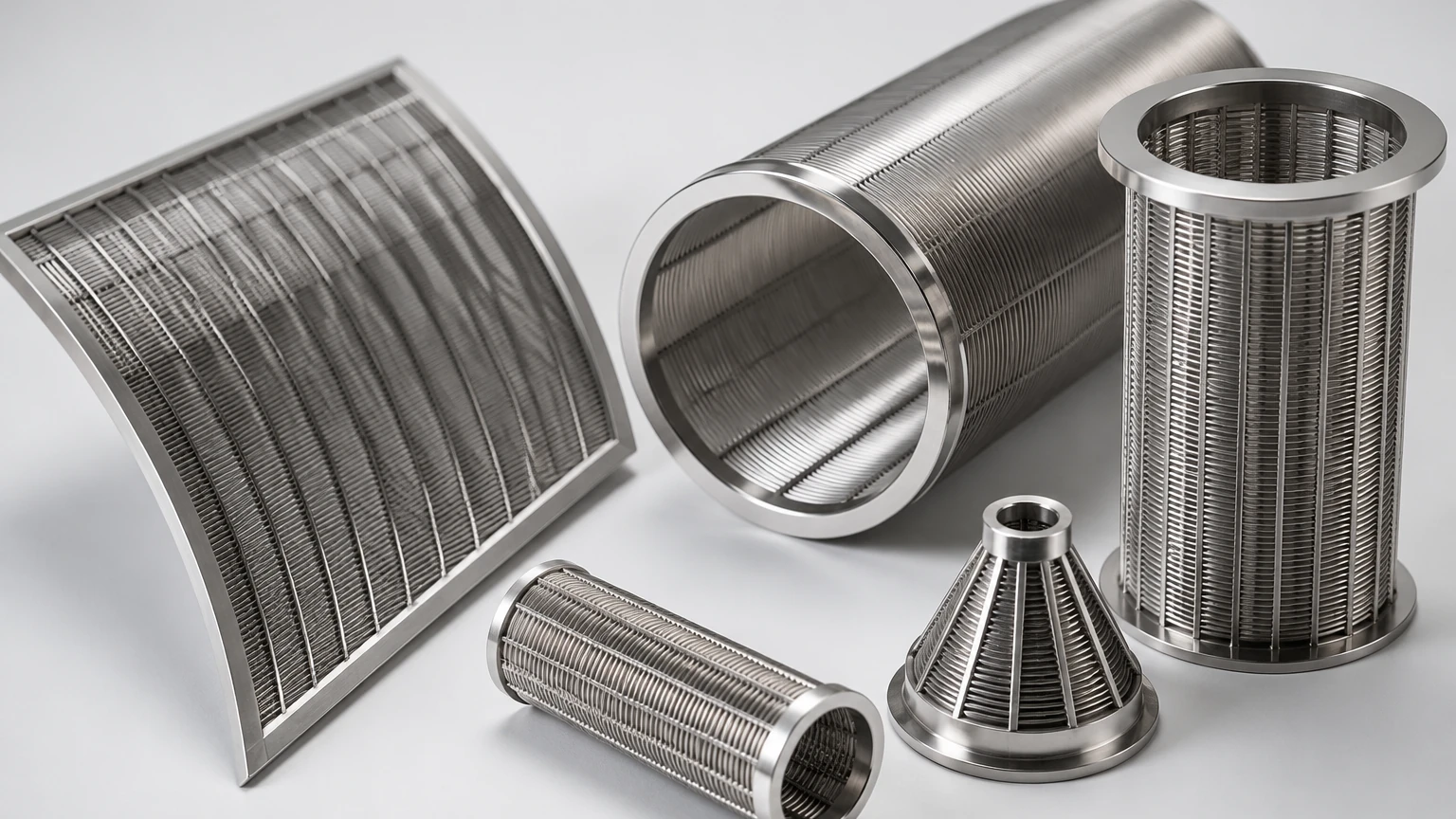
The fundamental design of vee wire consists of two primary components: the surface profile (the vee-shaped wire) and the support profiles (the rods). The surface wire is typically triangular or trapezoidal in cross-section. During manufacturing, this wire is wrapped or laid across support rods and welded at each contact point using advanced resistance welding techniques.
The Two-Point Contact Principle
The "V" shape of the profile wire is the defining characteristic of this technology. The narrowest part of the slot is at the very surface of the screen. As the slot extends inward, the opening widens. This geometry ensures that any particle small enough to pass through the initial slot opening will continue to flow through the screen without becoming wedged or trapped. This "two-point contact" significantly reduces the risk of blinding and clogging, which is a common failure mode in woven mesh filters where particles can easily become lodged in the intersections of the weave.
Structural Support and Rigidity
The support rods provide the necessary mechanical strength to withstand high differential pressures. Depending on the application, these rods can be round, rectangular, or even another vee-shaped wire. The spacing and frequency of these support rods are calculated based on the expected pressure drop and the mechanical load the screen must bear. For heavy-duty industrial applications, such as mining or deep-well water intake, the support structure is reinforced to prevent deformation under extreme stress.
Key Performance Advantages in Industrial Filtration
When comparing filtration media, vee wire offers several distinct advantages that contribute to long-term operational efficiency. These benefits are particularly evident in continuous flow systems where maintenance access is limited.
Anti-Clogging Characteristics
As mentioned, the diverging slot design is the primary defense against clogging. In industries like wastewater treatment or pulp and paper processing, where fibrous or irregularly shaped particles are common, the ability of the screen to self-clean or be cleaned via backwashing is essential. The smooth surface of the vee wire allows for efficient mechanical cleaning, such as scraping or brushing, without damaging the filter media.
Precision Slot Widths
Manufacturing vee wire allows for extremely tight tolerances in slot widths. Slots can be engineered as small as 20 microns or as large as several millimeters, depending on the separation requirements. This precision ensures a consistent cut-off point, which is vital for processes like catalyst recovery or resin retention in ion exchange columns. Because the slots are formed by the gap between parallel wires rather than a weave, the uniformity of the opening is maintained across the entire surface area of the filter.
High Effective Open Area
The ratio of the open slot area to the total surface area—known as the effective open area—is a critical metric for flow capacity. Vee wire designs can be optimized to maximize this area, thereby reducing pressure drop across the filter. A lower pressure drop means less energy is required to move fluid through the system, and it reduces the mechanical stress on the filter element itself. Engineers can balance the width of the profile wire and the slot size to achieve the optimal flow-to-strength ratio.
Material Selection and Durability Factors
The choice of material is as important as the mechanical design. Since vee wire is often used in corrosive or high-temperature environments, selecting the correct alloy is fundamental to the service life of the component.
1. Stainless Steel 304: The standard choice for general industrial applications. It offers good corrosion resistance and is cost-effective for water treatment and food processing where chemical exposure is moderate.
2. Stainless Steel 316L: Containing molybdenum, 316L provides superior resistance to chlorides and acids. This is the preferred material for marine environments, pharmaceutical manufacturing, and chemical processing plants where aggressive cleaning agents or process fluids are used.
3. Duplex Stainless Steels: For applications involving high pressure and highly corrosive media (such as oil and gas or desalination), Duplex alloys offer higher yield strength and exceptional resistance to stress corrosion cracking.
4. Specialty Alloys: In extreme cases involving high temperatures or specific chemical sensitivities, materials like Monel, Hastelloy, or Inconel can be utilized to ensure the longevity of the filter.
Beyond the alloy itself, the surface finish of the vee wire can be modified. Electropolishing is often used in the food and pharmaceutical industries to create an ultra-smooth surface that inhibits bacterial growth and further improves the ease of cleaning.
Customization Parameters for Specific Applications
No two industrial filtration requirements are identical. Customization is the core of effective vee wire implementation. When designing a filter element, several configuration options must be considered:
Flow Direction
The orientation of the vee wire determines the flow direction.
* Outside-to-In (FOTI): The most common configuration for filter cartridges and intake screens. The smooth surface is on the exterior, and the support rods are on the interior.
* Inside-to-Out (FITO): Often used in centrifuge baskets or internal reactor screens. The smooth surface is on the inside, allowing for internal mechanical cleaning or specific flow dynamics.
* Radial Flow: Used in specialized chemical reactors where the fluid moves horizontally across the screen surface.
Profile Wire and Support Rod Geometry
Engineers can select from various wire profiles to balance wear resistance and flow efficiency. A narrower profile wire increases the open area but may reduce the wear life in abrasive applications, such as sand filtration. Conversely, a wider, heavier profile wire provides more material to sacrifice in abrasive environments, extending the time between replacements.
End Fittings and Reinforcements
To integrate the vee wire screen into an existing system, custom end fittings—such as flanges, threaded couplings, or reinforced rings—are welded to the screen body. These fittings must be engineered to handle the same pressure and temperature ratings as the screen itself to prevent failure at the connection points.
Industrial Applications and Use Cases
The versatility of vee wire makes it a staple in numerous sectors. Its ability to handle high solids loads while maintaining flow makes it indispensable in the following areas:
Water and Wastewater Treatment
Vee wire is used extensively in well screens, intake screens for power plants, and underdrain systems for sand filters. Its high open area allows for low-velocity intake, which protects aquatic life and prevents the draw-in of debris. In wastewater plants, it is used for dewatering and sludge thickening.
Food and Beverage Processing
In the brewing industry, vee wire is the standard for lauter tun bottoms, providing a precise gap for wort separation while supporting the heavy weight of the grain bed. It is also used in sugar processing, juice extraction, and vegetable processing due to its hygienic properties and ease of sterilization.
Petrochemical and Refining
Reactor internals often utilize vee wire for center pipes, basket strainers, and catalyst support grids. The high temperature and pressure resistance of stainless steel vee wire ensure that these components can operate reliably during long production cycles without risk of collapse or bypass.
Mining and Aggregate
For the classification and dewatering of ores and minerals, vee wire screens provide the necessary abrasion resistance. The vibrating screens used in these industries rely on the structural rigidity of the welded vee wire to maintain slot accuracy under constant mechanical vibration.
Maintenance and Total Cost of Ownership
While the initial cost of a vee wire screen may be higher than that of a woven mesh or plastic alternative, the total cost of ownership (TCO) is often significantly lower. This is due to several factors:
* Extended Service Life: The robust welded construction resists mechanical damage and wear far better than thinner media.
* Reduced Cleaning Cycles: The anti-clogging design allows systems to run longer before requiring a cleaning cycle (backwash or manual intervention).
* Lower Energy Costs: Maintaining a low pressure drop reduces the load on pumps and motors.
* Minimal Replacement Frequency: Because the media is durable and can be cleaned repeatedly, the frequency of purchasing replacement parts is reduced.
Maintenance typically involves routine backwashing or CIP (Clean-in-Place) procedures. Because the surface is smooth and the slots are non-clogging, these processes are highly effective at restoring the original flow rate.
Procurement Checklist for Engineers
Before finalizing a specification for vee wire components, engineers and purchasing teams should confirm several key technical details with the manufacturer. Providing accurate data ensures the resulting product will meet the application's demands.
* Slot Opening: Define the required micron rating or slot width based on the smallest particle to be retained.
* Material Grade: Specify the alloy based on the chemical composition of the fluid and the operating temperature.
* Pressure Requirements: Determine the maximum operating pressure and the potential for pressure spikes or differential pressure limits.
* Flow Rate: Provide the required volume of fluid per unit of time to ensure the screen has sufficient open area.
* Dimensional Constraints: Confirm the outer diameter, inner diameter, and overall length, including any necessary tolerances for installation.
* Cleaning Method: Inform the manufacturer if the screen will be subjected to high-pressure backwashing, mechanical scraping, or chemical cleaning.
By addressing these factors, technical teams can ensure they receive a filtration solution that balances performance, durability, and cost. For those seeking specialized assistance in designing or sourcing these components, you can Review product options and application support to find a solution tailored to your specific industrial environment.
Kaifil continues to support global industries by manufacturing precision-engineered stainless steel filtration components. Whether for a standard water treatment project or a complex chemical reactor internal, the application of vee wire technology remains a cornerstone of efficient industrial separation. Through careful material selection and rigorous engineering standards, these components provide the reliability needed for modern industrial processes.
