


Filtri Autopulenti
In the landscape of industrial fluid management, the transition from manual filtration to automated systems represents a significant shift toward operational efficiency and reduced downtime. Filtri autopulenti, or self-cleaning filters, are at the forefront of this transition, providing a continuous filtration process that eliminates the need for frequent manual intervention. For engineers and procurement specialists, understanding the technical nuances of these systems—from their mechanical operation to the material science behind the filter elements—is essential for optimizing industrial processes.
Industrial filtration is rarely a static challenge. As fluids circulate through chemical processing plants, food production lines, or hydraulic systems, they accumulate contaminants that can compromise product quality and damage downstream equipment. Traditional basket strainers or cartridge filters require the system to be shut down or bypassed during cleaning cycles. In contrast, filtri autopulenti utilize internal mechanisms to clear the filter surface while the system remains online, ensuring a steady flow and consistent pressure levels.
Mechanism of Action: How Self-Cleaning Filters Operate
The efficacy of filtri autopulenti relies on their ability to detect and respond to contaminant buildup. Most systems operate based on a pressure differential (ΔP) principle. As the filter element—typically a stainless steel wire mesh or wedge wire screen—collects particles, the resistance to flow increases, causing the pressure to drop on the downstream side. Once a predetermined threshold is reached, the cleaning cycle is triggered.
There are three primary mechanisms used in these systems:
1. Backwashing (Reverse Flow): This method involves reversing a portion of the filtered fluid (or an external clean fluid) back through the filter element. The reverse flow dislodges the "filter cake" from the surface of the mesh, flushing it out through a discharge valve. This is highly effective for low-viscosity fluids like water.
2. Mechanical Scraping: For more viscous fluids or sticky contaminants, mechanical scrapers are used. A blade or brush moves across the surface of the filter element, physically removing the debris. The waste then settles into a collection chamber at the bottom of the housing for periodic purging.
3. Suction Scanning: This technology uses a scanning nozzle that moves across the interior of the filter screen. It creates a localized high-velocity vacuum effect that sucks particles off the mesh without requiring the entire system to be backwashed, minimizing fluid loss.
Engineering Considerations: Material and Mesh Selection
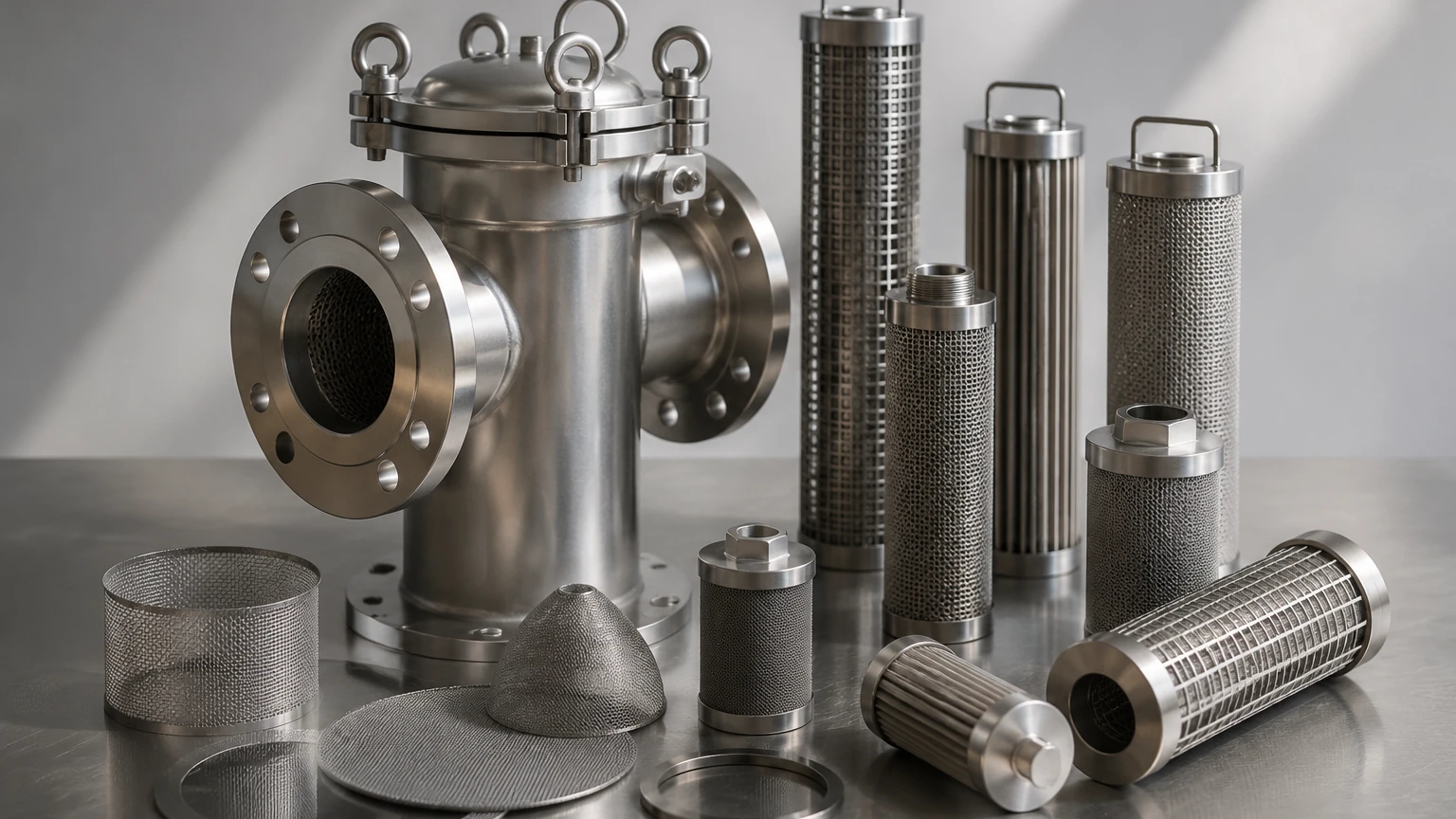
The heart of any self-cleaning system is the filter element itself. At Kaifil, the focus is on precision-engineered stainless steel components that can withstand the mechanical stresses of the cleaning cycle. When specifying filtri autopulenti, engineers must consider the structural integrity of the media.
Stainless Steel Grades
Stainless steel 304 and 316L are the industry standards. 316L is particularly favored in chemical and pharmaceutical applications due to its superior corrosion resistance, especially in environments containing chlorides. The durability of these materials ensures that the filter element does not deform under high pressure or during the abrasive scraping process.
Filter Media Types
* Wedge Wire: Known for its high strength and non-clogging characteristics, wedge wire is ideal for mechanical scraping systems. The V-shaped profile of the wire allows only two points of contact with particles, making them easier to dislodge.
* Sintered Wire Mesh: For applications requiring high precision and fine micron ratings, sintered mesh provides a multi-layer structure that offers both filtration accuracy and structural support. It is often used in backwashing systems where fine particle retention is critical.
* Perforated Metal: Used primarily as a support layer or for coarse filtration, perforated metal provides the necessary rigidity for the finer mesh layers to operate under high-pressure differentials.
For more information on material specifications and custom filtration components, you may visit the Main Page of our technical resource center.
Performance Metrics: Pressure Drop and Filtration Efficiency
When evaluating filtri autopulenti, two metrics are paramount: the initial pressure drop and the filtration rating (micron size).
Pressure Drop (ΔP): An oversized filter may lead to unnecessary capital expenditure, while an undersized filter will trigger cleaning cycles too frequently, leading to excessive wear and fluid loss. Engineers must calculate the flow velocity and fluid viscosity to ensure the filter housing and element can handle the required throughput without exceeding a 0.2 to 0.5 bar initial pressure drop.
Filtration Efficiency: The distinction between absolute and nominal ratings is vital. In critical applications, such as the protection of high-pressure spray nozzles or sensitive membranes, an absolute-rated stainless steel mesh ensures that 99.9% of particles above a specific micron size are captured. For general water intake or cooling tower loops, a nominal rating may suffice, offering a more cost-effective solution.
Industrial Applications and Compatibility
Filtri autopulenti are utilized across a diverse range of sectors, each with unique compatibility requirements:
* Water Treatment: Used for removing sand, algae, and silt from raw water intakes. These systems protect downstream RO (Reverse Osmosis) membranes and UV sterilizers.
* Food and Beverage: In this sector, hygiene is the priority. Filters must feature "dead-space-free" designs and polished stainless steel surfaces to prevent bacterial growth. They are commonly used for filtering syrups, chocolate, and edible oils.
* Chemical and Petrochemical: Here, chemical compatibility is the primary concern. The seals (O-rings) and the metal alloys must be resistant to the specific solvents or acids being processed. Self-cleaning filters reduce operator exposure to hazardous materials by automating the cleaning process.
* Pulp and Paper: These filters handle high volumes of water containing fibrous materials. Mechanical scraping is often the preferred method here to prevent fiber stapling on the mesh surface.
Maintenance, Durability, and Total Cost of Ownership
While the initial investment for filtri autopulenti is higher than for manual filters, the Total Cost of Ownership (TCO) is significantly lower in the long run. The primary cost drivers in filtration are labor, replacement parts, and fluid loss.
1. Reduced Labor Costs: Manual cleaning requires operators to stop work, open housings, and clean or replace elements. Automation redirects this labor to higher-value tasks.
2. Extended Element Life: Because self-cleaning systems prevent the deep embedding of particles (by cleaning at a specific ΔP), the stainless steel elements often last for years, whereas disposable cartridges must be replaced weekly or even daily.
3. Minimized Fluid Loss: Modern suction-scanning and backwashing systems are designed to use less than 1% of the total flow for the cleaning cycle, which is a critical factor when processing expensive chemicals or treated water.
Maintenance for these systems typically involves an annual inspection of the drive motor, seals, and the integrity of the mesh. Because the system is largely mechanical, the wear parts are predictable and easily managed through a preventative maintenance schedule.
Customization and OEM Solutions for Industrial Filtration
No two industrial processes are identical. Factors such as installation footprint, pipe orientation, and specific contaminant loads necessitate a customized approach to filtration. Kaifil specializes in manufacturing the internal components that define the performance of these systems.
Customization options often include:
* Variable Micron Ratings: Tailoring the mesh density to the specific particle size distribution of the process fluid.
* Reinforced Structures: Adding support cages to filter cartridges to handle extreme pressure surges or high-viscosity fluids.
* Specific Alloy Selection: Utilizing Duplex stainless steel or Hastelloy for highly corrosive environments where standard 316L might fail.
When selecting a partner for filtration components, it is important to confirm their manufacturing capabilities regarding welding precision and mesh consistency. Poorly welded seams or inconsistent pore sizes can lead to "bypass," where contaminants skip the filter entirely, defeating the purpose of the installation.
Conclusion: Making an Informed Decision
Investing in filtri autopulenti is a strategic decision that impacts the reliability of an entire production line. By focusing on the technical requirements—specifically the interaction between the fluid properties and the filter media—engineers can ensure they select a system that provides consistent performance with minimal oversight.
Before finalizing a purchase, it is recommended to conduct a fluid analysis to determine the particle type (hard vs. soft), concentration, and the fluid's rheological properties. This data allows for the precise engineering of the filter element, ensuring that the self-cleaning mechanism operates at peak efficiency. For those seeking reliable, high-performance filtration components and custom OEM support, reviewing the available technical options is the first step toward a more efficient industrial process. Review product options and application support on our Main Page to find the right solution for your specific filtration challenges.
