


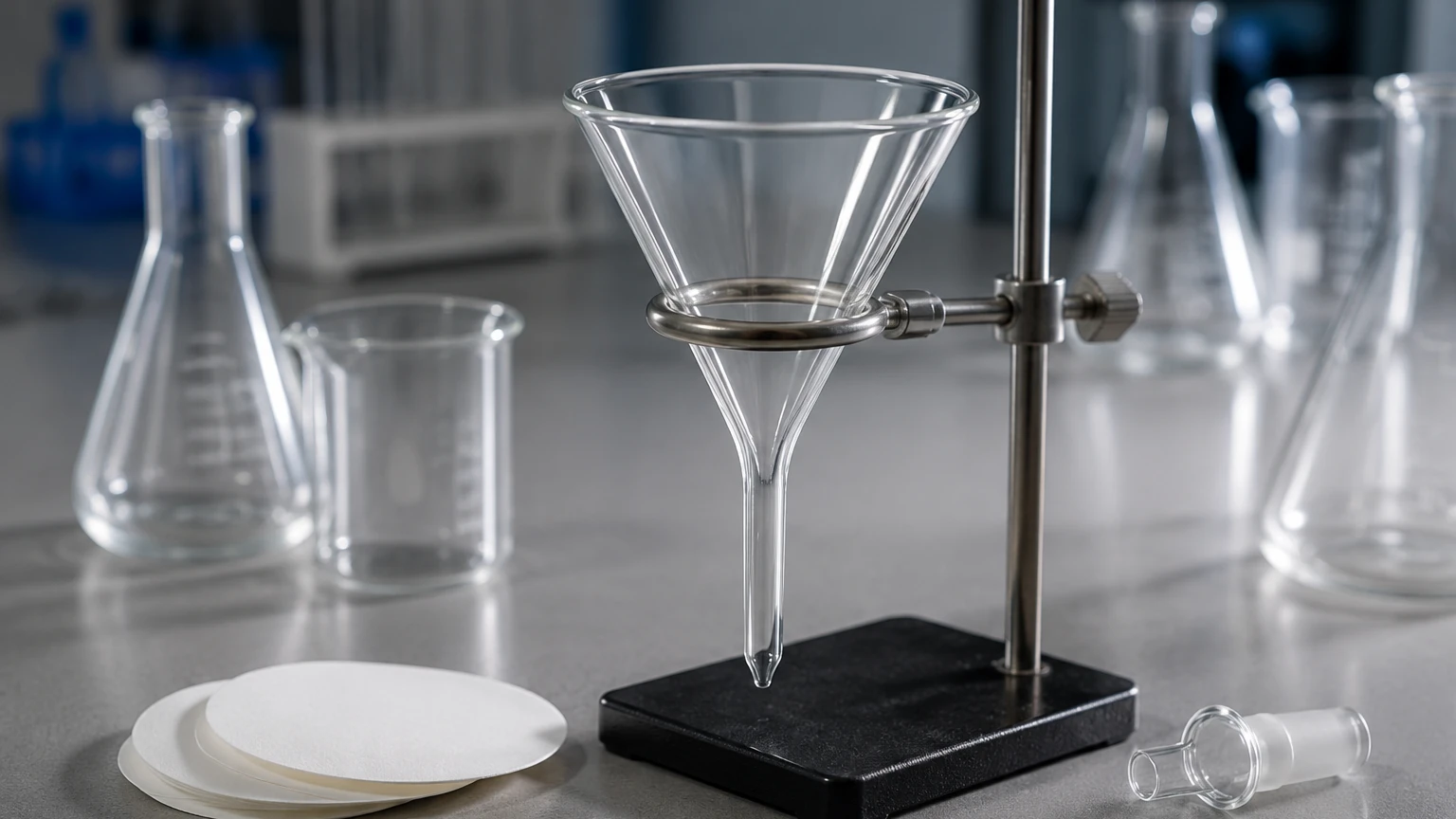
Glass Filtration Funnel
In the landscape of industrial research, chemical processing, and pharmaceutical development, the glass filtration funnel remains a foundational tool for liquid-solid separation. While large-scale production often relies on robust metallic systems, the initial stages of process development, quality control, and small-batch purification frequently occur within the confines of laboratory-grade glassware. Understanding the technical nuances of glass filtration funnels—from material composition to porosity standards—is essential for engineers and laboratory managers tasked with transitioning a process from the benchtop to the factory floor.
Industrial filtration is rarely a one-size-fits-all endeavor. The selection of a glass filtration funnel is dictated by the chemical nature of the filtrate, the thermal requirements of the procedure, and the desired clarity of the final product. As a technical resource, this guide examines the engineering considerations behind glass filtration systems and how they interface with larger industrial filtration strategies.
Understanding the Role of Glass Filtration Funnels in Industrial R&D
The primary advantage of using a glass filtration funnel in a B2B or industrial laboratory setting is its near-universal chemical compatibility and transparency. Unlike opaque plastic or metal alternatives, glass allows technicians to visually monitor the filtration rate, cake formation, and potential clogging in real-time. This visibility is critical during the optimization phase of a new chemical synthesis or pharmaceutical formulation.
In most industrial applications, these funnels are used in conjunction with vacuum systems (suction filtration) to accelerate the separation process. By creating a pressure differential across the filter media, the liquid is forced through the pores while solids are retained on the surface. This method is significantly more efficient than gravity filtration, particularly when dealing with fine precipitates or viscous fluids.
Material Science: The Importance of Borosilicate Glass 3.3
Not all glass is suitable for industrial filtration. High-performance glass filtration funnels are almost exclusively manufactured from borosilicate glass 3.3. This material is chosen for its exceptional thermal and chemical properties, which are standardized under ISO 3585.
Thermal Shock Resistance
Borosilicate glass has a very low coefficient of linear thermal expansion (approximately $3.3 \times 10^{-6} K^{-1}$). This makes it highly resistant to thermal shock, allowing the funnel to withstand rapid temperature changes without cracking. In processes involving hot solvents or cryogenic cooling, this stability is a safety requirement.
Chemical Durability
The high silica content in borosilicate glass provides superior resistance to water, neutral and acid solutions, concentrated acids and acid mixtures, as well as to chlorine, bromine, iodine, and organic substances. While it can be etched by hydrofluoric acid or hot concentrated alkalis, it remains the gold standard for most corrosive industrial environments.
Types of Glass Filtration Funnels and Their Applications
Selecting the correct geometry and design of a funnel is the first step in ensuring filtration efficiency. There are three primary types used in technical environments:
1. Buchner Funnels (Glass Variant)
While traditionally made of porcelain, glass Buchner funnels are preferred when chemical purity is paramount. They feature a flat, perforated plate that supports a filter paper or membrane. These are ideal for collecting large amounts of solid crystals from a solution.
2. Fritted Glass Funnels
Also known as sintered glass funnels, these units contain an integrated porous glass disc (the "frit"). The frit acts as the filter media itself, eliminating the need for disposable filter papers. This design reduces the risk of contamination and is essential when the solvent used would dissolve or react with paper filters.
3. Hirsch Funnels
Hirsch funnels are similar to Buchner funnels but feature angled sides and a much smaller plate diameter. They are designed for collecting small quantities of solids (microscale filtration), making them common in high-value pharmaceutical R&D where material loss must be minimized.
Porosity Grades and Engineering Specifications
For engineers, the most critical specification of a fritted glass filtration funnel is the porosity grade. The porosity refers to the maximum pore size of the sintered disc, which determines the size of the particles that will be retained. In the international market, these are typically categorized from G0 to G5 (or P1 to P500 depending on the standard used).
| Grade (ISO) | Pore Size (µm) | Typical Application |
| :— | :— | :— |
| P250 (G0) | 160 – 250 | Coarse filtration, gas dispersion |
| P100 (G1) | 100 – 160 | Coarse precipitates, support for other media |
| P40 (G2) | 40 – 100 | Medium filtration, crystalline precipitates |
| P16 (G3) | 16 – 40 | Fine filtration, analytical work |
| P10 (G4) | 10 – 16 | Very fine precipitates, mercury filtration |
| P1.6 (G5) | 1.1 – 1.6 | Bacteria-tight filtration, ultra-fine separation |
Choosing the correct porosity involves a trade-off between filtration speed and retention efficiency. A pore size that is too small will lead to rapid clogging (blinding) and require excessive vacuum pressure, while a pore size that is too large will allow solids to pass through into the filtrate.
Glass vs. Stainless Steel: Bridging the Gap to Industrial Scale
As a project moves from the laboratory to pilot plant and eventually to full-scale production, the limitations of glass become apparent. Glass is fragile, limited in size, and cannot withstand the high pressures required for high-throughput industrial processes. This is where the transition to stainless steel filtration components occurs.
For organizations moving beyond laboratory scale to industrial production, exploring the Main Page of specialized manufacturers provides insights into scaling filtration efficiency. Stainless steel filters, such as those produced by Kaifil, offer several advantages over glass in a production environment:
* Durability: Stainless steel can withstand mechanical impacts and high-pressure differentials that would shatter glass.
* Scalability: Metal filter cartridges and wire mesh systems can be manufactured in much larger dimensions to accommodate high flow rates.
* Clean-in-Place (CIP): Industrial metal filters are designed for automated cleaning cycles, whereas glass funnels often require manual cleaning or specialized ultrasonic baths.
* Precision Customization: While glass funnels come in standard sizes, stainless steel components can be engineered with specific pleating, layering, and support structures to meet exact industrial requirements.
Selection Criteria for Engineering Professionals
When specifying a glass filtration funnel for a technical application, purchasing teams and engineers should confirm the following parameters to ensure the tool is fit for purpose:
1. Effective Filtration Area (EFA): The surface area of the frit or the perforated plate. A larger EFA allows for higher flow rates and higher solids loading capacity.
2. Vacuum Compatibility: Ensure the glassware is "vacuum-rated." Standard glass funnels may implode under the pressure differentials required for industrial-grade suction filtration.
3. Joint Specifications: Most industrial glass systems use standardized ground glass joints (e.g., 24/40 or 29/32) to ensure airtight connections with vacuum flasks and manifolds.
4. Sterilization Requirements: If the process is for pharmaceutical or food use, the funnel must be capable of withstanding repeated autoclaving cycles (typically 121°C at 15 psi).
Maintenance and Safety Protocols
To maintain the integrity of a glass filtration funnel, particularly those with fritted discs, specific maintenance protocols must be followed. Clogging is the most common failure mode for fritted glass. If particles become embedded within the sintered structure, they can significantly reduce flow rates and potentially cross-contaminate future batches.
Cleaning Procedures
* Chemical Cleaning: For organic residues, a concentrated sulfuric acid and sodium nitrate solution is often used. For inorganic residues, hydrochloric acid or nitric acid may be necessary. Always verify chemical compatibility before applying cleaning agents.
* Ultrasonic Cleaning: This is the most effective method for removing trapped particles from deep within the pores of a fritted disc. The funnel should be submerged in a cleaning solution and subjected to ultrasonic waves.
* Drying: Glassware should be dried slowly. Rapid heating in a high-temperature oven can induce internal stresses in the glass-to-frit seal.
Safety Considerations
Industrial glass funnels should be inspected before every use for "star cracks," scratches, or chips. Under vacuum, these minor defects can lead to catastrophic failure (implosion). Using safety shielding or plastic-coated glassware (PVC-coated) can provide an extra layer of protection for operators.
Conclusion: Integrating Lab Results into Industrial Solutions
The glass filtration funnel is more than just a laboratory accessory; it is the proving ground for industrial separation processes. By carefully selecting the material, porosity, and design of the glass funnel, engineers can gather the data necessary to design larger, more robust systems.
Whether the goal is to achieve sterile filtration in a pharmaceutical lab or to test the slurry characteristics of a new chemical product, the principles of filtration remain constant. As the requirements for durability and volume increase, the transition from glass to high-performance stainless steel filtration components becomes a logical step in the engineering lifecycle. For technical teams seeking to optimize their industrial filtration performance, understanding the capabilities of both laboratory glass and custom-engineered metal filters is the key to achieving efficient, cost-effective, and reliable results.
