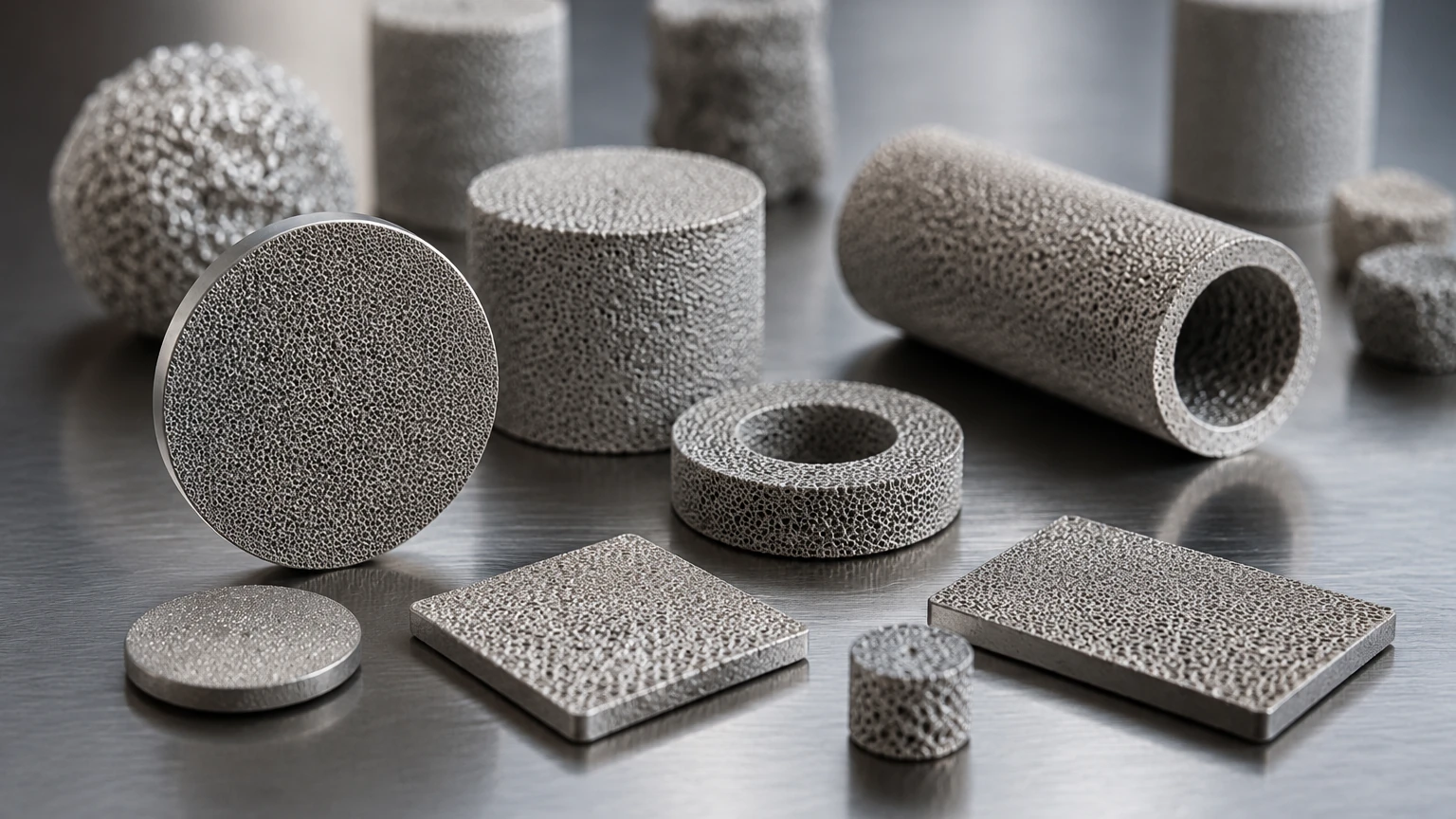
Porous Sintered Metal
In the landscape of industrial filtration and fluid control, porous sintered metal stands as a critical material for applications requiring extreme durability, thermal stability, and precise permeability. Unlike traditional fabric or polymer filters, sintered metal components are engineered through a powder metallurgy process that fuses metal particles together without melting them. This results in a rigid, porous structure capable of withstanding high pressures and corrosive environments that would compromise other filtration media. For engineers and technical procurement teams, understanding the nuances of this material is essential for optimizing system performance and reducing long-term operational costs.
The Engineering and Manufacturing of Porous Sintered Metal
The production of porous sintered metal is a sophisticated metallurgical process that begins with the selection of high-purity metal powders. While various alloys can be used, 316L stainless steel is the industry standard due to its excellent corrosion resistance and mechanical strength. Other specialized materials, such as Titanium, Inconel, Monel, and Hastelloy, are employed for specific chemical compatibilities or extreme temperature requirements.
The manufacturing process involves several critical stages:
1. Powder Selection and Grading: The size and shape of the metal particles directly determine the final pore size and distribution. Spherical powders are often preferred for uniform permeability, while irregular shapes may be used to enhance mechanical interlocking.
2. Compaction or Gravity Settling: The powder is placed into a mold or die. In some processes, it is compacted under high pressure to create a "green" part. In others, such as the production of thin sheets or tubes, gravity settling or rolling is used to maintain a higher degree of porosity.
3. Sintering: The green part is placed in a high-temperature furnace with a controlled atmosphere (often vacuum or reducing hydrogen). The temperature is raised to just below the melting point of the metal. Through solid-state diffusion, the contact points between particles fuse together, creating a continuous metallic skeleton with an interconnected network of pores.
4. Post-Processing: Depending on the application, the sintered component may undergo sizing, machining, or welding to meet precise dimensional tolerances. Surface treatments may also be applied to enhance hydrophobicity or chemical resistance.
By carefully controlling the sintering time, temperature, and particle size, manufacturers like Kaifil can engineer specific filtration ratings ranging from 0.1 microns to over 200 microns. You can explore these technical capabilities on our Main Page.
Key Physical and Performance Characteristics
The primary advantage of porous sintered metal over mesh or fiber-based media is its structural integrity. Because the particles are fused at a molecular level, the material does not migrate or shed fibers into the process stream—a critical requirement for pharmaceutical and food-grade applications.
Mechanical Strength and Pressure Resistance
Sintered metal elements are self-supporting. They can withstand high differential pressures (often exceeding 20-30 bar depending on the design) without the need for internal perforated cores or external cages. This rigidity prevents pore deformation under pressure spikes, ensuring consistent filtration efficiency throughout the service cycle.
Thermal Stability
While polymer filters are typically limited to temperatures below 150°C, stainless steel porous sintered metal can operate continuously at temperatures up to 450°C in oxidizing environments and even higher in reducing or inert atmospheres. Specialized alloys like Inconel can extend this range to 800°C or more, making them indispensable for hot gas filtration in petrochemical refining.
Corrosion and Chemical Resistance
The choice of alloy allows for compatibility with a wide range of aggressive fluids. 316L stainless steel resists most organic acids and industrial solvents. For applications involving high concentrations of chlorides or highly acidic environments, nickel-based alloys provide the necessary protection against pitting and stress corrosion cracking.
Engineering Selection Criteria for Industrial Applications
When selecting a porous sintered metal filter, engineers must balance several competing factors to ensure the filter performs reliably within the specific constraints of the system.
Micron Rating and Pore Size Distribution
It is important to distinguish between "absolute" and "nominal" filtration ratings. In sintered metal, the absolute rating refers to the pore size that will capture 99.9% of particles of a specific size. Pore size distribution is equally important; a narrow distribution ensures more predictable flow characteristics and prevents smaller particles from bypassing the filter through larger "pathways of least resistance."
Permeability and Pressure Drop (ΔP)
Permeability is a measure of how easily a fluid flows through the porous structure. It is governed by Darcy’s Law, where the flow rate is proportional to the pressure drop across the media. Engineers must calculate the initial clean pressure drop to ensure the system’s pump or compressor can handle the resistance. A higher porosity (percentage of void space) generally leads to lower pressure drops but may reduce the mechanical strength of the element.
Dirt Holding Capacity
This refers to the amount of contaminant the filter can collect before the pressure drop reaches a terminal limit. Sintered metal primarily functions through surface filtration or shallow depth filtration. In applications with high solids loading, the geometry of the filter (such as pleated designs) can be modified to increase the effective surface area and extend the time between cleaning cycles.
Critical Industrial Applications
The unique properties of porous sintered metal make it the preferred choice for several demanding sectors:
* Chemical and Petrochemical Processing: Sintered metal filters are used for catalyst recovery in fluid catalytic cracking (FCC) and for the filtration of high-temperature polymers and resins. Their ability to be cleaned and reused is a significant advantage in these high-volume processes.
* Food and Beverage Production: In the beverage industry, these filters are used for steam filtration (culinary grade steam) to remove pipe scale and rust before the steam contacts food products. They are also used for carbonation and aeration, where the porous structure creates fine, uniform bubbles.
* Pharmaceutical and Biotechnology: For sterile air and gas filtration, sintered metal provides a robust barrier against microbial contamination. The material’s ability to withstand Clean-in-Place (CIP) and Steam-in-Place (SIP) sterilization cycles is essential for maintaining aseptic conditions.
* Hydraulic and Lubrication Systems: In high-pressure hydraulic circuits, sintered metal elements protect sensitive valves and actuators from wear-generated metallic particles. Their resistance to fatigue and pressure surges ensures long-term protection of expensive machinery.
* Power Generation: Sintered metal is used in gas turbine fuel filtration and for protecting cooling systems in nuclear and thermal power plants.
Maintenance, Cleaning, and Regeneration
One of the most compelling reasons to specify porous sintered metal is its ability to be regenerated. Unlike disposable cartridges that contribute to waste and recurring costs, sintered metal elements can be cleaned multiple times, often returning to nearly 100% of their original permeability.
Backpulsing and Backwashing
In many liquid and gas systems, the filter can be cleaned in-situ. Backpulsing involves a rapid reversal of flow (often using compressed gas) to dislodge the filter cake from the surface. Backwashing uses a clean liquid to flush contaminants away. This capability is vital for continuous processes where downtime must be minimized.
Ultrasonic Cleaning
For deep-seated contaminants or stubborn residues, ultrasonic cleaning is highly effective. The filter element is submerged in a cleaning solvent, and high-frequency sound waves create cavitation bubbles that implode, stripping away particles from the internal pore structure.
Chemical and Thermal Cleaning
Sintered metal can be treated with caustic or acidic solutions to dissolve organic or inorganic foulants. In some cases, thermal cleaning (burn-off) is used to oxidize carbonaceous deposits, provided the temperature is controlled to prevent damage to the metallic grain structure.
Customization and OEM Considerations
Every industrial filtration challenge is unique, and off-the-shelf solutions often fall short of optimal performance. When working with a manufacturer like Kaifil, engineers can customize several parameters of the porous sintered metal component:
* Geometry: Elements can be produced as seamless tubes, flat discs, plates, cones, or complex custom shapes tailored to fit existing housings.
* Integrated Fittings: Sintered metal can be welded to solid metal end caps, threaded connectors, or flanges. This ensures a leak-proof seal and simplifies installation.
* Composite Structures: Multiple layers of different pore sizes can be sintered together to create a graduated density filter, which combines fine filtration with high dirt-holding capacity.
Before finalizing a design, it is critical to confirm the operating temperature, fluid chemistry, flow rate, and maximum allowable pressure drop. For more information on how custom filtration components can be integrated into your specific application, please refer to the Main Page.
Conclusion
Porous sintered metal represents a pinnacle of filtration engineering, offering a combination of strength, heat resistance, and precision that other materials cannot match. While the initial investment may be higher than disposable alternatives, the total cost of ownership is often lower due to the material's longevity and cleanability. By carefully selecting the appropriate alloy, pore size, and mechanical configuration, industrial operators can achieve reliable, high-performance filtration in even the most challenging environments.