


Rotary Drum Screens
In the landscape of industrial liquid-solid separation, rotary drum screens represent a critical mechanical filtration solution designed for continuous operation and high-volume processing. These systems are engineered to remove suspended solids from process water, wastewater, and industrial effluents, protecting downstream equipment and ensuring compliance with environmental or process-specific standards. For engineers and procurement professionals, understanding the technical nuances of these systems—from hydraulic capacity to material selection—is essential for optimizing system longevity and filtration efficiency.
As a manufacturer specializing in custom stainless steel filtration components, Kaifil provides the precision-engineered media that form the heart of these machines. Whether integrated into a new facility or used as a replacement for existing infrastructure, the choice of screening media dictates the overall performance of the system. For a broader look at our technical capabilities and product range, you may visit our Main Page.
The Mechanical Principles of Rotary Drum Screens
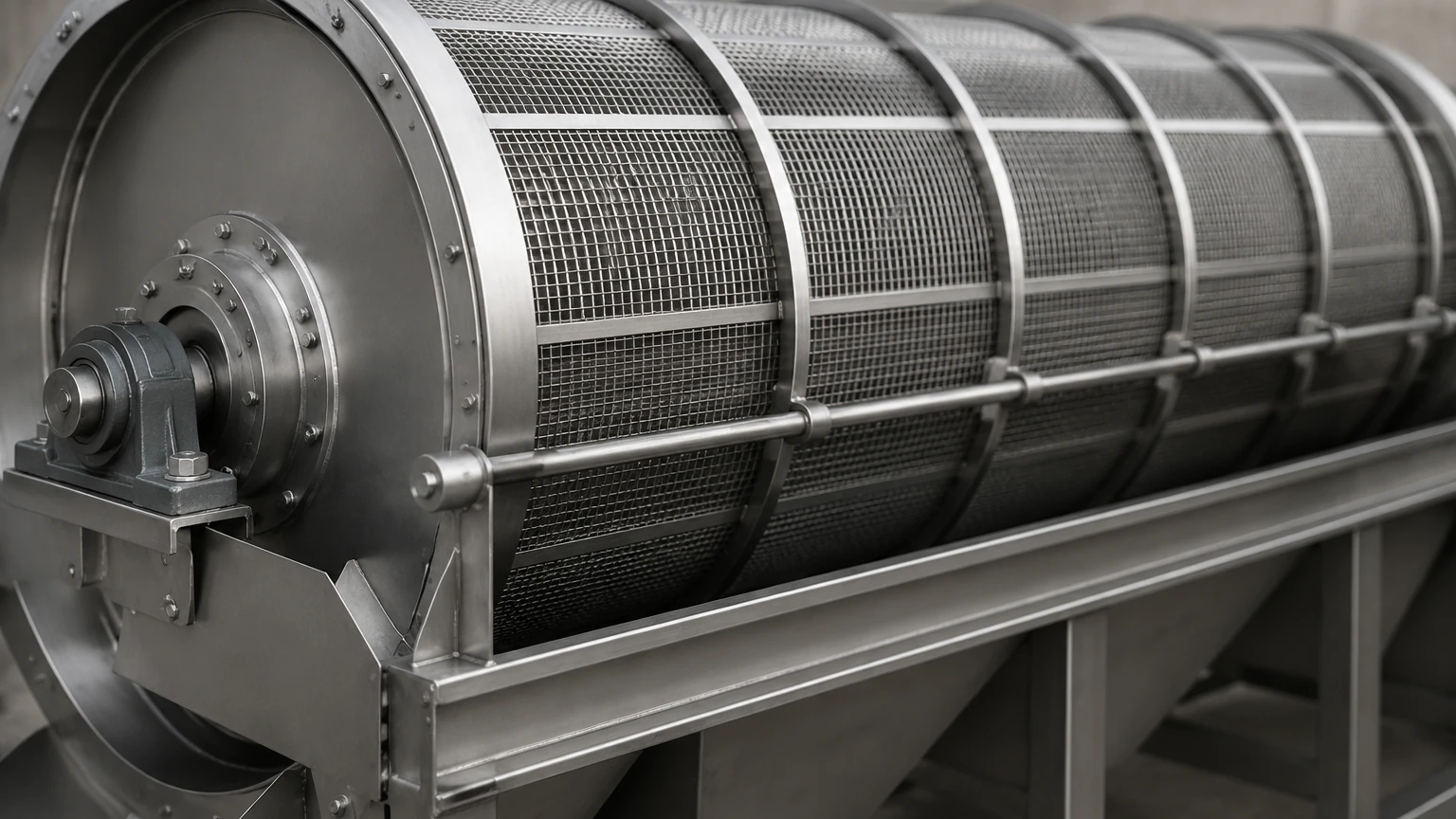
Rotary drum screens operate on a relatively simple yet highly effective mechanical principle: the use of a rotating cylindrical drum covered in a filtering medium to trap solids while allowing liquid to pass through. However, the engineering complexity lies in the delivery of the fluid and the management of the separated solids.
Internally Fed vs. Externally Fed Systems
There are two primary configurations for rotary drum screens: internally fed and externally fed.
1. Internally Fed Screens: In this configuration, the influent enters the interior of the drum through a distribution header. As the drum rotates, the liquid passes through the screen media to a collection tank below, while the solids are retained on the inner surface. Internal flights or a slight inclination of the drum transport the solids toward the discharge end. These are often preferred for applications with high grease content or where very fine screening is required.
2. Externally Fed Screens: Here, the influent is distributed across the exterior surface of the rotating drum. The liquid penetrates the screen into the center of the drum and exits through one end, while the solids remain on the outer surface. A stationary scraper blade (doctor blade) or a spray bar typically removes the accumulated solids. Externally fed systems are frequently chosen for their high hydraulic capacity and smaller footprint.
The Importance of Continuous Rotation
The continuous rotation of the drum is what allows these systems to handle high solids loading without the rapid blinding (clogging) associated with static screens. By constantly presenting a clean screening surface to the incoming flow, the system maintains a consistent pressure drop and hydraulic throughput.
Engineering Considerations for Screen Media
The performance of rotary drum screens is almost entirely dependent on the screen media. At Kaifil, we focus on stainless steel solutions because they offer the structural integrity and corrosion resistance necessary for demanding industrial environments.
Material Selection: SS304 vs. SS316L
Material compatibility is a primary concern for engineers. While Stainless Steel 304 is suitable for many general-purpose water treatment applications, Stainless Steel 316L is the standard for chemical processing, pharmaceutical, and food and beverage industries where chlorides or acidic cleaning agents are present. The "L" (low carbon) designation in 316L is particularly important for welded components, as it prevents intergranular corrosion in the heat-affected zones of the welds.
Media Types: Wedge Wire vs. Perforated Plate vs. Mesh
Choosing the right media type involves balancing filtration fineness with mechanical strength:
* Wedge Wire (V-Wire): This is the gold standard for rotary drum screens. The V-shaped profile of the wire creates a slot that widens inwardly. This design ensures that any particle capable of passing through the surface opening will continue through without getting wedged in the slot. Wedge wire offers high open area and exceptional structural rigidity.
* Perforated Plate: Used for coarser screening applications, perforated plates are durable and cost-effective. However, they typically offer less open area than wedge wire and are more prone to blinding if the particles are near the size of the perforations.
* Stainless Steel Wire Mesh: For fine filtration requirements (below 100 microns), woven wire mesh is often utilized. While it provides high precision, it usually requires a support structure (such as a coarser perforated plate) to withstand the hydraulic pressures and mechanical stresses of the drum's rotation.
Selection Criteria for Industrial Applications
When specifying rotary drum screens for a project, several variables must be evaluated to ensure the equipment meets the application's demands. Failure to account for these can lead to premature mechanical failure or insufficient separation.
Hydraulic Capacity and Solids Loading
The flow rate (measured in GPM or m³/h) is the starting point for sizing, but it must be adjusted based on the solids concentration. High-viscosity liquids or fluids with a high concentration of fibrous materials require a larger surface area to prevent overflow. Engineers must calculate the "effective screening area," which accounts for the portion of the drum submerged or covered by the influent at any given time.
Particle Characterization
Understanding the nature of the solids is critical. Are the particles abrasive, friable, or sticky? Sticky solids, such as those found in food processing or protein recovery, require specialized cleaning systems like high-pressure spray bars or brushes. Abrasive solids, common in mining or glass recycling, necessitate thicker wire profiles and potentially hardened stainless steel alloys.
Capture Efficiency vs. Head Loss
There is always a trade-off between the fineness of the screen (slot size) and the head loss (the pressure drop across the screen). A smaller slot size increases capture efficiency but reduces the hydraulic capacity per square foot of media. Engineers must determine the maximum allowable head loss to prevent upstream flooding or the need for excessive pumping power.
Maintenance and Operational Reliability
One of the primary advantages of rotary drum screens is their self-cleaning nature, but they are not "maintenance-free." To ensure a long service life, several operational factors must be managed.
Cleaning Mechanisms
Most industrial drum screens utilize a spray bar system to dislodge trapped solids. The frequency and pressure of the spray cycle should be adjustable. In applications with high fat or grease content, hot water or chemical cleaning cycles may be integrated into the spray system. Regular inspection of the spray nozzles is required to ensure uniform coverage and prevent localized blinding of the screen.
Drive System and Bearings
The drum is typically driven by a motor and gear reducer. Because these systems often operate in wet, corrosive environments, the choice of bearings and seals is paramount. Trunnion wheels and drive chains must be lubricated according to the manufacturer’s schedule, and seals should be checked for bypass, which would allow unfiltered liquid to contaminate the effluent.
Wear and Component Replacement
Over time, the friction between the scraper blade and the drum (in externally fed systems) will lead to wear. Similarly, the screen media itself can experience erosion if the influent contains abrasive grit. Choosing high-quality stainless steel components from the outset significantly extends the replacement cycle, reducing the total cost of ownership.
Customization and OEM Integration
For many industrial equipment manufacturers, a standard off-the-shelf rotary drum screen may not fit the specific footprint or process requirements of a specialized plant. This is where customization becomes a strategic advantage.
Customization options include:
* Variable Slot Sizes: Engineering a single drum with different slot sizes in different zones to achieve staged separation.
* Reinforced Structures: Adding internal ribs or specialized end-flanges to handle high-density solids or high-torque start-ups.
* Specialized Coatings: Applying passivating treatments or electropolishing to the stainless steel to enhance corrosion resistance and reduce surface adhesion.
Kaifil works closely with OEM partners to design and manufacture the internal filtration components that meet these exact specifications. By focusing on the precision of the wire spacing and the integrity of the welds, we ensure that the most vulnerable part of the rotary drum screen is its most reliable.
Conclusion: Making Informed Purchasing Decisions
Selecting the right rotary drum screen requires a deep dive into the specific hydraulic and physical characteristics of the waste stream. It is not merely a matter of choosing a drum diameter; it is an engineering exercise in material science, fluid dynamics, and mechanical design.
By prioritizing high-quality stainless steel media and considering the long-term implications of maintenance and energy consumption, facilities can achieve a reliable filtration process that protects downstream assets and optimizes resource recovery. For technical support in selecting the appropriate filtration media or to discuss custom OEM requirements, our team at Kaifil is prepared to provide engineering-led solutions. To explore our full range of stainless steel filtration products, please refer to our Main Page.
