


Wastewater Filtration Process
In industrial operations, the wastewater filtration process is a critical sequence of mechanical and physical-chemical stages designed to remove contaminants from process water before discharge or reuse. Unlike municipal treatment, industrial wastewater often contains high concentrations of suspended solids, corrosive chemicals, and varying thermal loads that require robust filtration hardware. For engineers and facility managers, selecting the correct filtration media is not merely a matter of compliance, but a strategic decision to protect downstream equipment, reduce maintenance downtime, and optimize total cost of ownership.
Stainless steel filtration components, such as those manufactured by Kaifil, play a central role in these processes due to their structural integrity and resistance to harsh environments. Understanding the nuances of the wastewater filtration process allows technical teams to specify components that meet precise micron requirements while withstanding the rigors of continuous industrial flow.
Overview of the Industrial Wastewater Filtration Process
The wastewater filtration process is typically categorized into primary, secondary, and tertiary stages. While biological and chemical treatments handle dissolved organic matter and pathogens, mechanical filtration is the backbone of solids separation.
1. Primary Filtration (Coarse Screening): This initial stage focuses on the removal of large debris and heavy suspended solids. It protects pumps and valves from mechanical damage. Heavy-duty wire mesh or wedge wire screens are commonly employed here.
2. Secondary Filtration (Fine Separation): Following primary treatment, secondary filtration targets smaller particulates that may have escaped initial screening. This stage often involves multi-layer sintered mesh or high-precision filter cartridges to achieve specific clarity levels.
3. Tertiary Filtration (Polishing): In applications requiring high-purity discharge or closed-loop recycling, tertiary filtration removes microscopic particles. This is where high-performance stainless steel cartridges with absolute micron ratings are essential.
By integrating durable metal filters into the wastewater filtration process, industries can achieve a higher degree of reliability compared to disposable polymer-based alternatives, which often fail under high pressure or chemical exposure.
Core Components and Media Selection
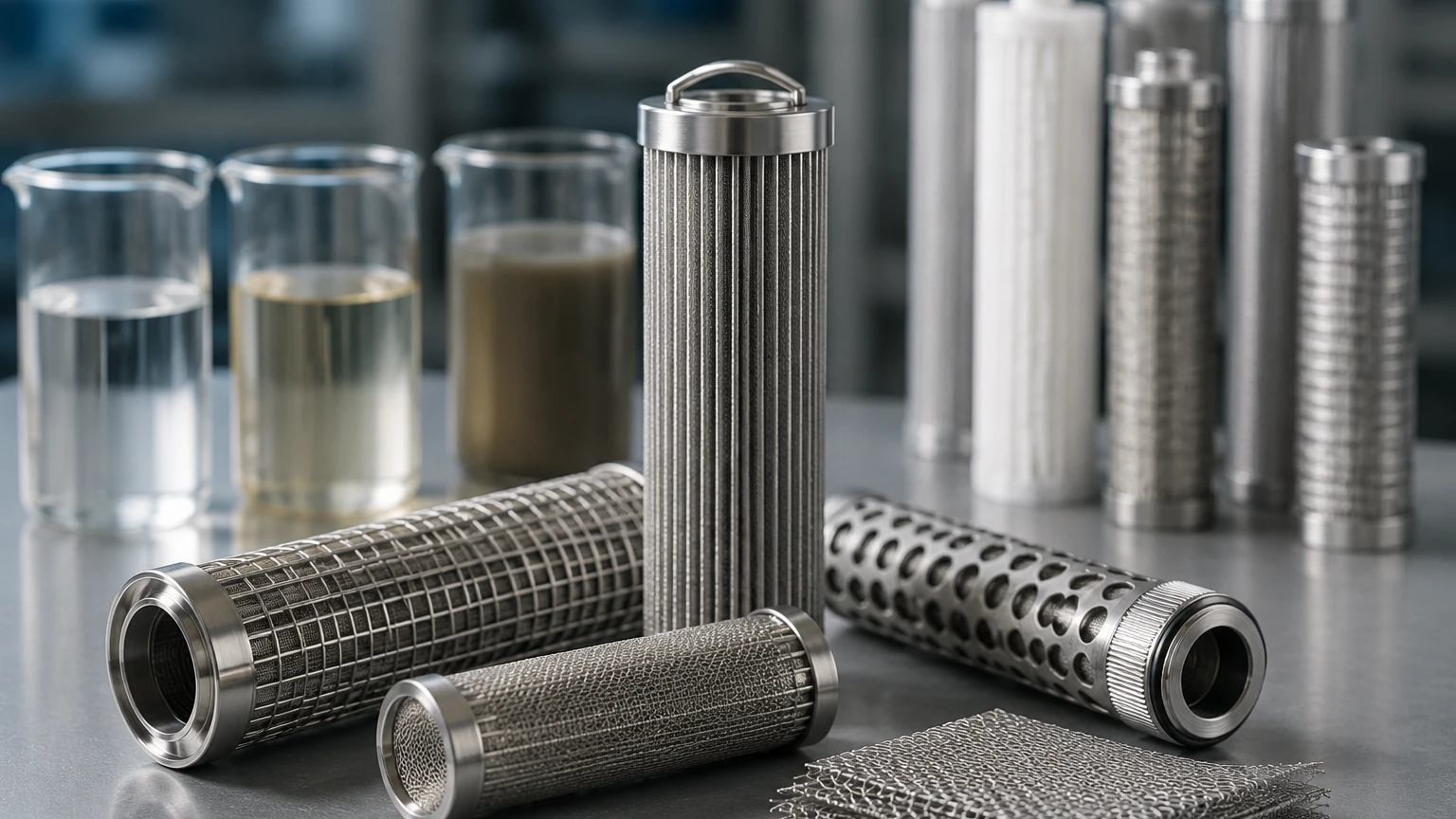
The efficiency of any wastewater filtration process depends heavily on the filtration media. In industrial settings, stainless steel is the preferred material for its longevity and cleanability. Several types of metal media are commonly utilized:
Woven Wire Mesh
Woven wire mesh is a versatile media available in various weave patterns, such as plain, twill, or Dutch weave. It offers a precise pore size and high open area, which is vital for maintaining flow rates in high-volume wastewater streams. For engineers, the choice of weave affects both the flow resistance and the particle retention characteristics.
Sintered Metal Filters
Sintered filters are created by bonding multiple layers of wire mesh or metal powder through a high-temperature thermal process. This results in a rigid, porous structure that can withstand extreme differential pressures. In a demanding wastewater filtration process involving high-viscosity fluids or high-pressure backwashing, sintered components provide the necessary structural stability to prevent media migration or deformation.
Wedge Wire Screens
Wedge wire is particularly effective in the early stages of the wastewater filtration process. Its V-shaped profile creates a non-clogging surface, as particles only contact the two leading edges of the wire. This design is ideal for self-cleaning filters and intake screens where high solids loading is expected.
Engineering Parameters for Efficient Filtration
When designing or upgrading a wastewater filtration process, engineers must evaluate several technical parameters to ensure the system performs as expected. Over-specifying can lead to unnecessary costs, while under-specifying can result in frequent clogging and equipment failure.
Micron Rating: Nominal vs. Absolute
One of the most common points of confusion in filter selection is the distinction between nominal and absolute micron ratings. A nominal rating indicates the filter's ability to retain a majority of particles of a certain size, while an absolute rating (often defined by a Beta Ratio) guarantees the retention of nearly 100% of particles at that size. In critical wastewater applications, such as protecting sensitive membranes in a Reverse Osmosis (RO) system, absolute-rated stainless steel cartridges are mandatory.
Differential Pressure ($\\Delta P$)
Differential pressure is the difference in pressure between the upstream and downstream sides of the filter. As the wastewater filtration process continues, solids accumulate on the media, increasing $\\Delta P$. Systems must be designed with clear thresholds for cleaning or replacement. High-quality stainless steel filters are designed to handle higher $\\Delta P$ than plastic filters, allowing for longer run times between maintenance cycles.
Flow Rate and Flux
Flux refers to the flow rate per unit of filter area. In wastewater treatment, maintaining an optimal flux is essential to prevent premature blinding of the filter media. Engineers must calculate the total surface area required based on the maximum anticipated flow of the wastewater filtration process to ensure the system does not become a bottleneck in production.
Addressing Corrosion and Chemical Compatibility
Industrial wastewater is rarely neutral. It may contain acids, alkalis, chlorides, or organic solvents that can rapidly degrade standard materials. The durability of the wastewater filtration process is therefore tied to the metallurgical properties of the filter components.
* Type 304 Stainless Steel: Suitable for general-purpose filtration where corrosion levels are low to moderate.
* Type 316L Stainless Steel: Contains molybdenum, which provides superior resistance to chlorides and pitting. This is the industry standard for most chemical and pharmaceutical wastewater applications.
* Specialty Alloys: In extreme cases involving high-temperature acids or concentrated brine, alloys like Hastelloy or Monel may be integrated into the filter design.
Selecting the correct alloy ensures that the filtration components do not leach contaminants back into the water and that the structural integrity of the filter is maintained over years of service.
Maintenance and Cleaning of Stainless Steel Filters
A primary advantage of using metal components in the wastewater filtration process is their ability to be cleaned and reused. Unlike disposable filters that contribute to industrial waste streams, stainless steel filters offer a sustainable, long-term solution.
Backwashing and Backpulsing
Automated wastewater filtration systems often use backwashing, where the flow is momentarily reversed to dislodge accumulated solids from the filter surface. The mechanical strength of stainless steel wire mesh allows for high-pressure backpulsing, which is more effective at clearing stubborn contaminants than the low-pressure cleaning required for synthetic media.
Ultrasonic Cleaning
For filters used in fine separation or tertiary treatment, particles may become deeply embedded in the mesh. Ultrasonic cleaning uses high-frequency sound waves in a cleaning solution to create cavitation bubbles that strip away contaminants at a microscopic level. This process can restore a filter to near-original performance levels, significantly extending its lifecycle.
Chemical Cleaning (CIP)
In the food, beverage, and pharmaceutical industries, Clean-in-Place (CIP) protocols are standard. Stainless steel filters are compatible with a wide range of caustic and acidic cleaning agents, allowing them to be sanitized without being removed from the housing, thereby streamlining the maintenance of the wastewater filtration process.
Custom OEM Solutions for Complex Filtration Challenges
Standard off-the-shelf filters often fail to meet the specific requirements of unique industrial wastewater streams. Factors such as unusual housing dimensions, specific flange requirements, or the need for reinforced internal supports require a customized approach.
Customization allows engineers to optimize the wastewater filtration process by tailoring the filter geometry and media layers to the specific particle size distribution and flow characteristics of their effluent. Whether it is a bespoke pleated cartridge for increased surface area or a heavy-duty lateral screen for a large-scale treatment tank, custom-engineered solutions provide a level of precision that standard products cannot match.
For technical professionals looking to optimize their systems, reviewing specific product options and engineering support is a vital step. You can explore a wide range of custom stainless steel filtration components on the Kaifil Main Page to find solutions tailored to your specific industrial requirements.
Conclusion: Optimizing the Wastewater Filtration Process
The success of an industrial wastewater filtration process is defined by its ability to consistently meet water quality standards while minimizing operational costs. By focusing on high-quality stainless steel media, engineers can ensure their systems are resilient against corrosion, pressure surges, and heavy solids loading.
When evaluating filtration components, it is essential to confirm the chemical compatibility of the alloys, the required micron efficiency, and the cleaning protocols that will be used. A well-designed filtration stage not only ensures regulatory compliance but also enhances the overall efficiency of the industrial facility. Through careful selection of wire mesh, sintered metal, or wedge wire components, the wastewater filtration process becomes a reliable and sustainable part of the industrial lifecycle.
