


Metal Filter Elements
In industrial process engineering, the selection of filtration components is a critical factor in maintaining system integrity, ensuring product purity, and protecting downstream equipment. Metal filter elements represent a specialized category of filtration media designed to withstand extreme operational conditions that would compromise polymer or cellulose-based filters. Manufactured primarily from stainless steel alloys, these elements offer a combination of mechanical strength, thermal stability, and chemical resistance essential for demanding applications in chemical processing, pharmaceuticals, and heavy industry.
As a professional manufacturer, Kaifil specializes in engineering custom stainless steel filtration solutions that address the specific challenges of high-pressure and high-temperature environments. Understanding the technical nuances of metal filter elements—from material science to structural design—is vital for engineers and procurement teams tasked with optimizing filtration performance and reducing the total cost of ownership.
Structural Classifications of Metal Filter Elements
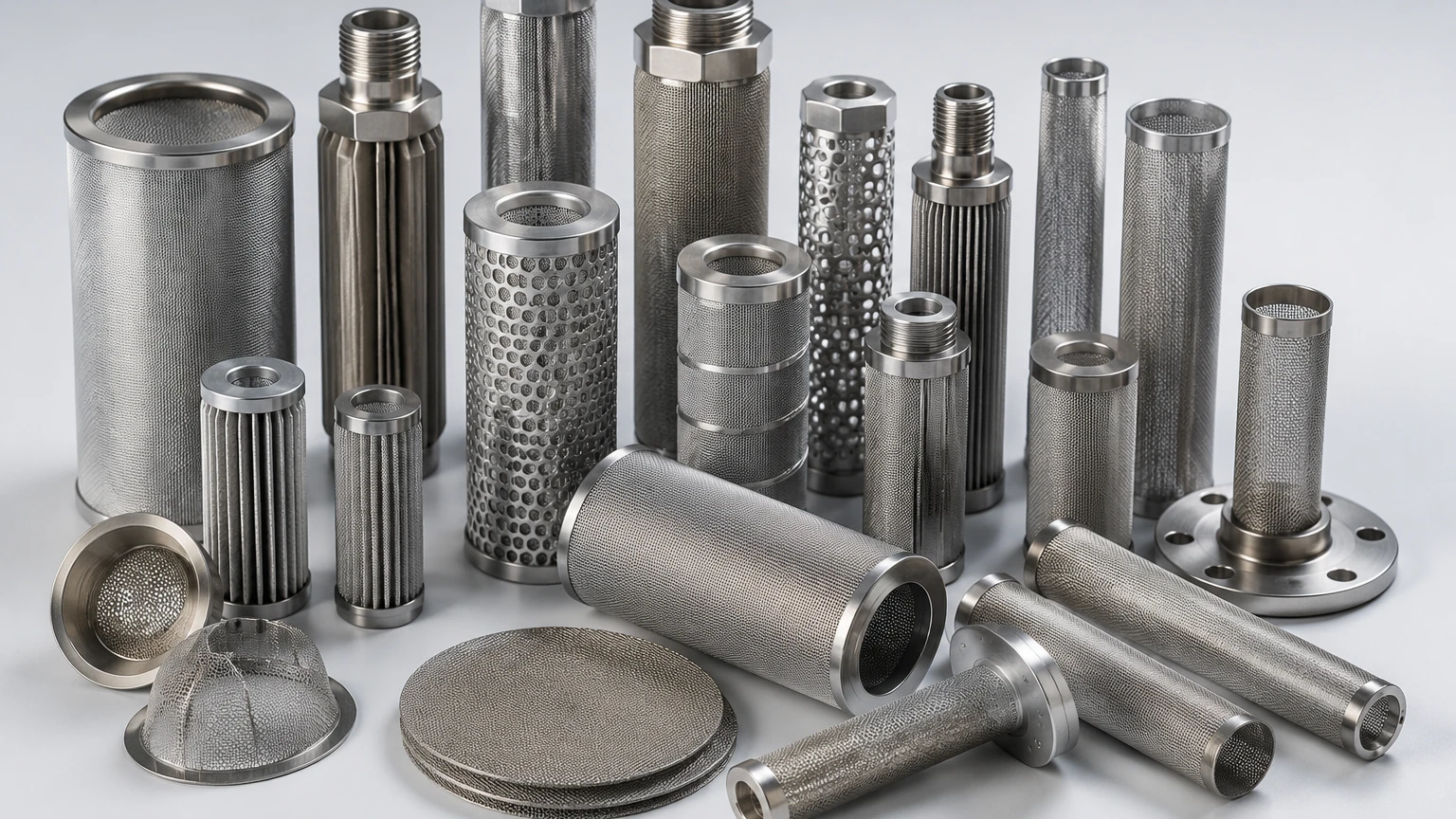
The performance of a metal filter is fundamentally determined by its construction method. Different manufacturing techniques yield varied pore structures, mechanical properties, and flow characteristics. The most common types of metal filter elements include:
Sintered Metal Wire Mesh
Sintered mesh is produced by layering multiple sheets of stainless steel wire cloth and bonding them through a vacuum sintering process. This creates a diffusion-bonded structure where the individual wires are fused at every contact point. The result is a highly stable, rigid filter medium that maintains its pore geometry even under high pressure. Sintered mesh elements are preferred for applications requiring precise absolute filtration ratings and backwash capabilities.
Pleated Wire Mesh Elements
For applications where high flow rates and low initial pressure drops are required, pleated wire mesh elements are often the optimal choice. By pleating the mesh, the effective filtration surface area is significantly increased within the same footprint compared to a cylindrical element. This design extends the dirt-holding capacity and lengthens the interval between cleaning cycles. These are frequently used in hydraulic systems and thin-film filtration.
Sintered Metal Fiber Felt
Unlike woven mesh, sintered fiber felt is a non-woven medium composed of randomly oriented stainless steel fibers. This depth-loading structure provides exceptionally high porosity (up to 80%) and a high dirt-holding capacity. Sintered fiber felt is particularly effective for filtering gel-like particles and contaminants in polymer melt filtration or high-viscosity fluid processing.
Wedge Wire (V-Wire) Elements
Wedge wire elements are constructed by wrapping a profile wire around longitudinal support rods. The V-shaped profile creates a slot that widens inwardly, reducing the risk of clogging and facilitating easy surface cleaning. These elements are exceptionally robust and are typically used in heavy-duty water treatment, mining, and pulp and paper industries where mechanical scraping or high-velocity backpulsing is required.
Engineering Considerations for Material Selection
The choice of alloy for metal filter elements is dictated by the chemical composition of the process fluid and the operating temperature. While stainless steel is the standard, different grades offer varying levels of protection.
1. 304 Stainless Steel: The most common grade, providing excellent mechanical properties and good corrosion resistance for general industrial use, including food and beverage applications.
2. 316L Stainless Steel: Contains molybdenum, which enhances resistance to pitting and crevice corrosion in chloride-rich environments. The "L" denotes low carbon content, which minimizes carbide precipitation during welding, ensuring the structural integrity of the filter element.
3. Specialty Alloys: In highly corrosive environments involving concentrated acids or high-temperature oxidation, alloys such as Hastelloy®, Inconel®, or Monel® may be required. These materials ensure that the metal filter elements do not undergo media migration or structural failure due to chemical degradation.
Engineers must also consider the thermal expansion coefficients of the materials. In high-temperature applications (exceeding 300°C), the differential expansion between the filter medium and the housing or end fittings must be accounted for to prevent bypass leakage.
Performance Metrics: Micron Ratings and Pressure Drop
When evaluating metal filter elements, two primary performance indicators are filtration accuracy and hydraulic resistance.
Absolute vs. Nominal Filtration
It is essential to distinguish between nominal and absolute micron ratings. A nominal rating refers to a filter's ability to retain a percentage of particles of a specific size (often 60-90%). In contrast, an absolute rating indicates the diameter of the largest hard spherical particle that can pass through the filter under specified test conditions (typically 99.9% efficiency). For critical pharmaceutical or semiconductor processes, absolute-rated sintered elements are mandatory to ensure process consistency.
Differential Pressure ($ΔP$)
The pressure drop across a filter element is influenced by the fluid viscosity, flow velocity, and the porosity of the medium. An efficiently designed metal filter element minimizes the initial $ΔP$ to reduce energy consumption in pumping systems. As the filter accumulates contaminants, the $ΔP$ increases. Engineers must define the "terminal pressure drop"—the point at which the element must be cleaned or replaced to prevent structural collapse or system failure.
Customization and OEM Integration
Industrial filtration systems rarely follow a one-size-fits-all approach. Customization is often necessary to integrate filter elements into existing housings or to meet unique process requirements. Key customization parameters include:
* End Fitting Configurations: Elements can be designed with various connections, such as Double Open End (DOE), Code 7 (226 bayonet), threaded connectors (NPT/BSP), or custom flange mounts.
* Reinforcement Layers: For high-pressure differential applications, internal support cores or external protective cages are added to prevent the mesh from deforming or bursting.
* Geometric Variations: Beyond standard cylindrical shapes, metal filter elements can be manufactured as conical filters, disc filters, or multi-tube bundles to optimize space and flow dynamics.
Kaifil provides comprehensive OEM support, working from technical drawings or performance specifications to produce metal filter elements that meet the exact demands of global industrial clients. By visiting the Main Page, technical teams can explore the full range of manufacturing capabilities available for bespoke filtration projects.
Maintenance and Cleaning Protocols
One of the primary advantages of metal filter elements over disposable media is their cleanability. A well-maintained stainless steel filter can last for several years, significantly reducing waste and long-term procurement costs. However, the cleaning method must be matched to the contaminant and the filter structure.
Ultrasonic Cleaning
This is the most effective method for removing fine particles trapped within the pores of sintered mesh or fiber felt. High-frequency sound waves create cavitation bubbles that dislodge contaminants without damaging the delicate wire structure.
Chemical Cleaning (CIP)
In the food and pharmaceutical industries, Clean-In-Place (CIP) systems use caustic or acidic solutions to dissolve organic deposits or mineral scales. It is vital to ensure that the filter alloy is compatible with the cleaning agents used.
Backwashing and Backpulsing
Automated systems often use a reverse flow of fluid or a high-pressure air pulse to clear the surface of wedge wire or pleated mesh elements. This is ideal for continuous processes where downtime must be minimized.
Risk Mitigation in Industrial Filtration
Failure to select the correct metal filter element can lead to several operational risks:
* Media Migration: In low-quality filters, individual wires or fibers may break off and enter the downstream flow, contaminating the final product. High-quality sintered elements eliminate this risk through diffusion bonding.
* Fatigue Failure: In systems with pulsating flows or frequent pressure shocks, the filter medium can suffer from mechanical fatigue. Proper structural reinforcement is necessary to mitigate this.
* Bypass Leakage: If the seals or end fittings are not precision-machined, unfiltered fluid may bypass the element. Ensuring tight tolerances in the manufacturing of end caps is critical for maintaining filtration efficiency.
Conclusion
Metal filter elements are indispensable components in modern industrial infrastructure, offering unmatched durability and precision. By selecting the appropriate material, construction type, and micron rating, engineers can ensure the longevity of their systems and the quality of their output. Whether the application involves high-viscosity polymers, corrosive chemicals, or sanitary food processing, the transition to high-performance stainless steel filtration provides a sustainable and cost-effective solution.
For technical assistance in selecting the right filtration components or to request a custom design, refer to the resources and product specifications available on the Kaifil Main Page.
