


Polypropylene Filter Cartridge
In the landscape of industrial liquid filtration, the polypropylene filter cartridge serves as a fundamental component for clarifying fluids, protecting downstream equipment, and ensuring product consistency. Known for its broad chemical compatibility and cost-effectiveness, this filtration medium is a staple in industries ranging from chemical processing to food and beverage production. For engineers and procurement specialists, understanding the technical nuances of polypropylene (PP) media—including its structural variations, performance limitations, and selection criteria—is essential for optimizing filtration efficiency and managing operational costs.
While high-performance environments often require the durability of stainless steel components, the polypropylene filter cartridge remains the primary choice for disposable pre-filtration and applications where high-purity, inert materials are required at a lower price point. This guide examines the engineering considerations necessary for selecting and implementing these cartridges within an industrial framework.
Technical Construction and Media Types
Polypropylene filter cartridges are generally categorized by their construction method, which dictates their filtration mechanism: depth filtration or surface filtration.
Melt-Blown Depth Cartridges
Melt-blown cartridges are manufactured through a continuous process where polypropylene resin is extruded, attenuated by high-velocity air, and wound onto a rotating mandrel. This creates a complex, three-dimensional matrix. High-quality melt-blown filters often feature a "gradient density" structure, where the outer layers have larger pores to trap coarse particles, while the inner layers become progressively denser to capture finer contaminants. This design maximizes the dirt-holding capacity and extends the service life of the filter.
Pleated Filter Cartridges
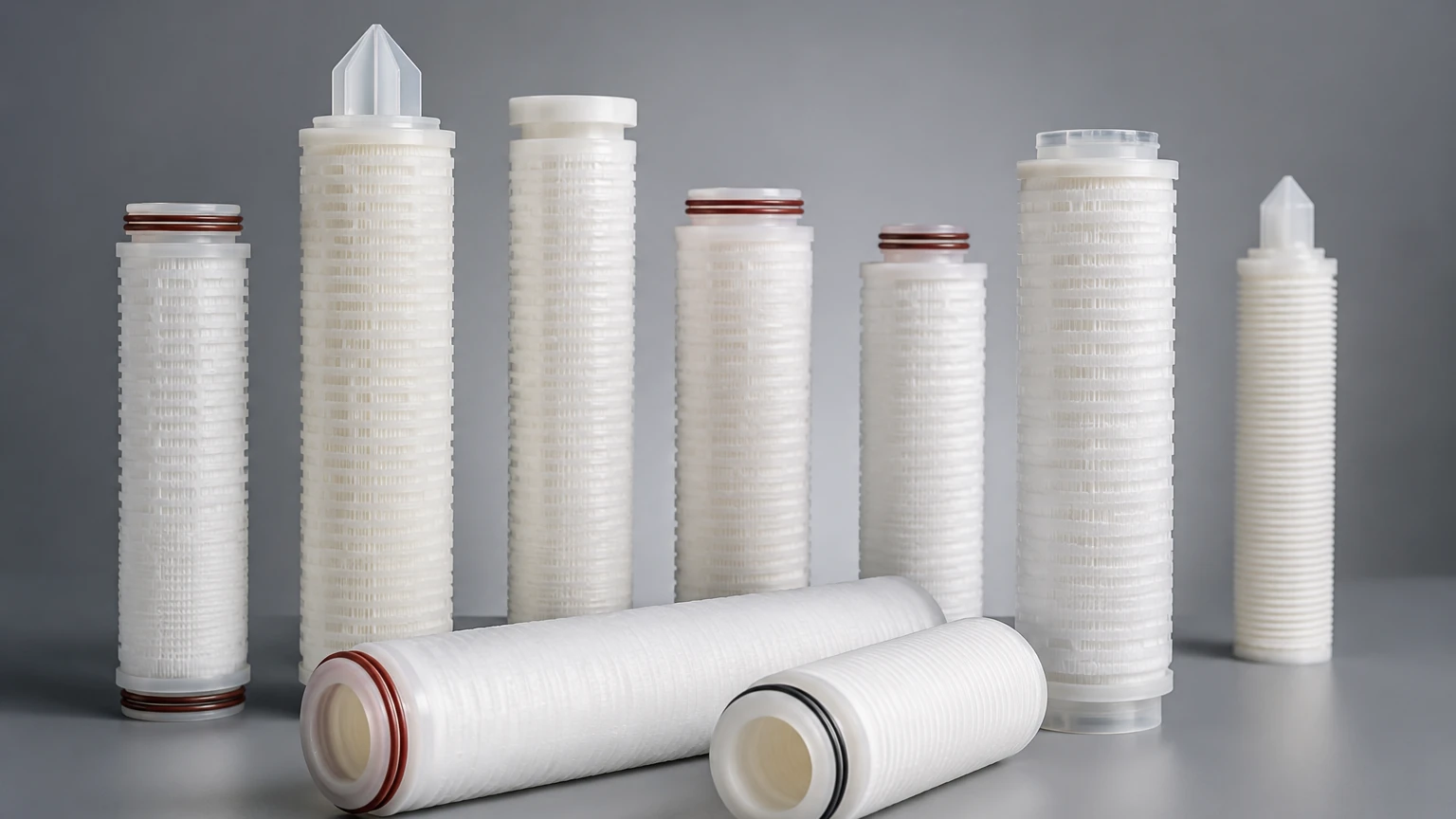
Pleated cartridges utilize a thin sheet of polypropylene microfiber media folded to increase the effective filtration area (EFA). Unlike depth filters, pleated designs primarily act as surface or near-surface filters. The increased surface area allows for significantly higher flow rates and lower initial pressure drops compared to melt-blown versions of the same dimensions. Pleated polypropylene filter cartridges are typically used when high precision and high flow volumes are required in a compact housing.
Thermal Bonding and Purity
A critical engineering advantage of polypropylene is its ability to be thermally bonded. High-grade cartridges are constructed without the use of surfactants, binders, or adhesives. This eliminates the risk of extractables leaching into the process fluid, which is a vital requirement for pharmaceutical and food-grade applications. When evaluating suppliers, technical teams should confirm that the cartridge components—including the core, cage, and end caps—are made of the same high-purity polypropylene to ensure uniform chemical resistance.
Material Properties and Chemical Compatibility
Polypropylene is a thermoplastic polymer characterized by its non-polar nature and resistance to a wide array of chemicals. This makes the polypropylene filter cartridge suitable for diverse industrial environments.
* Chemical Resistance: PP is highly resistant to many organic solvents, acids, and alkalis. It is particularly effective in deionized water systems, plating baths, and various chemical transfer applications. However, it is susceptible to degradation by strong oxidizing agents and certain aromatic hydrocarbons.
* Temperature Constraints: The primary limitation of polypropylene is its thermal threshold. Most PP cartridges are rated for continuous operation up to approximately 60°C to 80°C (140°F to 176°F). Beyond these temperatures, the structural integrity of the fibers may soften, leading to pore deformation or "unloading" of captured contaminants.
* Hydrophobic Nature: Polypropylene is naturally hydrophobic. While this is beneficial for air and gas filtration, for aqueous liquid filtration, the media must often be pre-wetted or specially treated to allow water to pass through the fine pores efficiently.
Performance Metrics: Beyond Micron Ratings
Selecting a polypropylene filter cartridge requires a deeper analysis than simply looking at the micron rating. Engineers must evaluate how the filter will perform under dynamic process conditions.
Nominal vs. Absolute Filtration
Most melt-blown cartridges are "nominally" rated, meaning they can trap a high percentage (typically 80% to 90%) of particles at the stated micron size. In contrast, "absolute" rated cartridges, often in pleated configurations, are designed to achieve a Beta ratio (β) of 5000 or higher, indicating 99.98% efficiency at the specified micron level. For critical downstream protection, absolute ratings are mandatory.
Differential Pressure (ΔP)
The pressure drop across a filter is a key indicator of its efficiency and remaining life. An industrial system must be designed to handle the "clean pressure drop" while allowing enough headroom for the "terminal pressure drop" (the point at which the filter is considered blinded and must be replaced). Over-sizing a filtration system to reduce initial ΔP can significantly extend the interval between change-outs, reducing labor costs and process downtime.
Dirt-Holding Capacity
This refers to the total mass of contaminants a cartridge can retain before reaching its terminal pressure drop. A polypropylene filter cartridge with a high dirt-holding capacity is essential in processes with high solids loading. Depth filters generally excel in this area compared to standard pleated filters, though advanced pleated designs can compete by offering massive surface areas.
Evaluating Polypropylene vs. Stainless Steel Solutions
In many industrial settings, the choice between a disposable polypropylene filter cartridge and a cleanable stainless steel filter is a matter of total cost of ownership (TCO) and process requirements. As a manufacturer specializing in precision filtration, Kaifil provides the engineering support necessary to determine which material best suits a specific application.
* When to choose Polypropylene: PP is ideal for single-use applications, batch processing where cross-contamination must be avoided, and environments where the chemical profile would corrode lower grades of metal. It is the standard for pre-filtration stages to protect more expensive secondary filters.
* When to transition to Stainless Steel: For high-temperature applications (above 100°C), high-pressure environments, or processes requiring aggressive backwashing, stainless steel wire mesh or sintered metal filters are superior. While the initial capital expenditure for stainless steel is higher, its cleanability and multi-year lifespan often result in a lower TCO in permanent installations.
Many sophisticated systems utilize a hybrid approach: using a polypropylene filter cartridge as a sacrificial pre-filter to remove the bulk of contaminants, followed by a precision stainless steel or high-efficiency membrane filter for final polishing. Review product options and application support on the Main Page to understand how these technologies integrate into a complete filtration strategy.
Operational Risks and Mitigation
Improper selection or maintenance of polypropylene cartridges can lead to several operational failures:
1. Bypass: If the cartridge is not seated correctly in the housing or if the O-rings/gaskets are incompatible with the fluid, contaminated liquid can bypass the filter media entirely. Ensuring the use of high-quality end-cap configurations (such as Code 7 or 222/226) can mitigate this risk.
2. Media Migration: In low-quality melt-blown filters, fibers may break loose and enter the filtrate. Specifying "fixed-pore" structures or choosing pleated designs with protective cages prevents this issue.
3. Unloading: As differential pressure increases, some depth filters may compress, causing previously trapped particles to be pushed through the media. Monitoring ΔP and adhering to strict change-out protocols is the only way to prevent unloading.
4. Chemical Softening: Even if a chemical is listed as "compatible," long-term exposure at elevated temperatures can soften PP fibers, leading to premature failure. Testing under actual process conditions is recommended for aggressive chemical streams.
Engineering Checklist for Procurement
Before finalizing a purchase order for a polypropylene filter cartridge, technical teams should confirm the following parameters with their supplier:
* Fluid Characteristics: What is the viscosity, pH, and specific gravity of the liquid? Higher viscosity fluids require larger filtration areas or coarser micron ratings to maintain flow.
* Contaminant Profile: Is the contaminant deformable (like gels) or hard/spherical? Depth filters are generally better for gels, while pleated filters handle hard particulates efficiently.
* Flow Requirements: What is the maximum and average flow rate (GPM or L/min)? Ensure the housing and cartridge combination can handle peak flows without exceeding the recommended flux rate.
* Regulatory Compliance: Does the cartridge need to meet FDA, USP Class VI, or EC food contact regulations? Documentation of compliance should be requested upfront.
* Housing Compatibility: Does the cartridge length (10", 20", 30", 40") and end-cap style match the existing filter housing? Small discrepancies in gasket thickness can lead to significant bypass issues.
Conclusion
The polypropylene filter cartridge remains an indispensable tool for industrial fluid management. Its versatility allows it to serve as a workhorse in diverse sectors, provided that engineers account for its thermal and structural limits. By understanding the distinction between depth and pleated media and evaluating the long-term costs relative to permanent solutions like stainless steel, organizations can achieve a balance of high performance and economic efficiency. For those seeking to optimize their filtration stages or integrate custom metal components with standard cartridge systems, consulting with filtration experts like those at Kaifil ensures that every component of the process is engineered for reliability.
