


Spin Filtration
In industrial liquid-solid separation, spin filtration—often referred to as centrifugal or vortex filtration—represents a critical methodology for managing high-solids loading and protecting downstream equipment. Unlike static filtration, where particles settle purely through mechanical interception on a stationary medium, spin filtration leverages fluid dynamics and centrifugal force to enhance separation efficiency. For engineers and procurement specialists, understanding the technical nuances of this process is essential for optimizing system uptime and reducing the total cost of ownership (TCO) in demanding environments such as chemical processing, food production, and hydraulic systems.
At its core, spin filtration utilizes the velocity of the fluid to create a rotational flow pattern. This motion drives heavier particles toward the outer walls of the filter housing or a specialized centrifugal separator, while the clarified liquid passes through a central filter element. By integrating high-quality stainless steel components, such as those found on the Kaifil Main Page, facilities can achieve a balance between high flow rates and precise micron-level retention.
The Mechanics and Principles of Spin Filtration
The efficacy of spin filtration is governed by the principles of centrifugal force and Stokes' law. When a fluid enters a cylindrical filter housing tangentially, it creates a vortex. The resulting centrifugal force acts upon the suspended particles, pushing those with a higher density than the carrier fluid toward the periphery. This action significantly reduces the particle load reaching the internal filter medium, which is typically a stainless steel wire mesh or a sintered metal cartridge.
Centrifugal Separation vs. Barrier Filtration
In a standard spin filtration setup, the process is two-fold. First, the "spin" action removes the bulk of the larger, denser contaminants. These particles lose momentum as they hit the outer wall and settle into a collection chamber or sump at the bottom of the housing. Second, the fluid must pass through a precision-engineered metal filter element to remove the remaining fine particulates. This hybrid approach prevents the filter medium from blinding prematurely, extending the interval between cleaning cycles and maintaining a more consistent pressure drop across the system.
Fluid Velocity and Particle Trajectory
The success of the separation depends heavily on the inlet velocity. If the velocity is too low, the centrifugal force will be insufficient to move particles toward the wall. Conversely, excessively high velocity can lead to turbulence that re-suspends settled particles. Engineers must calculate the optimal flow rate based on the specific gravity of the contaminants and the viscosity of the fluid to ensure the spin filtration mechanism operates within its intended performance envelope.
Engineering Considerations: Material Selection and Durability
When designing or specifying a spin filtration system, material selection is the most critical factor influencing long-term reliability. Industrial applications often involve corrosive chemicals, high temperatures, or abrasive particulates that would quickly degrade polymer-based filters.
Stainless Steel: The Industrial Standard
Stainless steel, specifically grades 304 and 316L, is the preferred material for spin filtration elements. Its inherent mechanical strength allows the filter to withstand the high-pressure differentials and structural stresses associated with high-velocity vortex flows.
1. Corrosion Resistance: In chemical processing and water treatment, 316L stainless steel provides superior resistance to pitting and crevice corrosion, especially in the presence of chlorides.
2. Thermal Stability: Metal filters maintain their structural integrity at temperatures exceeding 400°C, where synthetic fibers would melt or deform.
3. Abrasion Resistance: The centrifugal action in spin filtration often subjects the filter medium to high-velocity impacts from abrasive solids. Sintered wire mesh and perforated metal supports offer the hardness required to resist erosion over thousands of operational hours.
Filter Media Structures
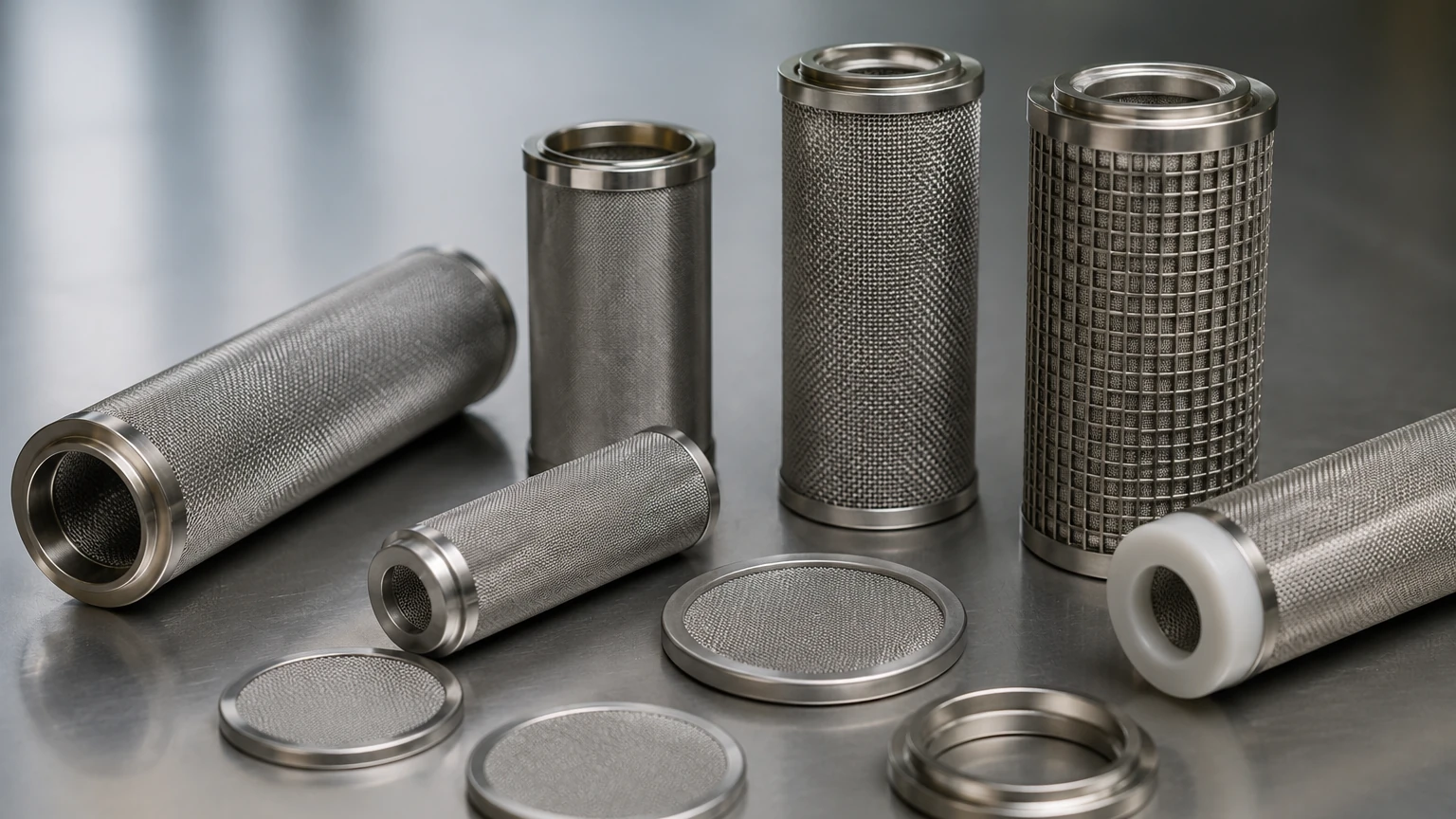
The internal element of a spin filter can be constructed using various methods. Woven wire mesh is common for general-purpose separation, offering a high open-area ratio and predictable flow paths. For more rigorous applications, sintered metal mesh—where multiple layers of wire cloth are bonded through heat and pressure—provides enhanced rigidity and prevents wire migration, ensuring that the filtration rating remains constant even under fluctuating pressures.
Performance Evaluation: Efficiency, Flow, and Pressure Drop
For technical professionals, the performance of a spin filtration system is measured by its ability to maintain a target cleanliness level while minimizing energy consumption. This requires a deep dive into the relationship between micron ratings, flow capacity, and the resulting pressure drop (ΔP).
Micron Ratings and Capture Efficiency
Spin filtration systems are often rated by both their centrifugal efficiency (the size of particles removed by the vortex) and their absolute filtration rating (the size of particles captured by the mesh). It is a common misconception that a finer mesh is always better. In reality, selecting a mesh that is too fine can lead to unnecessary pressure drops and frequent clogging. Engineers should aim for a balance where the centrifugal action handles the "heavy lifting" and the mesh provides the final polish.
Managing Pressure Drop
The initial pressure drop in a clean system is a function of the filter's geometry and the fluid's viscosity. In spin filtration, the tangential entry creates a slight inherent pressure drop due to the change in fluid direction. However, because the spin action keeps the filter surface cleaner for longer, the *rate* of pressure increase is significantly lower than in traditional static filters. Monitoring the ΔP is the most effective way to determine when the collection sump needs purging or the internal element requires cleaning.
Industrial Applications and Sector-Specific Benefits
Spin filtration is utilized across a diverse range of industries, each with unique requirements for cleanliness and durability. By leveraging custom-engineered stainless steel components, these sectors can optimize their specific processes.
Chemical and Petrochemical Processing
In these environments, filters must handle aggressive solvents and high-pressure streams. Spin filtration is often used to remove catalysts from process streams or to protect high-pressure pumps from particulate damage. The ability to use all-welded stainless steel construction ensures that there are no bypass paths caused by gasket failure or chemical degradation of the filter housing.
Food and Beverage Clarification
Sanitary design is paramount in food and beverage applications. Spin filtration systems made from 316L stainless steel are compatible with Clean-in-Place (CIP) procedures. They are used to clarify juices, oils, and syrups, where the centrifugal action helps separate pulp or heavy sediments without the need for consumable filter aids like diatomaceous earth, thereby reducing waste and operational costs.
Hydraulic and Cooling Water Systems
In large-scale cooling towers and hydraulic power units, continuous filtration is required to prevent the buildup of scale and wear particles. Spin filtration allows for the continuous removal of solids while the system remains online. By purging the sediment from the vortex chamber, operators can maintain fluid quality without interrupting the flow to critical machinery.
Maintenance, Cleaning, and Total Cost of Ownership
One of the primary drivers for adopting spin filtration with stainless steel media is the reduction in long-term operational costs. While the initial capital expenditure (CAPEX) may be higher than disposable plastic or paper filters, the lifecycle savings are substantial.
Reusability and Cleaning Methods
Unlike disposable cartridges, stainless steel spin filter elements are fully cleanable. Depending on the nature of the contaminant, cleaning can be achieved via:
* Backwashing: Reversing the flow of fluid to dislodge particles trapped in the mesh.
* Ultrasonic Cleaning: Using high-frequency sound waves in a solvent bath to remove fine particulates from deep within sintered layers.
* Chemical Cleaning: Using acids or alkalis to dissolve organic or mineral scale without damaging the metal substrate.
Reducing Downtime
The centrifugal design naturally extends the time between manual cleanings. In many automated systems, a sensor detects the pressure differential and triggers an automatic purge valve at the bottom of the vortex chamber. This allows the system to eject concentrated solids without stopping the main process flow, which is a significant advantage in 24/7 manufacturing operations.
Engineering Selection: Customization and OEM Solutions
Every industrial process has unique variables—flow rate, viscosity, particle distribution, and chemical compatibility. A standard off-the-shelf filter may not provide the optimal performance required for specialized applications. This is where custom engineering and OEM capabilities become invaluable.
Defining Specifications
Before purchasing a spin filtration system, engineers should confirm the following data points with their manufacturer:
* Particle Size Distribution (PSD): Understanding the range of particle sizes helps in selecting the correct mesh and housing geometry.
* Operating Pressure and Temperature: These dictate the wall thickness of the housing and the type of welding or joining methods used for the filter element.
* Connection Types: Whether the system requires ANSI flanges, NPT threads, or sanitary tri-clamp fittings for seamless integration into existing piping.
The Value of Professional Manufacturing
Partnering with a manufacturer like Kaifil allows for the development of bespoke filtration components tailored to specific equipment footprints. Whether it is a custom-diameter wire mesh cartridge or a precision-machined filter support, professional manufacturing ensures that the component meets the rigorous standards of industrial service. For more information on available configurations and technical support, professionals can review product options and application support on the Kaifil Main Page.
Conclusion
Spin filtration stands as a robust and efficient solution for modern industrial separation challenges. By combining the physical laws of centrifugal motion with the durability of stainless steel filtration media, engineers can create systems that are not only effective at removing contaminants but also economical to operate over the long term. When selecting a spin filtration solution, focusing on material quality, precise engineering, and the ability to customize components for specific application needs will ensure the highest level of performance and reliability. As industries continue to push for higher efficiency and reduced environmental impact, the role of cleanable, durable metal filtration systems will only become more prominent.
