


Filter Steel
In industrial filtration, the term "filter steel" refers to a specialized category of stainless steel alloys and metal structures engineered to perform mechanical separation under demanding conditions. Unlike standard structural steel, filter steel must balance high permeability with precise particle retention, often while resisting corrosive chemicals, extreme temperatures, and high differential pressures. For engineers and procurement specialists, selecting the correct grade and configuration of filter steel is critical to ensuring process efficiency and equipment longevity.
At Kaifil, we specialize in transforming raw filter steel into high-performance components, ranging from woven wire mesh to multi-layer sintered filter cartridges. This guide examines the technical nuances of filter steel, the engineering considerations behind material selection, and the practical applications that define modern industrial filtration.
Material Grades: The Chemistry of Filter Steel
The performance of any filtration system begins with the metallurgy. While many alloys are available, the vast majority of industrial applications rely on a few specific grades of stainless steel due to their balance of cost, availability, and chemical resistance.
304 and 304L Stainless Steel
Grade 304 is the most common "filter steel" used in general industrial applications. It provides excellent mechanical strength and basic corrosion resistance. However, for components requiring extensive welding, 304L (the low-carbon version) is often preferred. The lower carbon content prevents chromium carbide precipitation during the welding process, which maintains the alloy's corrosion resistance in the heat-affected zones.
316L Stainless Steel
For more aggressive environments, such as chemical processing or marine applications, 316L is the industry standard. The addition of molybdenum (typically 2-3%) significantly enhances resistance to pitting and crevice corrosion in chloride-rich environments. As a primary manufacturer, Kaifil utilizes 316L extensively for pharmaceutical and food-grade filtration where hygiene and material stability are paramount.
Advanced Alloys: 904L and Duplex
In extreme cases where standard 300-series steels fail, specialty filter steel grades like 904L or Duplex stainless steels (such as 2205) are employed. These materials offer superior resistance to stress corrosion cracking and high-concentration acids, making them essential for heavy chemical manufacturing and offshore oil and gas filtration.
Structural Formats of Filter Steel Media
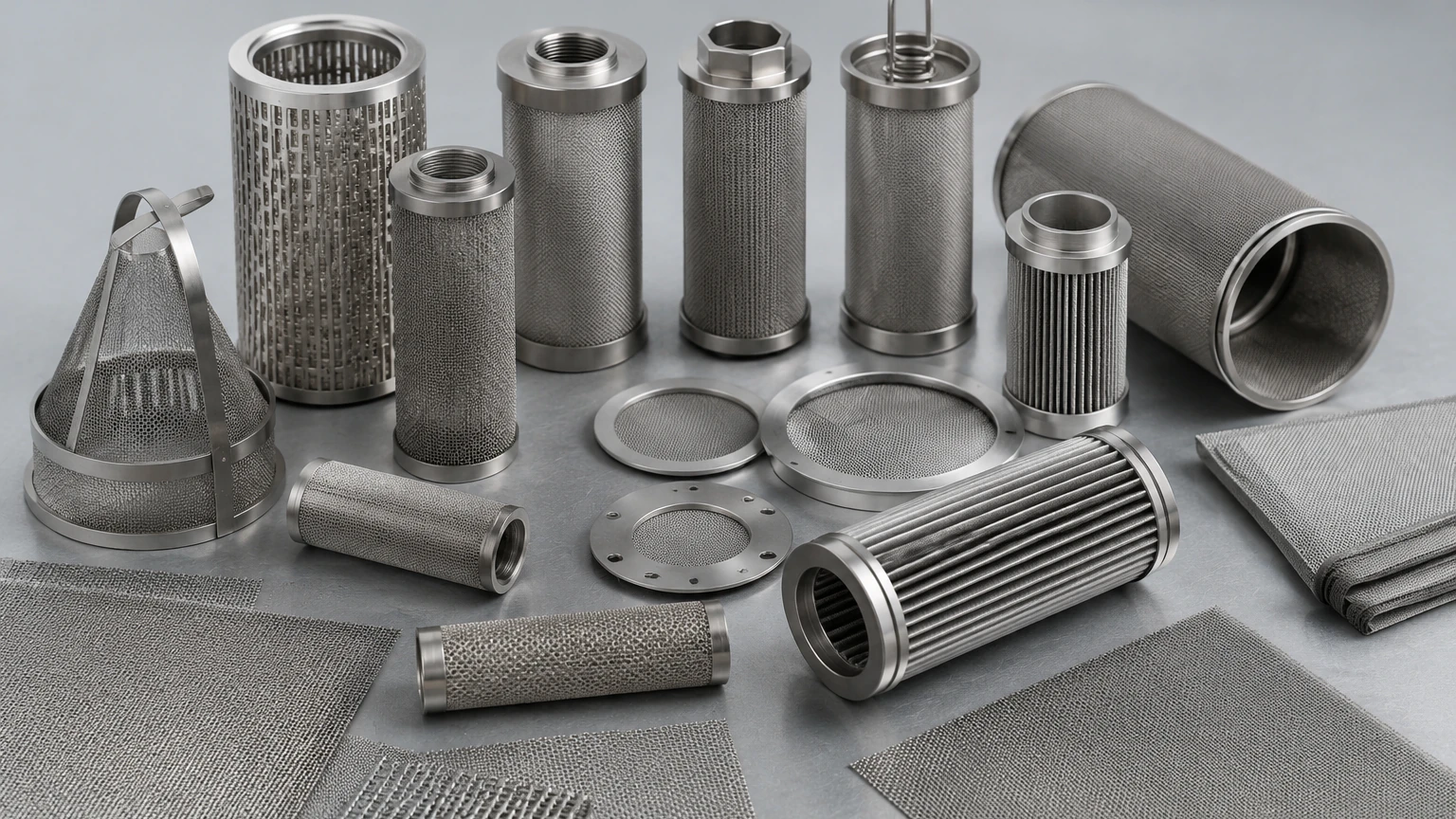
Filter steel is rarely used in a solid sheet; instead, it is processed into various media formats to achieve specific filtration goals. The choice of format determines the micron rating, flow rate, and cleaning characteristics of the final product.
Woven Wire Mesh
Woven filter steel is created by weaving individual wires into a precise grid. Different weave patterns—such as Plain Weave, Twilled Weave, and Dutch Weave—allow for different performance profiles. Plain Dutch Weave, for instance, provides a dense structure with high strength and fine filtration capabilities, whereas Plain Weave offers higher open areas for high-flow, low-pressure applications.
Sintered Metal Mesh
Sintering is a process where multiple layers of woven wire mesh are bonded together using heat and pressure without melting the material. This creates a monolithic structure that is incredibly robust. Sintered filter steel is ideal for high-pressure environments because the layers cannot shift or migrate, ensuring a consistent micron rating even under mechanical stress.
Sintered Metal Powder
Unlike mesh, sintered powder filters are made by compressing stainless steel powder into a specific shape and then sintering it. This results in a porous metal structure with a tortuous path for fluids, providing excellent depth filtration. These are often used in gas filtration and applications requiring very fine particle retention.
Engineering Considerations for Selection
When specifying filter steel components, engineers must look beyond the material grade and consider the operational parameters of the entire system. Key evaluation criteria include:
1. Filtration Rating: Absolute vs. Nominal
A critical distinction in filter steel performance is the micron rating. A nominal rating refers to the ability of the filter to retain a percentage of particles of a certain size (e.g., 90% of 10-micron particles). An absolute rating, however, indicates the size of the largest particle that can pass through the medium. For mission-critical pharmaceutical or hydraulic applications, absolute-rated filter steel is usually required to prevent downstream contamination.
2. Differential Pressure and Permeability
Every filter introduces a pressure drop (delta P) into the system. The goal is to maximize permeability—the ease with which fluid passes through the media—while maintaining the required filtration accuracy. Factors such as wire diameter, weave density, and the total surface area of the filter steel contribute to this balance. Over-specifying a filter (choosing a finer mesh than necessary) can lead to premature clogging and increased energy costs for pumps.
3. Mechanical Strength and Collapse Pressure
In high-viscosity or high-flow applications, the filter steel must withstand significant mechanical forces. If the differential pressure exceeds the structural limits of the media, the filter may collapse or bypass. This is why many stainless steel cartridges include internal support cores and external cages made of perforated filter steel to provide structural integrity.
Applications Across Demanding Industries
The versatility of filter steel makes it indispensable across various sectors. Each industry has unique requirements that dictate the design of the filtration component.
* Chemical Processing: Here, the primary concern is chemical compatibility. Filter steel must resist degradation from solvents, acids, and bases while maintaining precise separation of catalysts or impurities.
* Food and Beverage: Hygiene is the priority. Stainless steel filters must have smooth surface finishes (low Ra values) to prevent bacterial growth and must be capable of withstanding Clean-in-Place (CIP) procedures involving high-temperature steam and caustic detergents.
* Pharmaceuticals: This industry requires the highest levels of traceability and precision. Filter steel components must often meet stringent regulatory standards, ensuring that no metallic fibers migrate into the final product.
* Hydraulic Systems: In hydraulic circuits, filter steel protects sensitive valves and pumps from wear-inducing particles. These filters must handle high-pressure pulses and provide long service intervals.
Customization and OEM Solutions
No two industrial processes are identical, which is why customization is a core component of the Kaifil philosophy. When sourcing filter steel solutions, purchasing teams should confirm the ability of the manufacturer to adapt designs to specific housing requirements and flow conditions.
Customization options often include:
* End Cap Configurations: Adapting filters to fit existing housings with 222, 226, or DOE (Double Open End) fittings.
* Pleating: Increasing the surface area of the filter steel by pleating the mesh, which extends the dirt-holding capacity and reduces the frequency of replacement.
* Layering: Combining different mesh counts to create a graduated filtration effect, where coarser outer layers protect the finer internal layers.
For a comprehensive look at how these customized components can be integrated into your specific system, you can visit the Main Page to review product options and application support.
Maintenance and Total Cost of Ownership
One of the primary advantages of using stainless steel as a filtration medium is that it is cleanable and reusable. While the initial investment in filter steel is higher than disposable polymer filters, the total cost of ownership (TCO) is often significantly lower over the life of the equipment.
Cleaning Methods
Properly maintained filter steel can last for years. Common cleaning techniques include:
* Ultrasonic Cleaning: Using high-frequency sound waves in a solvent bath to dislodge particles from deep within the mesh.
* Backwashing: Reversing the flow of fluid through the filter to flush out accumulated debris.
* Chemical Cleaning: Using specific acids or alkalis to dissolve organic or inorganic scaling, provided the steel grade is compatible with the cleaning agent.
Replacement Cycles
Despite their durability, filter steel components are not infinite. Engineers should monitor the "clean pressure drop" after each cleaning cycle. If the baseline pressure drop begins to rise, it indicates that the media is becoming permanently fouled or that the pore structure is deforming, signaling that a replacement is necessary.
Conclusion
Selecting the right filter steel involves a deep understanding of metallurgy, fluid dynamics, and the specific constraints of the industrial environment. By choosing high-quality stainless steel grades and the appropriate structural format—whether it be woven mesh or sintered metal—companies can achieve reliable, cost-effective filtration that protects their equipment and ensures product purity.
As a dedicated manufacturer, Kaifil provides the technical expertise and manufacturing precision required to develop these critical components. From material selection to final production, we work to ensure that every filter steel product meets the rigorous demands of our global partners. For more detailed technical specifications and to explore our full range of filtration solutions, please refer to the resources available on our Main Page.
