


Hplc Frit
In the precision-driven world of analytical chemistry, the performance of a High-Performance Liquid Chromatography (HPLC) system is often determined by its smallest components. Among these, the hplc frit serves as a critical guardian of the analytical column. While it may appear to be a simple porous disk, the engineering behind an hplc frit involves complex considerations of fluid dynamics, material science, and mechanical tolerances. For engineers and laboratory managers, understanding the technical nuances of these components is essential for maintaining system integrity, ensuring reproducible results, and extending the lifespan of expensive chromatographic columns.
As a specialized manufacturer of stainless steel filtration solutions, Kaifil provides precision-engineered components designed to meet the rigorous demands of industrial and laboratory filtration. For detailed information on our full range of technical capabilities, professionals are encouraged to visit our Main Page.
The Role of the Frit in High-Performance Liquid Chromatography
The primary function of an hplc frit is twofold: it acts as a mechanical barrier to retain the stationary phase (packing material) within the column, and it serves as a final filtration stage to protect the column bed from particulate contamination.
Mechanical Retention
HPLC columns are packed with micro-particulate silica or polymer beads, often ranging from 1.5 µm to 5 µm in diameter. Without a robust frit at both the inlet and outlet of the column, these particles would be washed out by the high-pressure flow of the mobile phase. The hplc frit must possess a pore size small enough to retain these particles while maintaining high permeability to minimize pressure drop.
Flow Distribution
Beyond simple retention, the inlet frit plays a vital role in flow distribution. As the mobile phase enters the column, it must be distributed evenly across the entire cross-section of the packing bed. An uneven flow profile can lead to "channeling," where the solvent travels faster through certain parts of the column than others. This results in peak broadening and a significant loss in chromatographic resolution. A high-quality hplc frit ensures a uniform laminar flow, which is critical for achieving sharp, symmetrical peaks.
Engineering and Material Composition of HPLC Frits
The choice of material for an hplc frit is dictated by the chemical nature of the mobile phase and the operating pressures of the system. In most industrial and analytical applications, stainless steel is the material of choice due to its mechanical strength and broad chemical compatibility.
Sintered Stainless Steel (316L)
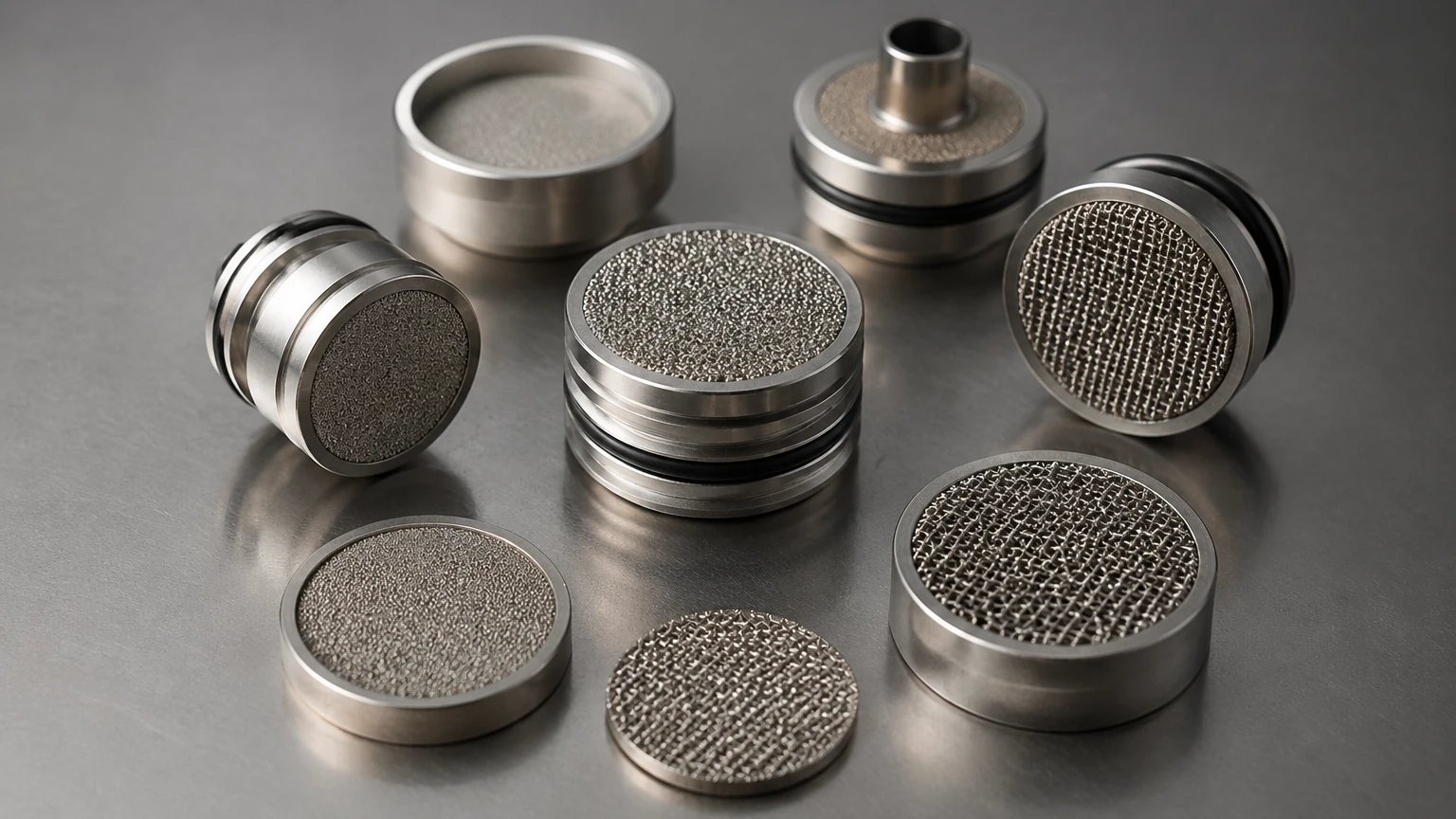
Most hplc frits are manufactured using a sintering process. Fine stainless steel powder, typically Grade 316L, is compressed in a mold and heated in a controlled atmosphere until the particles bond together without melting. This process creates a rigid, porous structure with a highly controlled pore size distribution. 316L stainless steel is preferred because of its excellent resistance to corrosion from a wide variety of solvents and buffers used in HPLC.
Titanium and PEEK Alternatives
In specific applications where stainless steel may interact with the analytes—such as in the analysis of proteins or highly acidic samples—alternative materials are employed. Titanium frits offer enhanced biocompatibility and resistance to halides. For completely metal-free systems, PEEK (Polyetheretherketone) frits are used. However, PEEK frits generally have lower pressure ratings compared to their metal counterparts and may deform under the extreme pressures (up to 15,000 psi or more) found in UHPLC (Ultra-High Performance Liquid Chromatography).
Porosity and Filtration Efficiency: Technical Specifications
Selecting the correct porosity for an hplc frit is a balancing act between filtration efficiency and system backpressure. Porosity is typically defined by the "nominal pore size," which indicates the size of particles the frit is expected to retain.
The 1/3 Rule for Particle Retention
A common engineering guideline in chromatography is that the frit pore size should be no larger than one-third (and preferably one-fifth) of the average diameter of the packing material. For a column packed with 5 µm particles, a 2 µm frit is standard. For columns using 3 µm or smaller particles, a 0.5 µm frit is required. Using a frit with pores that are too large will result in "media migration," where the stationary phase leaks out, eventually destroying the column.
Porosity vs. Permeability
While pore size is critical for retention, permeability determines how much pressure is required to move the mobile phase through the frit. A frit with a narrow pore size distribution and high interconnected porosity will offer lower resistance to flow. High backpressure at the frit can lead to localized heating, which can negatively impact the stability of temperature-sensitive analytes and lead to baseline noise.
Impact on Chromatographic Performance: Backpressure and Peak Shape
The hplc frit is often the first component to fail or degrade in a chromatography system. Because it acts as a filter, it naturally accumulates debris over time. This debris can come from several sources:
1. Sample Contamination: Undissolved solids or precipitates in the sample.
2. Pump/Valve Wear: Small fragments of seal material or metal-on-metal wear from the HPLC pump.
3. Mobile Phase Impurities: Particulates from poorly filtered buffers or microbial growth in aqueous solvents.
Identifying Backpressure Issues
As an hplc frit becomes clogged, the system backpressure will steadily increase. If the pressure rise is sudden, it usually indicates a large particulate pulse. If the rise is gradual over many injections, it suggests a buildup of fine material. High backpressure not only stresses the pump seals and capillary connections but can also cause the frit itself to deform, potentially compressing the stationary phase and creating a void at the head of the column.
Dead Volume and Extra-Column Band Broadening
In the design of hplc frits, minimizing "dead volume" is essential. Dead volume refers to any space within the frit or its housing where the mobile phase can stagnate or mix. In modern high-efficiency columns, even a few microliters of excess volume in the frit can cause significant band broadening, particularly for early-eluting peaks. This is why precision manufacturing and tight dimensional tolerances are non-negotiable for OEM filter components.
Common Challenges: Clogging, Contamination, and Chemical Compatibility
Engineers must be aware of the chemical environment the hplc frit will inhabit. While 316L stainless steel is robust, it is not invincible.
Halide Corrosion and Passivation
High concentrations of chloride ions at low pH can cause pitting corrosion in stainless steel. To mitigate this, stainless steel frits are often passivated—a process involving treatment with nitric or citric acid to enhance the protective chromium oxide layer on the surface. For users frequently running high-salt buffers, ensuring that the hplc frit has been properly passivated is a key procurement requirement.
Ghost Peaks and Carryover
A contaminated hplc frit can be a source of "ghost peaks" or sample carryover. If the frit material has high non-specific adsorption, analytes from a previous injection may stick to the frit and slowly bleed off during subsequent runs. This is particularly problematic in trace analysis and proteomic applications. In these cases, choosing a frit with a highly polished surface finish or a bio-inert material is necessary.
Maintenance and Replacement Cycles for Industrial Filtration Components
In an industrial or high-throughput laboratory setting, the cost of replacing an hplc frit is negligible compared to the cost of a ruined analytical column or the downtime associated with system failure.
Preventive Replacement
Rather than waiting for a pressure alarm to stop a run, many facilities implement a preventive maintenance schedule. The frequency of replacement depends on the cleanliness of the samples and the robustness of the upstream filtration. If a system is equipped with high-quality in-line filters and guard columns, the hplc frit within the main column may last for thousands of injections. However, if the frit is used as the primary filter, it should be replaced as soon as a 10-15% increase in baseline pressure is observed.
Cleaning vs. Replacement
While some laboratories attempt to clean hplc frits using ultrasonication in strong acids or solvents, this is generally not recommended for precision analytical work. Ultrasonication can sometimes dislodge particles only to have them re-settle in a way that further restricts flow or compromises the structural integrity of the sintered bond. For critical applications, using a new, factory-certified frit is the most reliable approach.
Customization and OEM Solutions for Precision Filtration
Every HPLC system and column design has unique requirements regarding dimensions, pressure ratings, and flow characteristics. Standard off-the-shelf frits may not always provide the optimal balance of filtration and flow for specialized applications.
Engineering for Specific Applications
Custom hplc frit manufacturing allows for the adjustment of several parameters:
* Diameter and Thickness: Tailored to fit specific column hardware without creating bypass leaks.
* Pore Size Distribution: Optimized for specific stationary phase particle sizes to maximize permeability.
* Edge Treatments: Some frits are designed with a solid outer ring or are encapsulated in a polymer (like PEEK or PTFE) to ensure a leak-free seal against the column wall.
Kaifil specializes in these types of custom metal filtration components, leveraging advanced sintering technology to produce frits that meet the exacting standards of the chromatography industry. Our expertise in material selection and precision manufacturing ensures that every component contributes to the overall efficiency of the filtration system.
Conclusion
The hplc frit is a fundamental component that bridges the gap between mechanical filtration and chemical analysis. By understanding the engineering principles behind frit porosity, material compatibility, and flow dynamics, technical professionals can significantly improve the reliability of their HPLC systems. Whether you are designing a new analytical instrument or managing a high-throughput quality control lab, selecting high-quality, precision-engineered frits is a prerequisite for success.
For engineers seeking reliable OEM partners for custom filtration solutions, exploring the Main Page provides a gateway to technical support and high-performance metal filter components tailored to demanding industrial environments.
