


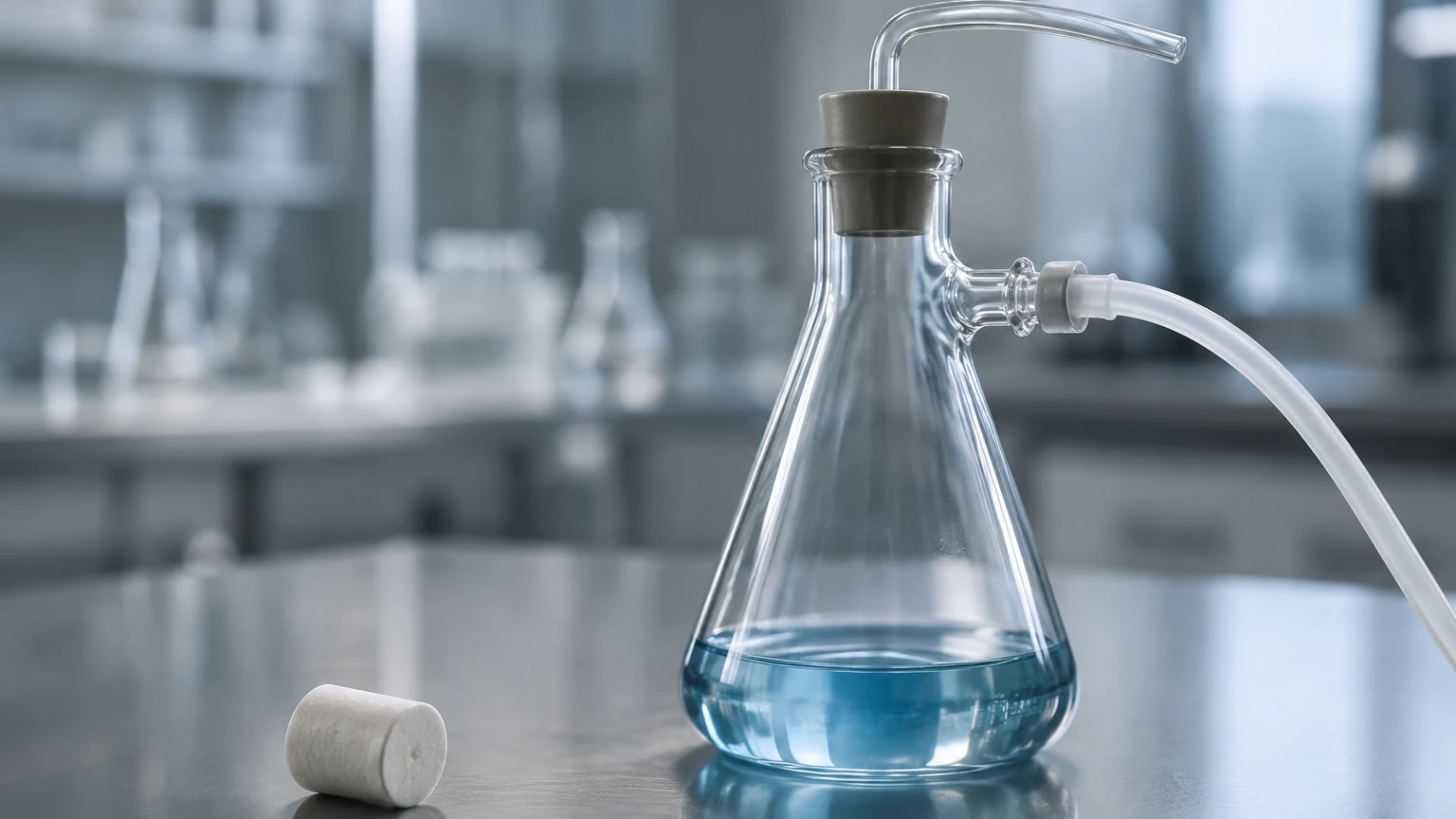
Erlenmeyer Flask with Vacuum
In the realm of laboratory-scale liquid-solid separation, the Erlenmeyer flask with vacuum—commonly referred to as a Büchner flask or filter flask—is an indispensable tool. While it is a staple in research and development settings, its function serves as the foundational blueprint for large-scale industrial filtration processes. Understanding the mechanics, safety requirements, and material limitations of vacuum filtration at the benchtop level is critical for engineers who must eventually scale these processes into high-volume production environments using robust stainless steel filtration components.
Vacuum filtration is preferred over gravity filtration when speed is essential or when the solid residue needs to be dried as much as possible. By creating a pressure differential, the process forces liquid through a filter medium at a significantly higher rate than gravity alone could achieve. For industrial professionals, the transition from an Erlenmeyer flask with vacuum to a full-scale industrial filter cartridge system requires a deep understanding of fluid dynamics and material compatibility.
Engineering Principles of Vacuum Filtration
The core principle behind the use of an erlenmeyer flask with vacuum is the creation of a vacuum within the flask's interior. This is achieved by connecting a vacuum pump or a water aspirator to a side arm (hose barb) integrated into the flask’s neck.
When the vacuum source is activated, the air pressure inside the flask drops below atmospheric pressure. This creates a suction effect across the filter medium placed in a funnel atop the flask. The atmospheric pressure pushing down on the liquid in the funnel, combined with the lower pressure inside the flask, accelerates the flow of the filtrate through the medium.
Pressure Differential and Flow Rates
In industrial applications, this same principle is applied using vacuum drums or pressurized housings. The flow rate ($Q$) in such a system is generally governed by Darcy’s Law, which considers the permeability of the filter medium, the surface area, the viscosity of the liquid, and the pressure drop ($ΔP$). In a laboratory setup using an Erlenmeyer flask with vacuum, the $ΔP$ is limited by the strength of the glass and the capacity of the vacuum pump. Engineers must calculate these variables carefully to prevent "blinding" or clogging of the filter media, where fine particles become trapped within the pores, prematurely halting the process.
Structural Design and Safety Considerations
Unlike standard Erlenmeyer flasks, a flask designed for vacuum use features significantly thicker glass walls. This added thickness is necessary to withstand the external atmospheric pressure when the internal environment is evacuated.
Implosion Risks
The primary safety concern with an erlenmeyer flask with vacuum is the risk of implosion. If the glass has even minor scratches, chips, or internal stresses, the pressure differential can cause the flask to fail catastrophically. In industrial settings, this risk is mitigated by moving away from glass toward metallic solutions. High-performance filtration systems often utilize 304 or 316L stainless steel housings and filter elements, which offer superior structural integrity and can handle much higher pressure differentials than laboratory glassware.
Material Compatibility
In both laboratory and industrial filtration, chemical compatibility is paramount. While borosilicate glass is resistant to many acids and bases, it is susceptible to hydrofluoric acid and concentrated phosphoric acid at high temperatures. When scaling up, engineers often look to the Main Page of specialized manufacturers to find stainless steel alloys that provide the necessary corrosion resistance for specific chemical processing environments.
Components of a Vacuum Filtration Assembly
A complete vacuum filtration setup involving an Erlenmeyer flask typically includes several key components, each of which must be selected based on the specific requirements of the filtrate and the cake (the solid residue).
1. The Filter Flask: The heavy-walled Erlenmeyer flask with a side arm.
2. The Funnel: Usually a Büchner funnel (ceramic, plastic, or stainless steel) or a Hirsch funnel for smaller volumes.
3. The Seal: A rubber stopper or a G36 adapter that ensures an airtight connection between the funnel and the flask.
4. The Filter Medium: This can range from qualitative filter paper to sophisticated sintered metal mesh.
5. The Vacuum Source: A diaphragm pump, rotary vane pump, or water aspirator.
6. The Trap: A secondary flask placed between the filter flask and the vacuum source to prevent liquid from entering the pump.
Selecting Filter Media: From Paper to Stainless Steel
One of the most critical decisions in setting up an erlenmeyer flask with vacuum is the choice of filter media. In preliminary lab tests, paper filters are common due to their low cost. However, paper has significant limitations: it lacks mechanical strength when wet, has poor chemical resistance to strong solvents, and cannot be easily cleaned or reused.
The Move to Metal Mesh
For industrial pilot programs and production lines, stainless steel wire mesh filters are the preferred choice. These filters offer several advantages over traditional media:
* Precision Micron Ratings: Stainless steel mesh can be manufactured with highly accurate pore sizes, ensuring consistent filtration performance.
* Durability: Metal filters withstand high temperatures and high-pressure differentials that would rupture paper or plastic membranes.
* Cleanability: Unlike disposable filters, stainless steel cartridges and mesh can be backwashed or ultrasonically cleaned, significantly reducing the total cost of ownership.
* No Media Migration: In pharmaceutical and food and beverage applications, it is vital that the filter itself does not shed fibers into the filtrate. Stainless steel provides a stable, non-shedding surface.
Scaling from Laboratory to Industrial Production
When a process moves from the R&D phase (using an erlenmeyer flask with vacuum) to full-scale production, the filtration requirements change drastically. The goal shifts from simply obtaining a sample to achieving high-throughput, continuous operation with minimal downtime.
Engineering Considerations for Scale-Up
* Surface Area: To maintain the same flow rate at a larger volume, the filtration surface area must increase proportionally. This is often achieved through the use of pleated filter cartridges, which pack a large amount of surface area into a compact footprint.
* Housing Design: Industrial filters require robust housings that can be integrated into existing piping systems. These housings must be designed for easy access to the filter elements for maintenance.
* Automation: While a lab technician manually monitors an Erlenmeyer flask, industrial systems often use differential pressure sensors to trigger automated backwash cycles or to alert operators that a filter change is required.
For those looking to transition their filtration processes from the benchtop to the factory floor, exploring the Main Page of a professional manufacturer like Kaifil provides insights into the variety of custom stainless steel filtration solutions available. These include wire mesh filters and precision metal components designed for the most demanding industrial environments.
Common Challenges in Vacuum Filtration Systems
Whether working with a small erlenmeyer flask with vacuum or a large-scale industrial manifold, engineers frequently encounter several common challenges:
1. Filter Blinding
Blinding occurs when particles that are the same size as the filter pores become lodged within them. This rapidly reduces flow and increases the pressure drop. To combat this, engineers may select a "depth filter" or a multi-layered sintered mesh that captures particles throughout the thickness of the media rather than just on the surface.
2. Air Leaks
In a vacuum system, even a tiny leak can significantly degrade performance. In the lab, this usually happens at the stopper. In industrial systems, leaks often occur at gaskets or flange connections. Using high-quality O-rings and ensuring proper torque on housing bolts are essential maintenance steps.
3. Thermal Stress
If the liquid being filtered is at an extreme temperature, the filtration assembly must be able to handle the thermal expansion. Stainless steel is particularly well-suited for these applications, as it maintains its mechanical properties across a wide temperature range, unlike many plastics or standard glass.
The Importance of Customization in Filtration
No two industrial processes are identical. The viscosity of the fluid, the morphology of the suspended solids, and the required purity of the filtrate all dictate the need for customized filtration solutions. While an erlenmeyer flask with vacuum is a "one size fits all" tool for the lab, industrial filtration requires a more tailored approach.
Customization options often include:
* Variable Micron Ratings: Fine-tuning the pore size to balance flow rate and filtration efficiency.
* Custom Dimensions: Designing filter cartridges that fit into existing equipment or specialized housings.
* Material Selection: Choosing between different grades of stainless steel (e.g., 304, 316, 316L) or exotic alloys based on the corrosive nature of the process fluid.
Conclusion
The erlenmeyer flask with vacuum remains a foundational tool for understanding the mechanics of liquid-solid separation. However, for engineers and purchasing teams in the chemical, pharmaceutical, and food industries, the laboratory setup is only the beginning. Achieving efficient, durable, and cost-effective filtration at scale requires a transition to professional-grade metal filtration components.
By focusing on high-quality materials like stainless steel and considering the engineering requirements of pressure, flow, and compatibility, organizations can optimize their filtration performance. For those ready to explore advanced filtration technology, visiting the Main Page of an experienced manufacturer is the best way to find reliable OEM and customized solutions that meet specific industrial application requirements. Whether you are refining a process in the lab or managing a global production line, the right filtration partner ensures that your systems operate at peak efficiency with minimal maintenance costs.
