


Stainless Steel Water Filter Cartridge
In industrial liquid processing, the selection of filtration media is a critical engineering decision that directly impacts operational efficiency, product purity, and long-term maintenance costs. The stainless steel water filter cartridge represents a high-performance alternative to disposable polymer-based filters, particularly in environments characterized by high temperatures, aggressive chemical profiles, or high differential pressures. As a professional manufacturer, Kaifil specializes in engineering these components to meet the rigorous demands of sectors ranging from chemical processing to food and beverage production.
Understanding the technical nuances of a stainless steel water filter cartridge is essential for engineers and procurement teams who must balance initial capital expenditure with the total cost of ownership. This guide examines the structural engineering, material science, and performance metrics that define high-quality industrial metal filters.
Engineering Fundamentals of Stainless Steel Filtration
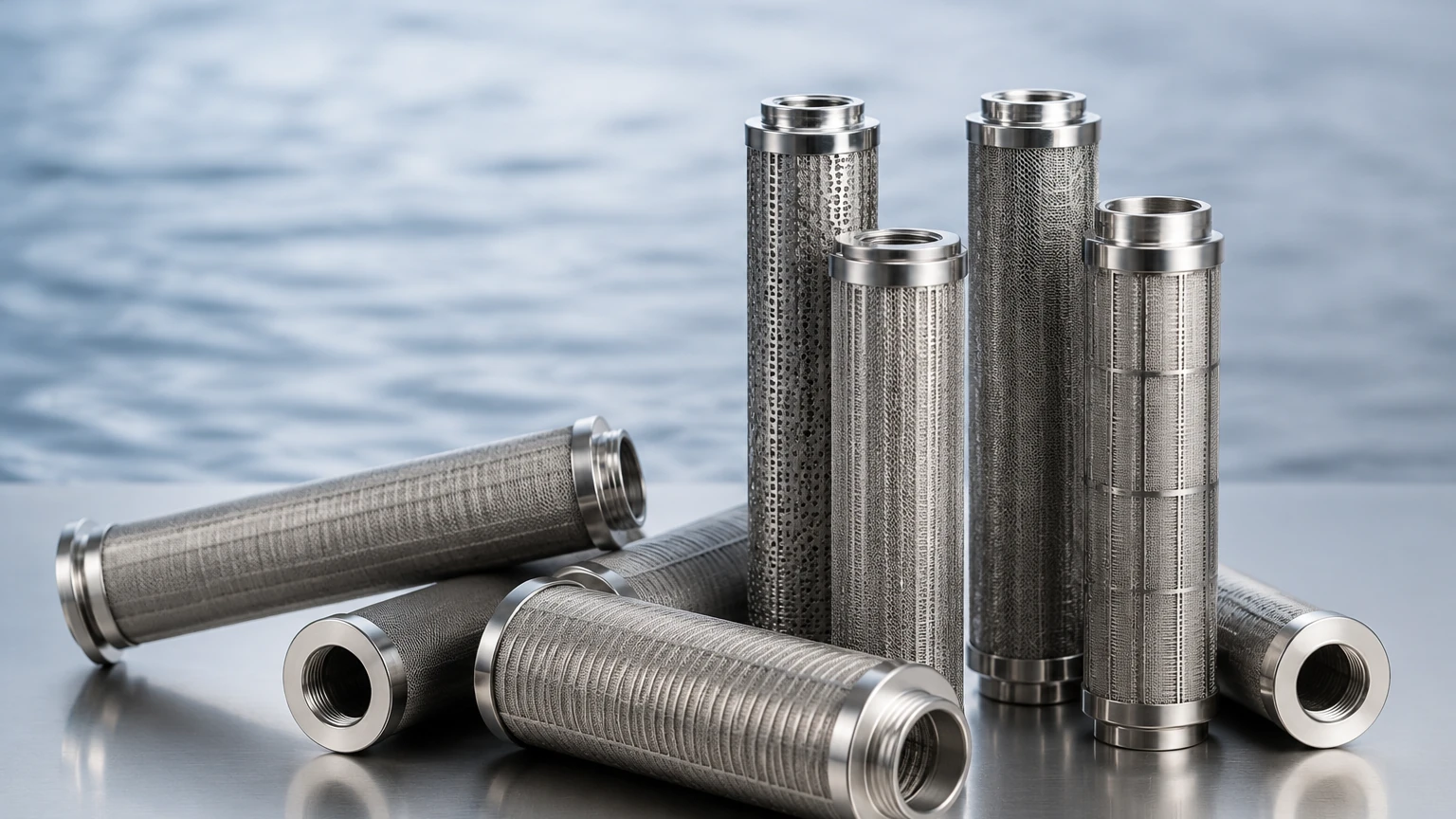
Unlike disposable melt-blown or string-wound cartridges, a stainless steel water filter cartridge is designed as a permanent or semi-permanent structural component. The filtration mechanism typically relies on one of three primary media types: woven wire mesh, sintered metal powder, or sintered metal fiber felt.
Woven Wire Mesh
Stainless steel wire mesh filters are characterized by a precise, two-dimensional pore structure. These are ideal for surface filtration where particles are trapped on the exterior of the media. The uniformity of the weave allows for predictable flow rates and easy cleaning through backwashing. Engineers often specify pleated wire mesh designs to increase the available surface area, which reduces the flux rate per unit area and extends the time between cleaning cycles.
Sintered Metal Media
For applications requiring higher structural integrity or finer filtration grades, sintered media is preferred. Sintered metal powder cartridges are formed through a process of isostatic pressing and high-temperature vacuum sintering, creating a rigid, porous structure capable of depth filtration. Alternatively, sintered fiber felt utilizes non-woven stainless steel fibers to provide high porosity (up to 80%) and high dirt-holding capacity while maintaining a low pressure drop.
Material Selection and Chemical Compatibility
The primary advantage of a stainless steel water filter cartridge is its resistance to environmental degradation. However, the specific grade of stainless steel must be matched to the fluid chemistry. For more technical specifications on material grades, you can visit our Main Page.
1. AISI 304/304L: Suitable for general water treatment, food and beverage applications, and mildly corrosive environments. It offers excellent weldability and structural strength.
2. AISI 316/316L: The industry standard for pharmaceutical and chemical processing. The addition of molybdenum provides enhanced resistance to pitting and crevice corrosion, particularly in chloride-rich environments or saline water.
3. Specialty Alloys: For extreme conditions involving high-concentration acids or ultra-high temperatures, alloys such as 310S or Hastelloy may be utilized in the cartridge construction.
Beyond the metal itself, the selection of sealing materials—such as EPDM, Viton (FKM), or PTFE gaskets—is vital. These seals must be compatible with both the process fluid and the cleaning agents used during maintenance to prevent bypass leakage.
Performance Metrics: Efficiency and Micron Ratings
When evaluating a stainless steel water filter cartridge, engineers must distinguish between nominal and absolute micron ratings. A nominal rating indicates the filter's ability to retain a majority of particles of a certain size, whereas an absolute rating (often defined by a Beta Ratio of 5000 or 99.9% efficiency) guarantees that no particles larger than the specified size will pass through the media.
Pressure Drop (Delta P)
In industrial systems, the clean pressure drop is a key indicator of energy efficiency. A well-engineered stainless steel cartridge minimizes resistance to flow. As contaminants accumulate, the differential pressure increases. Stainless steel cartridges are uniquely capable of withstanding high collapse pressures—often exceeding 50-100 PSI—allowing them to remain in service far longer than plastic alternatives that might deform or burst under similar stress.
Dirt Holding Capacity
While surface filtration (mesh) has a lower dirt-holding capacity than depth filtration (sintered fiber), the ability to clean and reuse the cartridge offsets this limitation. In high-solids applications, multi-layered sintered structures are often employed to provide graduated filtration, trapping larger particles in the outer layers and finer particles in the inner core.
Industrial Application Scenarios
The versatility of the stainless steel water filter cartridge makes it indispensable across several critical industries:
* Chemical and Petrochemical: Used for the filtration of catalysts, solvents, and polymers where high temperatures and corrosive fluids would degrade synthetic media.
* Food and Beverage: Ideal for steam filtration (culinary steam), syrup filtration, and beverage polishing. Stainless steel is inherently non-leaching and meets stringent FDA compliance standards for food contact.
* Pharmaceutical and Biotech: Employed in the recovery of active pharmaceutical ingredients (APIs) and the filtration of process gases. The ability to withstand CIP (Clean-in-Place) and SIP (Steam-in-Place) sterilization is a primary requirement here.
* Power Generation and Hydraulics: Used in high-pressure boiler feed water systems and hydraulic fluid circuits to protect sensitive downstream components from particulate wear.
Customization and OEM Considerations
Standard off-the-shelf filters rarely meet the specific needs of complex industrial systems. Customization is a core strength of Kaifil’s manufacturing process. When specifying a custom stainless steel water filter cartridge, several design variables must be confirmed:
* End Cap Configurations: Options include Double Open End (DOE), 222/Flat, 226/Fin (Bayonet), or threaded connections (NPT/BSP). Proper fitment is essential to ensure a zero-bypass seal within the filter housing.
* Structural Reinforcement: For high-viscosity fluids or high-pressure pulses, internal support cores and outer protective cages are added to prevent media pleat bunching or structural collapse.
* Surface Treatments: Electropolishing or passivation can be applied to enhance corrosion resistance and improve the "cleanability" of the surface by reducing microscopic roughness where bacteria or contaminants could lodge.
Maintenance, Cleaning, and Reusability
The most significant economic advantage of a stainless steel water filter cartridge is its reusability. Unlike disposable filters that contribute to waste streams and recurring procurement costs, metal cartridges can be restored to near-original performance through various cleaning methods.
Ultrasonic Cleaning
This method uses high-frequency sound waves to create cavitation bubbles in a cleaning solution. These bubbles implode on the surface and within the pores of the filter media, dislodging deeply embedded contaminants that backwashing cannot reach.
Chemical Cleaning
Depending on the contaminant, the cartridge may be soaked in caustic solutions, acids, or solvents. This is particularly effective for removing organic buildup, mineral scales, or polymer residues. It is imperative that the cleaning chemistry is compatible with the specific grade of stainless steel and the gasket material.
Backwashing and Backpulsing
In automated systems, the flow can be momentarily reversed to flush particles off the surface of the mesh. This is common in continuous water treatment processes where downtime must be minimized.
Total Cost of Ownership (TCO) Analysis
While the initial purchase price of a stainless steel water filter cartridge is higher than that of a polypropylene or fiberglass equivalent, the TCO is often significantly lower over a 2-to-5-year period. Factors contributing to this include:
* Reduced Disposal Costs: Elimination of hazardous waste disposal fees associated with contaminated disposable cartridges.
* Lower Downtime: Extended service intervals and the ability to clean in-place reduce the frequency of system shutdowns.
* Process Stability: Stainless steel does not suffer from fiber migration or unloading (releasing trapped particles due to pressure surges), ensuring consistent product quality.
* Energy Savings: The high porosity of sintered fiber media often allows for lower operating pressures compared to dense disposable depth filters.
Selection Guide for Engineers
Before purchasing or commissioning a custom filtration solution, technical teams should confirm the following parameters with the manufacturer:
1. Operating Temperature: Both the continuous and peak temperatures.
2. Fluid Chemistry: pH levels, presence of chlorides, and viscosity at operating temperature.
3. Contaminant Profile: Particle size distribution, concentration (PPM), and the nature of the solids (deformable vs. hard).
4. Flow Requirements: Maximum and minimum flow rates and allowable initial pressure drop.
5. Regulatory Compliance: Requirements for FDA, 3A Sanitary Standards, or specific industry certifications.
By addressing these factors, engineers can ensure that the selected stainless steel water filter cartridge provides the necessary filtration precision without becoming a bottleneck in the production process.
Conclusion
The stainless steel water filter cartridge is more than a simple consumable; it is a precision-engineered component that provides reliability in the most demanding industrial environments. Through advanced manufacturing techniques such as vacuum sintering and precision pleating, Kaifil delivers filtration solutions that offer superior durability, cleanability, and efficiency. Whether for protecting high-pressure hydraulic systems or ensuring the purity of food-grade liquids, these metal filters represent a sustainable and cost-effective choice for modern industry. For detailed product inquiries and engineering support, please refer to our Main Page.
