


Automatic Backflush Filter
In industrial liquid processing, maintaining continuous flow while ensuring high-purity filtration is a critical engineering challenge. Manual filtration systems, while effective for low-solids applications, often lead to significant downtime and labor costs when handling high-load or critical process streams. An automatic backflush filter provides a robust solution to these challenges by integrating a self-cleaning mechanism that operates without interrupting the primary fluid flow. This technology is essential in sectors such as chemical processing, water treatment, and power generation, where system uptime is directly linked to operational profitability.
For engineers and procurement teams, selecting the right automatic backflush filter requires a deep understanding of fluid dynamics, material compatibility, and the mechanical nuances of the cleaning cycle. This guide explores the technical foundations of these systems and the criteria necessary for successful industrial integration.
Understanding the Mechanics of Automatic Backflush Systems
The primary function of an automatic backflush filter is to remove suspended solids from a liquid stream and automatically clean the filter element once it becomes fouled. Unlike manual strainers or bag filters, which require the system to be bypassed or shut down for cleaning, the backflush mechanism utilizes a portion of the process fluid (or an external clean source) to reverse the flow through the filter media, dislodging accumulated debris.
The Filtration Cycle
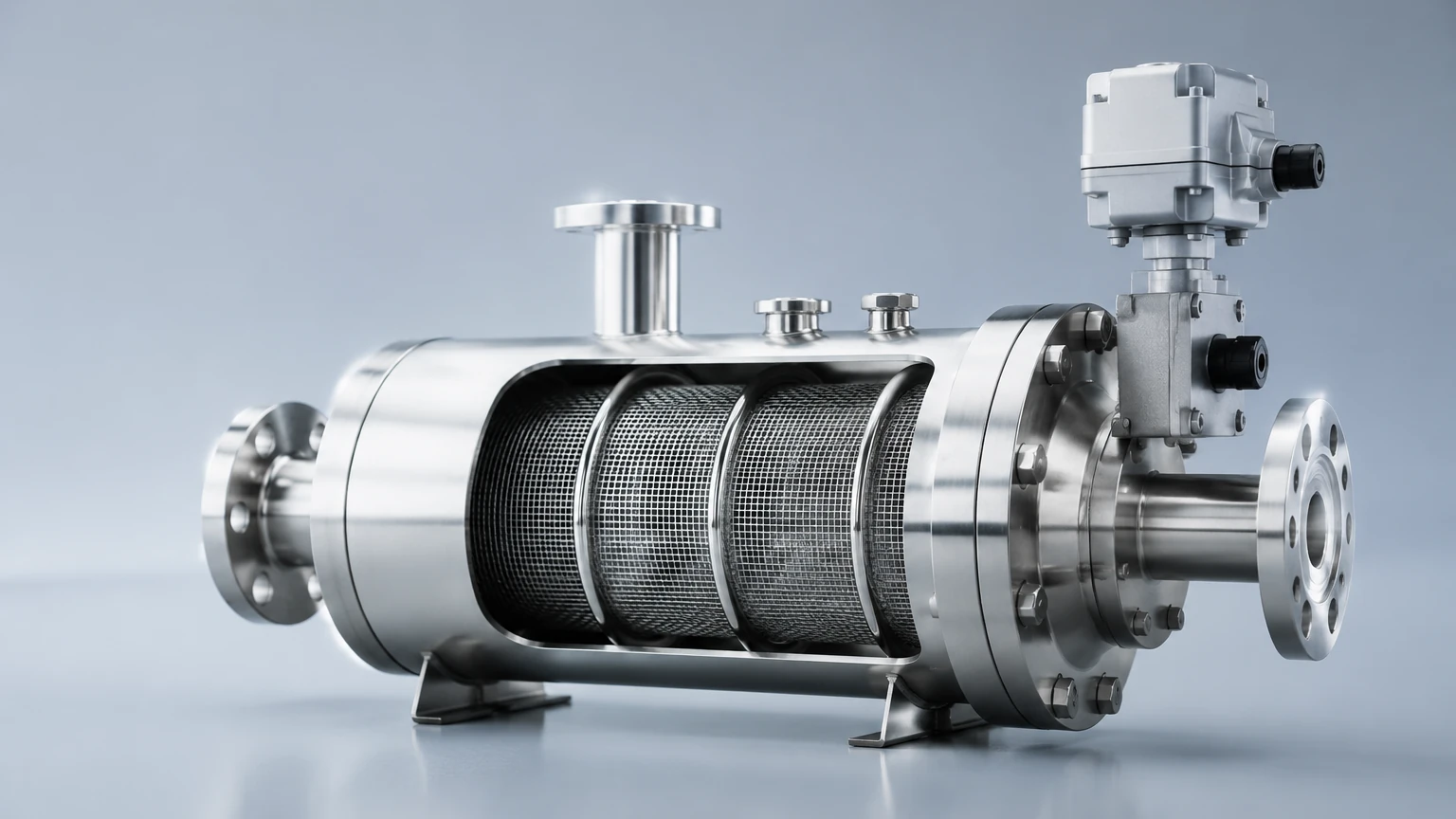
During normal operation, the liquid enters the filter housing and passes through the filter element—typically a high-strength stainless steel wedge wire or sintered mesh. Solids are retained on the interior or exterior surface of the element, depending on the specific design. As the layer of debris (the filter cake) builds up, the resistance to flow increases, creating a pressure differential (ΔP) between the inlet and outlet ports.
The Cleaning Trigger
Most modern systems utilize a dual-trigger mechanism for the cleaning cycle:
1. Differential Pressure: A sensor monitors the ΔP. Once it reaches a pre-set threshold (commonly between 0.5 and 1.0 bar), the control system initiates the backflush.
2. Timer-Based: To prevent excessive buildup during low-flow periods or to handle sticky contaminants that might not trigger a rapid pressure rise, a timer serves as a secondary fail-safe.
The Backflush Mechanism
When the cycle begins, a backwash valve opens to a lower-pressure environment (such as a drain or a recovery tank). This creates a high-velocity reverse flow. In many high-performance designs, a rotating cleaning arm or scanner moves across the surface of the filter element, focusing the suction on a small area at a time. This ensures that the majority of the filter remains in service, allowing for uninterrupted flow to the downstream process.
Critical Components and Material Selection for Industrial Durability
The longevity of an automatic backflush filter is largely determined by its materials of construction. Because these filters are often used in demanding environments involving corrosive chemicals or high temperatures, stainless steel is the industry standard. At Main Page, the focus remains on leveraging high-grade alloys to ensure structural integrity under repetitive mechanical stress.
Filter Element Construction
The element is the heart of the system. Common types include:
* Wedge Wire: Ideal for heavy-duty applications. The V-shaped profile of the wire prevents permanent clogging (plugging) because the opening widens inward, allowing particles to be easily flushed away during the reverse cycle.
* Sintered Multi-Layer Mesh: Used for fine filtration (down to 1–5 microns). Multiple layers of stainless steel wire cloth are sintered together to provide both high permeability and the mechanical strength required to withstand backpressure pulses.
Housing and Seals
The filter housing must be rated for the maximum operating pressure of the system, often following ASME or PED standards. Material selection typically involves SS304 for general water applications or SS316L for pharmaceutical and chemical environments where resistance to pitting and crevice corrosion is paramount. Seal materials (EPDM, Viton, or PTFE) must be verified against the chemical profile and temperature of the process fluid to prevent premature failure.
Engineering Considerations: Flow Rate, Pressure, and Micron Rating
Properly sizing an automatic backflush filter is not merely a matter of matching pipe diameters. Engineers must calculate the "filtration flux"—the volume of liquid passing through a unit area of the filter media over time. If the flux is too high, particles can be forced into the mesh pores, making them difficult to remove during backflushing.
Viscosity and Solids Loading
High-viscosity liquids require larger filtration surfaces and potentially higher backflush pressures to effectively clear the media. Similarly, the concentration and nature of the solids (e.g., fibrous, granular, or gelatinous) dictate the choice of the cleaning mechanism. For example, fibrous contaminants may require a mechanical scraper in addition to the backflush flow to ensure the element is fully restored.
Backwash Volume Loss
One technical trade-off of the automatic backflush filter is the loss of process fluid during the cleaning cycle. Engineers must account for this "reject rate" in their mass balance calculations. High-efficiency systems are designed to minimize this loss by using high-velocity, low-volume pulses or by incorporating a secondary recovery stage.
Evaluating the Total Cost of Ownership (TCO)
While the initial capital expenditure (CAPEX) for an automatic backflush filter is higher than that of manual systems, the Total Cost of Ownership (TCO) is often significantly lower over the equipment's lifecycle. When evaluating these systems, purchasing teams should consider the following factors:
1. Labor Savings: Eliminating the need for manual cleaning reduces man-hours and minimizes the risk of human error during reassembly.
2. Consumable Costs: Unlike bag or cartridge filters that require frequent replacement and disposal, the stainless steel elements in a backflush filter are designed for years of service.
3. Process Continuity: The ability to maintain 24/7 operation without shutdown prevents costly production bottlenecks.
4. Energy Efficiency: By maintaining a lower average differential pressure compared to a fouled manual filter, the system reduces the load on upstream pumps, leading to measurable energy savings.
Common Operational Risks and Mitigation Strategies
Despite their automated nature, these systems are not "set and forget." Understanding potential failure modes is essential for maintaining system reliability.
* Short-Circuiting of the Cleaning Cycle: If the backwash valve or the internal scanning arm fails to seal correctly, the pressure differential may never drop, causing the system to stay in a continuous cleaning loop. Regular inspection of the internal seals and drive motor is necessary.
* Media Blinding: This occurs when particles are smaller than the micron rating but become lodged due to their shape or adhesive properties. If backflushing cannot clear the media, a chemical clean-in-place (CIP) cycle or ultrasonic cleaning of the element may be required.
* Pressure Spikes: Rapid changes in system pressure (water hammer) can deform the filter elements. Installing surge tanks or slow-closing valves can mitigate this risk.
Customization and Integration into Existing Industrial Lines
Every industrial facility has unique spatial and technical constraints. Customization is often required to integrate an automatic backflush filter into an existing footprint. This includes the orientation of inlet/outlet flanges, the integration of the control panel with the plant’s existing Distributed Control System (DCS) or Programmable Logic Controller (PLC) via Modbus or Profibus, and the addition of bypass manifolds for emergency maintenance.
As a specialist manufacturer, Kaifil provides tailored filtration components that address these specific engineering requirements. Whether the application involves high-temperature steam filtration or the removal of fine catalysts in a chemical reactor, the filter must be engineered to the exact specifications of the fluid and the environment.
Pre-Purchase Checklist for Technical Teams
Before finalizing the specification for an automatic backflush filter, technical teams should confirm the following data points with the manufacturer:
* Fluid Characteristics: Confirm the chemical composition, pH, temperature range, and viscosity at operating temperature.
* Contaminant Profile: Identify the particle size distribution (PSD) and the nature of the solids (e.g., hard vs. soft particles).
* Flow Dynamics: Define the minimum, normal, and maximum flow rates, as well as the available system pressure for the backflush cycle.
* Cleaning Source: Determine if the system will use the internal process fluid for backflushing or if an external clean water/gas source is required to avoid contaminating the downstream process.
* Certification Requirements: Ensure the unit meets local and industry-specific regulations, such as FDA compliance for food applications or ATEX certification for explosive environments.
By addressing these technical variables early in the procurement phase, engineers can ensure that the automatic backflush filter delivers the expected performance, durability, and return on investment. For more detailed technical specifications on stainless steel filtration components, reviewing specialized manufacturing capabilities at the Main Page can provide the necessary context for complex industrial projects.
