


Filtro Coalescente Para Aire Comprimido
In industrial environments, compressed air is often referred to as the "fourth utility." However, unlike electricity or water provided by municipal grids, the quality of compressed air is entirely dependent on the on-site treatment system. One of the most critical components in this treatment chain is the coalescing filter, or *filtro coalescente para aire comprimido*. These components are engineered to remove sub-micronic oil aerosols, water droplets, and solid particulates that standard centrifugal separators or particulate filters cannot capture.
For engineers and procurement professionals, understanding the technical nuances of coalescing filtration is essential for protecting downstream equipment, ensuring product purity, and maintaining energy efficiency. This guide explores the engineering principles, material considerations, and selection criteria for high-performance coalescing filtration solutions.
The Fundamental Role of Coalescing Filters in Compressed Air Systems
Compressed air naturally contains contaminants introduced from the ambient intake air and the compressor itself. These typically include water vapor, oil aerosols from lubricated compressors, and atmospheric dust. While a standard particulate filter can remove solid debris, it is ineffective against liquid aerosols.
A *filtro coalescente para aire comprimido* operates on a continuous process of merging small droplets into larger ones. As the air passes through a specialized filter medium, microscopic liquid particles are trapped and forced to collide, forming larger drops that eventually become heavy enough to fall to the bottom of the filter housing, where they are discharged via a drain valve. This process is vital for achieving "technically oil-free" air, which is a requirement in industries such as pharmaceutical manufacturing, food processing, and high-precision electronics assembly.
Engineering Principles: How Coalescence Occurs
The efficiency of a coalescing filter is not governed by a single mechanism but by a combination of three distinct physical principles. Engineers must account for these when selecting a filter for specific flow rates and pressure conditions.
1. Direct Impaction
Direct impaction occurs when larger particles (typically those greater than 1 micron) travel in a straight line and collide directly with the filter fibers. Because these particles have significant mass and momentum, they cannot follow the streamlines of the air as it weaves through the filter media.
2. Interception
Interception applies to mid-sized particles (approximately 0.1 to 1 micron). These particles are small enough to follow the air's path but large enough that their physical dimensions cause them to come into contact with the fibers as they pass by. Once the particle touches a fiber, it adheres due to Van der Waals forces.
3. Diffusion (Brownian Motion)
The smallest particles (below 0.1 micron) do not follow the air streamlines. Instead, they move erratically due to collisions with gas molecules—a phenomenon known as Brownian motion. This random path increases the probability that the particles will eventually strike a filter fiber and be captured. This is why high-quality coalescing filters are remarkably efficient at capturing even the smallest oil mists.
Material Selection and Structural Integrity
The performance and longevity of a *filtro coalescente para aire comprimido* are heavily influenced by the materials used in the filter element. While many standard filters use borosilicate glass microfibers, industrial applications often require more robust solutions, especially when dealing with high temperatures, high pressures, or chemically aggressive environments.
Stainless Steel and Precision Metal Media
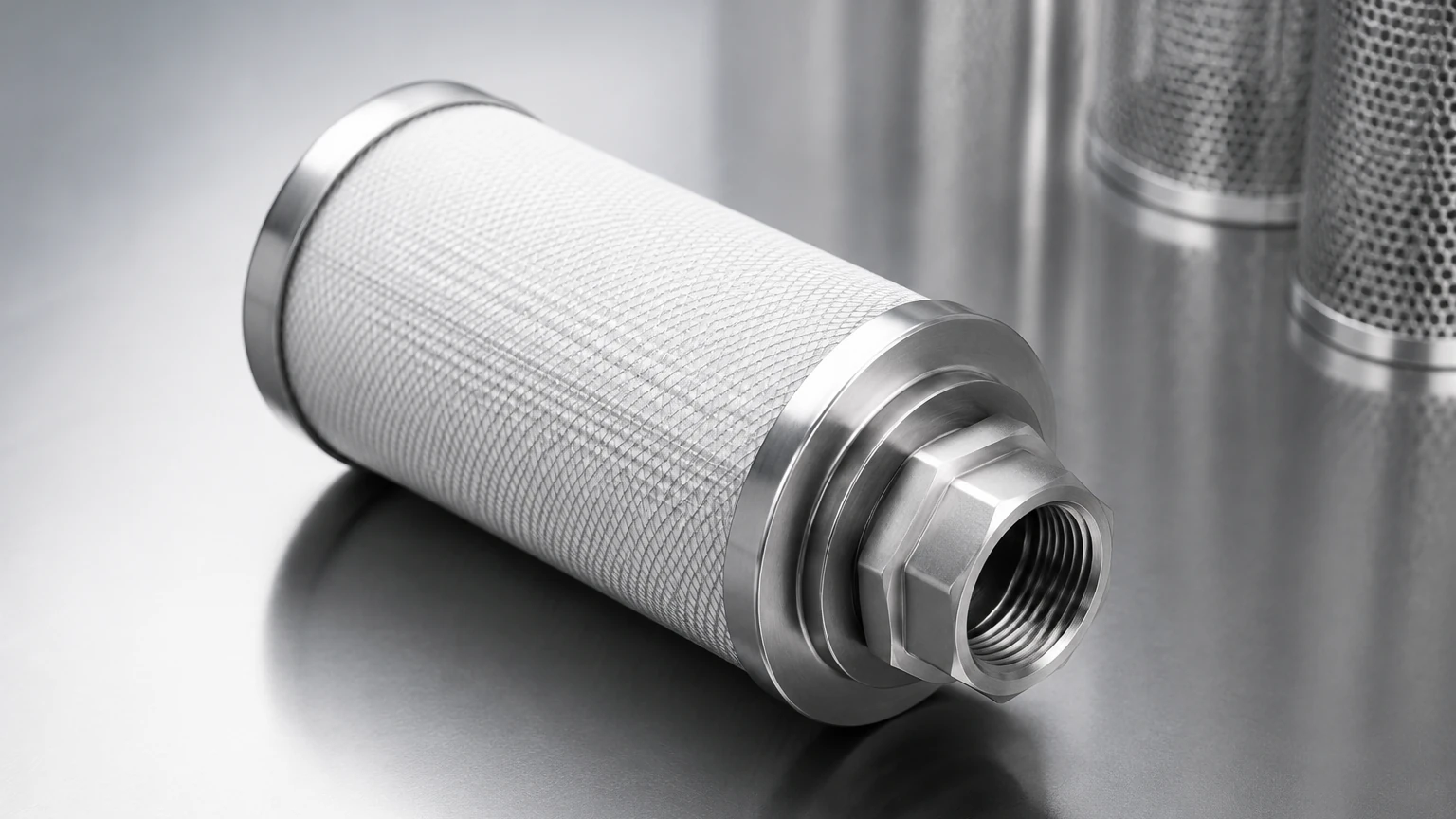
In demanding industrial sectors, stainless steel filtration components offer significant advantages. Stainless steel wire mesh and sintered metal structures provide the mechanical strength necessary to withstand high differential pressures without collapsing. Furthermore, stainless steel is naturally resistant to corrosion, which is a common issue in compressed air lines where moisture is prevalent.
At Kaifil, the focus is on providing durable, custom-engineered stainless steel filtration solutions that meet precise micron ratings. For engineers, choosing a stainless steel support structure for a coalescing element ensures that the filter maintains its geometric integrity over thousands of operational hours, preventing bypass and ensuring consistent air quality.
Evaluating Performance Metrics: Efficiency and Pressure Drop
When reviewing technical specifications for a *filtro coalescente para aire comprimido*, two metrics are paramount: filtration efficiency and differential pressure (Delta P).
Filtration Efficiency and Oil Carryover
Efficiency is typically expressed as a percentage of particles captured or as the maximum amount of oil carryover permitted downstream. High-grade coalescing filters can achieve oil carryover levels as low as 0.01 mg/m³. In sensitive applications, multiple stages of filtration are often used, beginning with a general-purpose coalescer and followed by a high-efficiency oil removal filter.
The Cost of Pressure Drop
Every filter introduces a restriction to the airflow, resulting in a pressure drop. From an engineering standpoint, pressure drop is a direct energy cost. A higher Delta P requires the compressor to work harder to maintain the required system pressure. It is estimated that for every 2 PSI (0.14 bar) of pressure drop, the compressor energy consumption increases by approximately 1%.
Therefore, selecting a filter with a low initial saturated pressure drop is critical for total cost of ownership (TCO). Quality filters are designed with a high void volume to allow for maximum airflow while maintaining high capture rates.
Industrial Applications and Compatibility Considerations
The choice of a *filtro coalescente para aire comprimido* must be aligned with the specific requirements of the application. Different industries have different tolerance levels for oil and water contamination.
* Chemical and Petrochemical: In these environments, filters must often handle corrosive gases or high-temperature air. Stainless steel filter cartridges are frequently preferred here due to their chemical compatibility.
* Food and Beverage: Air used for packaging or direct product contact must be free of oil and microorganisms. Filters must comply with stringent hygiene standards and often require materials that can withstand sterilization processes.
* Pharmaceuticals: Precision is non-negotiable. Coalescing filters are used in conjunction with sterile filters to ensure the air used in cleanrooms and production lines meets ISO 8573-1 Class 1 or Class 0 standards.
* Hydraulic Systems: Compressed air is often used to pressurize hydraulic reservoirs. Contamination in this air can lead to oil degradation and component wear, making effective coalescing filtration a preventative maintenance necessity.
Maintenance Strategies for Optimized Filtration
A coalescing filter is not a "set and forget" component. Its performance degrades as it becomes saturated with liquids and trapped solid particulates. Effective maintenance is the only way to ensure the continued protection of downstream equipment.
Monitoring Differential Pressure
The most effective way to determine when a filter element needs replacement is by monitoring the differential pressure. Most industrial filter housings are equipped with a Delta P gauge. A common industry standard is to replace the element when the pressure drop reaches 5-7 PSI (0.35-0.5 bar), or at least once a year, whichever comes first.
Managing Liquid Drainage
The liquids captured by the coalescing process must be removed from the filter housing. If the drain fails, the liquid level will rise until it reaches the filter element, at which point it will be "re-entrained" into the airstream, defeating the purpose of the filter. Automatic drains (either float-type or electronic timed) are recommended for industrial applications to ensure reliable liquid removal without manual intervention.
Custom Engineering and OEM Filtration Solutions
Not every compressed air system fits a standard mold. Unique flow rates, unconventional housing dimensions, or extreme operating conditions often require customized filtration components. This is where manufacturing expertise becomes a competitive advantage.
Working with a specialized manufacturer allows engineers to specify the exact material grade, filtration accuracy, and mechanical dimensions required for their system. Custom stainless steel filter cartridges can be designed to retrofit existing housings while providing improved durability or higher temperature resistance than the original equipment manufacturer (OEM) parts.
For organizations looking to optimize their filtration performance or develop proprietary filtration systems, reviewing professional product options is the first step. You can Review product options and application support to understand how customized metal filtration components can be integrated into your specific industrial workflow.
Conclusion: Making Informed Purchasing Decisions
Selecting the right *filtro coalescente para aire comprimido* involves more than just matching a pipe size. It requires a deep dive into the air quality requirements of the application, the environmental conditions of the facility, and the long-term energy implications of pressure drop.
By focusing on high-quality materials like stainless steel for structural support and ensuring the filter media is matched to the specific aerosol challenges of the system, engineers can significantly reduce downtime and maintenance costs. Whether you are designing a new compressed air network or upgrading an existing one, prioritizing technical performance over initial purchase price is the key to achieving reliable, high-purity industrial air.
