


Melt Filtration
Melt filtration is a critical process in the production of high-quality polymers, resins, and specialized chemical products. In industrial extrusion and fiber spinning, the presence of even microscopic contaminants can lead to catastrophic failure in the final product, such as fiber breakage, film defects, or surface imperfections in molded parts. For engineers and technical procurement teams, understanding the nuances of melt filtration is essential for optimizing production efficiency and ensuring the longevity of downstream equipment.
At its core, melt filtration involves the removal of solid particles, gels, and degraded materials from a molten polymer stream. Because these melts often exhibit high viscosity and are processed under extreme temperatures and pressures, the filtration media must possess exceptional mechanical strength and thermal stability. This guide examines the technical considerations, material selections, and performance criteria necessary for implementing an effective filtration strategy.
Understanding the Mechanics of Melt Filtration
Unlike low-viscosity liquid filtration, melt filtration deals with non-Newtonian fluids that behave differently under varying shear rates and temperatures. When a molten polymer passes through a filter medium, it encounters resistance, resulting in a pressure drop (Delta P). This pressure drop is governed by the fluid's viscosity, the flow rate, and the permeability of the filter medium.
In a continuous production environment, the pressure drop across the filter will naturally increase as contaminants accumulate on the surface or within the depth of the media. If the filtration system is not designed to handle these loads, the increased pressure can lead to filter deformation, media migration, or even the forcing of deformable contaminants (such as gels) through the pores. Engineering a system requires balancing the need for high filtration fineness with the requirement for a manageable pressure profile that does not compromise the polymer's molecular structure or the extruder's throughput.
Material Science: Selecting Media for High-Temperature Environments
The choice of filter media is perhaps the most significant factor in the success of a melt filtration application. Given the harsh operating conditions—often exceeding 300°C and pressures reaching 350 bar—stainless steel is the industry standard. Specifically, 316L stainless steel is preferred for its excellent corrosion resistance and ability to maintain structural integrity under thermal stress.
There are three primary types of stainless steel media used in melt filtration:
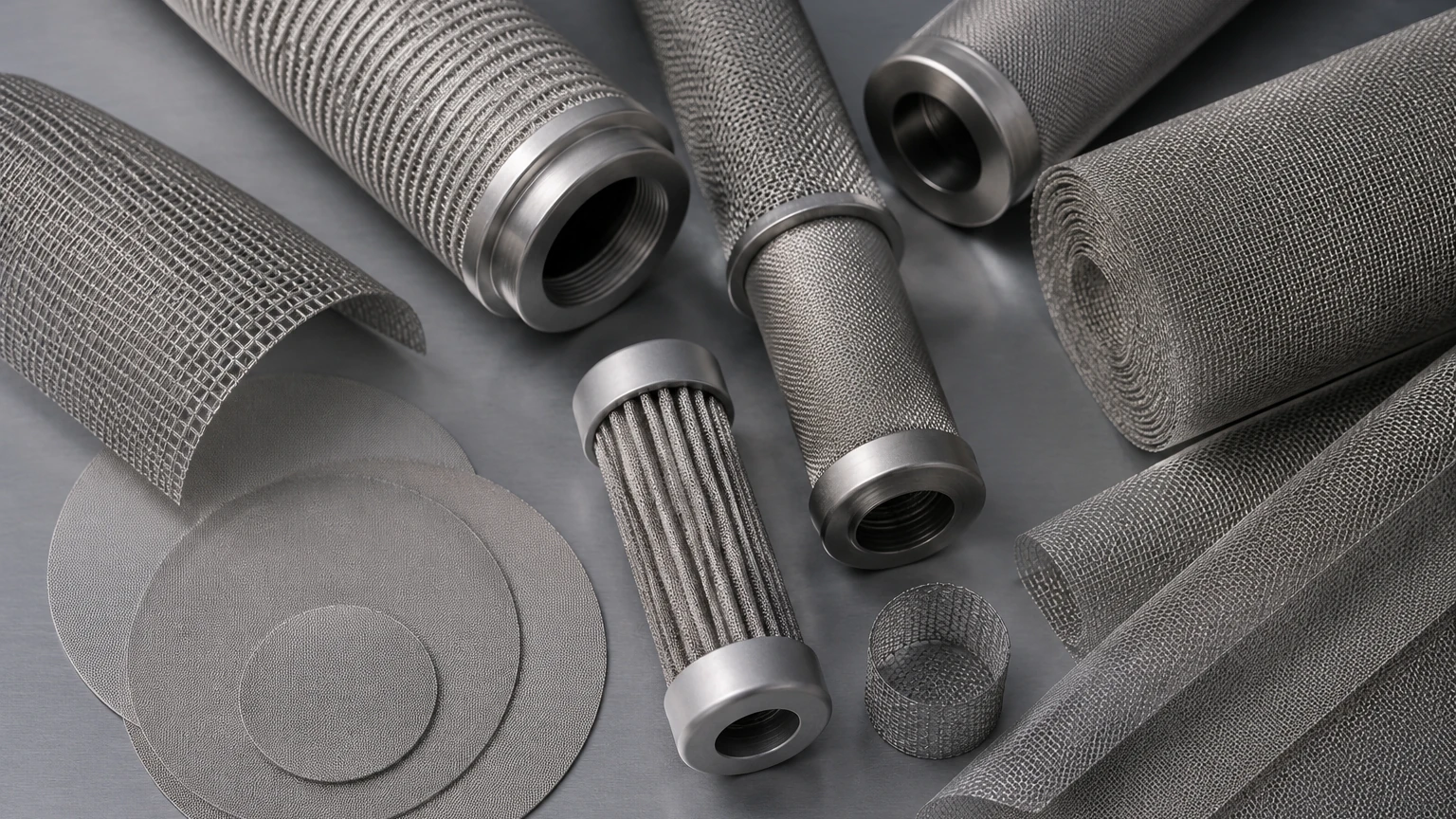
1. Sintered Metal Fiber Felt: This is a non-woven medium produced by sintering fine stainless steel fibers into a random, three-dimensional structure. It offers high porosity (up to 80%) and high dirt-holding capacity. This depth-loading characteristic is ideal for removing gels and hard particles simultaneously without causing a rapid spike in pressure.
2. Sintered Wire Mesh: This medium consists of multiple layers of woven wire mesh that are bonded through a sintering process. It provides a precise, fixed pore size and excellent mechanical strength. It is often used as a surface filter where precise particle size exclusion is the primary goal.
3. Metal Powder Sintered Media: Created by sintering spherical or irregular metal powders, this media offers very high pressure resistance and is often used in specialized applications where extremely fine filtration is required in a compact space.
Selecting the right structure depends on the specific rheology of the melt and the nature of the contaminants. For instance, if the primary goal is to remove hard carbonized particles, a multi-layer mesh might be sufficient. However, if the melt contains soft gels, a depth-style fiber felt is usually required to trap the deformable particles within the fiber matrix.
Performance Metrics: Permeability, Precision, and Pressure
When evaluating filtration components, engineers must look beyond the simple micron rating. A "20-micron" filter from one manufacturer may perform very differently from another depending on whether the rating is "nominal" or "absolute."
* Absolute Rating: Refers to the diameter of the largest spherical particle that can pass through the filter under specified test conditions. In high-precision applications like biaxially oriented polypropylene (BOPP) film or fine denier fiber spinning, absolute ratings are mandatory to ensure product consistency.
* Nominal Rating: An arbitrary value based on the weight percentage of particles of a certain size that the filter can retain. While useful for general industrial applications, nominal ratings can be misleading in melt filtration where high pressures can deform particles and push them through.
Another critical metric is the Dirt Holding Capacity (DHC). A filter with high DHC will allow for longer production runs between filter changes, directly impacting the Total Cost of Ownership (TCO). By utilizing pleated designs, manufacturers can significantly increase the effective filtration area within the same housing volume, thereby lowering the initial pressure drop and extending the service life of the cartridge.
Addressing Contamination: Gels, Degradation, and Particulates
Contaminants in melt processing generally fall into three categories: external particulates, degraded polymer (black spots), and gels. Each presents a unique challenge to the filtration system.
* External Particulates: These include dust, metal shavings from equipment wear, or additives that have not properly dispersed. These are typically hard and are easily captured by surface filtration.
* Degraded Polymer: Often caused by excessive residence time or localized overheating, these "black spots" can ruin the aesthetic and structural quality of the end product. They require consistent filtration to prevent accumulation in dead zones within the filter housing.
* Gels: These are high-molecular-weight or cross-linked polymer regions that do not melt at the same temperature as the bulk material. Because they are deformable, they can "snake" through traditional mesh pores. Effective gel removal often requires a combination of depth filtration and controlled shear rates to ensure the gels are trapped within the media rather than being extruded through it.
To ensure your system is equipped to handle these specific challenges, you can review product options and application support on our Main Page.
Engineering Custom Solutions for Complex Systems
Standard off-the-shelf filters rarely meet the rigorous demands of specialized melt filtration lines. Customization is often necessary to match the filter geometry to the existing housing and to optimize the media layers for the specific polymer being processed.
Key customization factors include:
* Layer Configuration: Combining a coarse protective layer, a fine filtration layer, and a robust support layer to withstand high differential pressures.
* Pleat Density: Optimizing the number and depth of pleats to maximize surface area without causing "pleat crowding," which can restrict flow and create stagnant zones.
* End Fitting Design: Ensuring a leak-proof seal through precision-machined flanges or threaded connections, often using specialized gaskets compatible with high-temperature melts.
Working with a manufacturer that understands the interplay between metallurgy and polymer rheology allows for the development of filter cartridges that not only clean the melt but also minimize the residence time, reducing the risk of thermal degradation.
Operational Longevity and Maintenance Strategies
In B2B industrial environments, the cost of the filter itself is often secondary to the cost of production downtime. Therefore, the cleanability and reusable nature of stainless steel melt filters are significant advantages. Unlike disposable polymer or paper filters, stainless steel components can be cleaned and returned to service multiple times.
Common cleaning methods include:
1. Pyrolysis: Heating the filter in a vacuum or inert atmosphere to decompose the polymer into carbon and gases, which are then removed.
2. Chemical Cleaning: Using specialized solvents or alkaline baths to dissolve specific polymer types.
3. Ultrasonic Cleaning: Using high-frequency sound waves in a liquid bath to dislodge inorganic particulates from deep within the sintered structure.
However, it is vital to monitor the "bubble point" and pressure drop after each cleaning cycle. Over time, repeated cleaning and high-pressure cycles can lead to media fatigue or pore enlargement. A professional filtration partner can provide guidance on the maximum number of cleaning cycles a specific filter design can withstand before its structural integrity or filtration efficiency is compromised.
Technical Selection Checklist for Engineers
Before finalizing a melt filtration specification, engineering teams should confirm the following data points with their supplier:
* Operating Temperature and Pressure: What are the normal operating conditions and the maximum design limits?
* Polymer Viscosity: What is the Melt Flow Index (MFI) or dynamic viscosity at the processing temperature?
* Target Contaminant Profile: Are you primarily removing hard particles, soft gels, or both?
* Flow Rate: What is the required throughput, and what is the maximum allowable pressure drop at the start of the cycle?
* Housing Constraints: Does the filter need to fit into an existing candle filter housing or a disc-style screen changer?
By addressing these factors during the design phase, companies can avoid the common pitfalls of premature filter blinding and product quality fluctuations. For specialized assistance in developing a filtration component that meets these exact requirements, visit the Main Page to connect with technical experts.
Conclusion
Melt filtration is a sophisticated discipline that sits at the intersection of mechanical engineering and material science. By selecting high-quality stainless steel media, optimizing the filter structure for specific rheological conditions, and implementing a rigorous maintenance schedule, manufacturers can ensure high-purity output and long-term operational stability. As industrial requirements for polymer purity continue to tighten, the role of precision-engineered filtration solutions becomes increasingly central to manufacturing success.
