


Air Cyclone Filter
In industrial gas-solid separation, the air cyclone filter serves as a critical primary stage for removing particulate matter from air or gas streams. Unlike barrier-type filters that rely on a physical medium to intercept particles, a cyclone operates on the principle of inertial separation. For engineers and procurement specialists in sectors such as chemical processing, food and beverage, and pharmaceutical manufacturing, understanding the mechanics, limitations, and integration requirements of these systems is essential for optimizing filtration efficiency and protecting downstream equipment.
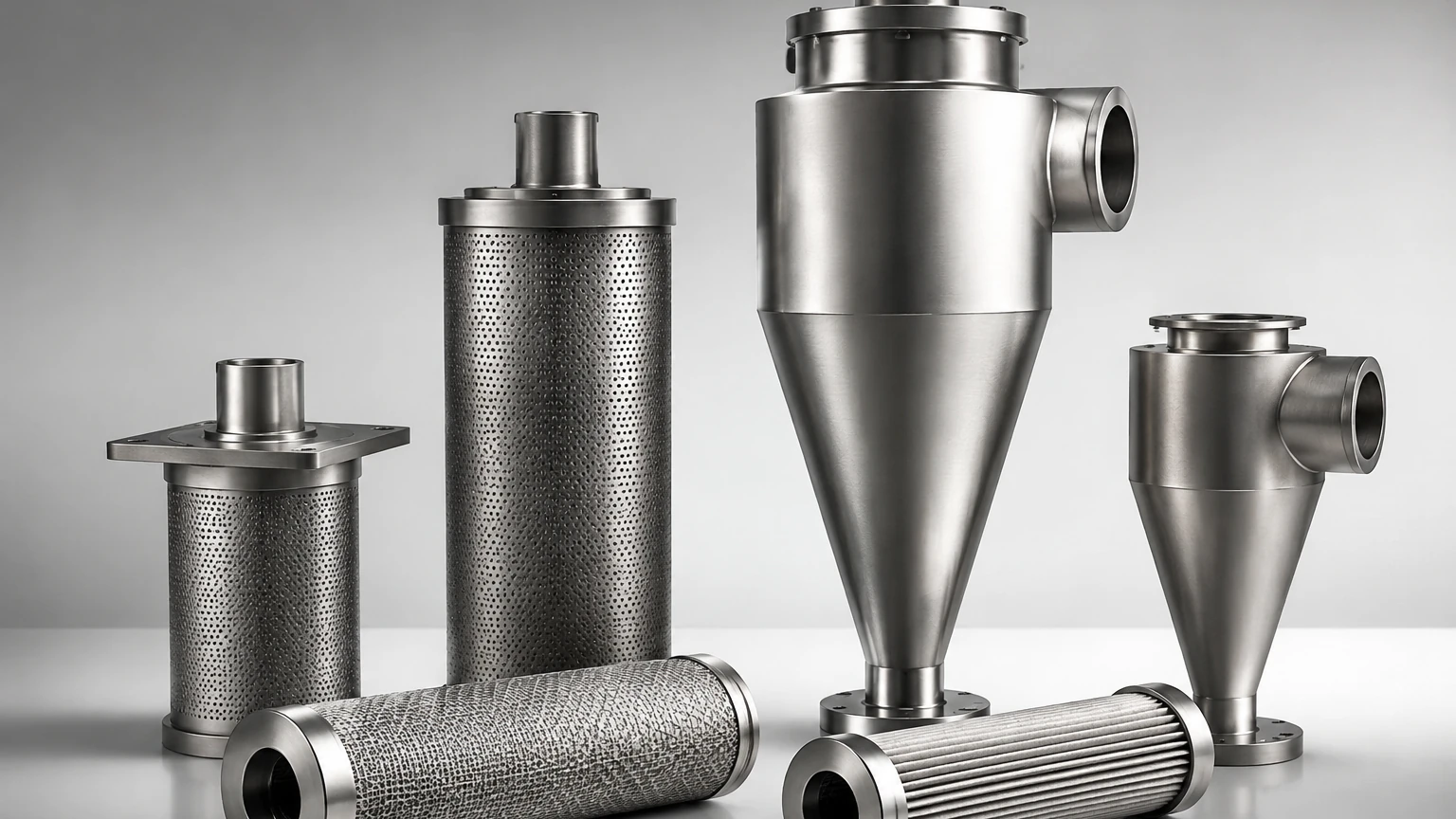
While an air cyclone filter is highly effective at removing bulk solids and large particulates, industrial processes often require a higher level of purity than a cyclone can provide alone. This is where precision-engineered secondary filtration, such as the stainless steel wire mesh and cartridge solutions provided by Kaifil, becomes indispensable. By combining the high-capacity pre-separation of a cyclone with the absolute filtration accuracy of stainless steel media, facilities can achieve a balance between operational longevity and stringent air quality standards.
The Mechanics of Cyclonic Separation
The fundamental operation of an air cyclone filter is based on centrifugal force. The process begins when a particle-laden gas stream enters the cylindrical body of the cyclone at a high velocity, typically through a tangential inlet. This entry method forces the gas into a downward spiral, creating a powerful vortex.
As the gas rotates, the centrifugal force acts on the suspended particles. Because the particles have greater mass and density than the surrounding gas, they are flung toward the outer walls of the cyclone. Once they strike the wall, they lose kinetic energy and slide down the conical section of the unit into a collection hopper or dust bin. Meanwhile, the gas stream, now stripped of its heavier particulate load, reverses direction near the bottom of the cone and forms an inner vortex that travels upward through the center of the unit, exiting through a vortex finder at the top.
For engineers, the efficiency of this process is governed by the "cut point" (d50), which represents the particle size at which the cyclone is 50% efficient. Particles larger than the cut point are likely to be captured, while smaller particles often remain entrained in the exiting gas stream. This inherent limitation is why an air cyclone filter is frequently paired with high-precision stainless steel filter cartridges to capture the remaining fine dust.
Key Engineering Parameters for Selection
When specifying an air cyclone filter for an industrial application, several technical factors must be evaluated to ensure the system meets performance expectations without incurring excessive energy costs.
1. Particle Size Distribution (PSD)
Cyclones are most effective for particles larger than 10 microns. If the process generates a significant volume of sub-micron particles, the cyclone will serve primarily as a pre-filter to reduce the load on secondary filters. Engineers must analyze the PSD of the dust to determine if a single-stage cyclone is sufficient or if a multi-stage filtration system is required.
2. Pressure Drop ($Δ$P)
The pressure drop across a cyclone is a direct indicator of the energy required to move air through the system. A higher inlet velocity generally increases separation efficiency but also leads to a higher pressure drop. Balancing these two factors is critical for minimizing the total cost of ownership. Excessive pressure drop can lead to increased fan power consumption and potential system instability.
3. Gas Properties
The temperature, moisture content, and chemical composition of the gas stream significantly impact material selection. In high-temperature or corrosive environments, standard carbon steel cyclones may fail prematurely. In such cases, stainless steel construction is preferred for its thermal stability and resistance to oxidation.
4. Throughput and Loading
The volume of air (CFM) and the concentration of solids (grains per cubic foot) dictate the physical size of the cyclone. Overloading a cyclone can lead to "re-entrainment," where captured particles are swept back into the clean air stream, drastically reducing efficiency.
Integrating Secondary Stainless Steel Filtration
As noted, an air cyclone filter is rarely the final stage in high-purity industrial processes. In applications such as pharmaceutical powder recovery or food-grade pneumatic conveying, the air exiting the cyclone must undergo further refinement. This is where Kaifil’s expertise in Main Page solutions provides a technical advantage.
Integrating a stainless steel wire mesh filter or a pleated stainless steel cartridge after the cyclone offers several benefits:
* Absolute Filtration: While the cyclone handles the bulk of the material, the stainless steel filter provides a definitive barrier against fine particulates, often achieving filtration ratings down to 1-5 microns.
* System Protection: Fine dust that escapes a cyclone can be abrasive to downstream blowers, compressors, and sensors. A secondary metal filter acts as a safeguard.
* Durability and Reusability: Unlike polymer-based filters, stainless steel components can withstand high pressures and temperatures. They are also cleanable via backwashing or ultrasonic cleaning, which reduces the frequency of replacement and lowers long-term waste.
Material Selection: 304 vs. 316L Stainless Steel
For the internal components of an air cyclone filter or the media of the secondary filter, the choice of material is a primary engineering consideration.
* Grade 304 Stainless Steel: This is the standard choice for general industrial applications. It offers excellent strength and good corrosion resistance for most dry dust collection scenarios.
* Grade 316L Stainless Steel: For applications involving salt-laden air, high humidity, or acidic chemical vapors, 316L is necessary. The addition of molybdenum provides enhanced resistance to pitting and crevice corrosion, making it the preferred choice for chemical processing and marine environments.
Kaifil specializes in customizing these materials to meet specific filtration accuracies, ensuring that the filter media can handle the specific flow dynamics and particle characteristics of the application.
Common Risks and Performance Optimization
Even a well-designed air cyclone filter can encounter operational issues if not properly maintained or if the process conditions change. Engineers should be aware of the following risks:
Erosion
In applications involving abrasive dust (such as silica or metal shavings), the high-velocity impact of particles against the cyclone walls can cause thinning of the material. Specifying thickened wear plates or utilizing high-grade stainless steel can mitigate this risk.
Air Leakage at the Discharge
The hopper at the bottom of the cyclone must maintain a pressure seal. If air leaks into the bottom of the cone, it can disrupt the vortex and carry captured dust back up through the center of the unit. Utilizing a high-quality rotary valve or airlock is essential for maintaining separation efficiency.
Clogging and Bridging
If the dust is hygroscopic (moisture-absorbing), it may clump together and bridge the discharge opening. In these instances, heating the cyclone walls or using vibratory discharge aids may be necessary. Furthermore, the secondary stainless steel filter must be monitored for pressure increases that indicate fine dust bypass from the cyclone.
Total Cost of Ownership (TCO) Considerations
When evaluating the purchase of an air cyclone filter and its associated secondary components, the initial capital expenditure (CAPEX) is only one part of the equation. Engineers must consider the following to determine the TCO:
1. Energy Consumption: A more efficient cyclone design may have a higher initial cost but lower pressure drop, saving thousands in electricity over its lifespan.
2. Maintenance Labor: Systems that utilize cleanable stainless steel cartridges from manufacturers like Kaifil reduce the labor costs associated with frequent filter change-outs.
3. Product Recovery: In industries like pharmaceuticals, the material captured by the cyclone and secondary filter is often valuable product. Increasing capture efficiency by even 1% can result in significant annual savings.
4. Uptime: High-quality metal filtration components are less prone to catastrophic failure compared to fabric bags or plastic cartridges, ensuring continuous production cycles.
Customization and OEM Solutions
Every industrial environment presents unique challenges, from space constraints to specific chemical compatibilities. Off-the-shelf filtration units often fall short of meeting precise engineering requirements. Kaifil provides extensive OEM and customization capabilities for filtration components, allowing engineers to specify exact dimensions, filtration ratings, and connection types.
Whether you are designing a new pneumatic conveying system or retrofitting an existing dust collection setup, selecting the right combination of an air cyclone filter and precision metal media is vital. By focusing on the technical fundamentals of airflow, particle dynamics, and material science, facilities can ensure reliable, high-performance filtration that protects both the environment and the bottom line.
For more information on customized stainless steel filtration components and engineering support for industrial applications, visit the Main Page to review product options and application support.
