


How Does Vacuum Filter Work
In industrial liquid-solid separation, the efficiency of a process often hinges on the ability to remove liquids from a slurry quickly and effectively. Vacuum filtration is a cornerstone technology in this field, utilized across chemical processing, pharmaceuticals, food and beverage production, and wastewater treatment. For engineers and procurement specialists, understanding the mechanics, engineering constraints, and component selection for these systems is vital for optimizing throughput and ensuring product purity. This guide provides a technical deep dive into the operational principles and design considerations of industrial vacuum filtration systems.
The Fundamental Principle: Pressure Differential
To understand how does vacuum filter work, one must first look at the physics of pressure. Unlike gravity filtration, which relies solely on the weight of the liquid to pass through a medium, or pressure filtration, which pushes liquid through using a pump or compressed gas, vacuum filtration utilizes a pressure differential created by a vacuum source on the downstream side of the filter media.
In a typical setup, the slurry (a mixture of solids and liquids) is placed on a filter medium, such as a stainless steel wire mesh or a synthetic cloth. A vacuum pump or an ejector system evacuates the air from the collection chamber (the filtrate side) beneath the medium. This creates a low-pressure zone. Because the atmospheric pressure acting on the surface of the slurry is significantly higher than the pressure inside the collection chamber, the liquid is "pushed" through the filter medium by the atmosphere.
This pressure differential, typically measured in inches of mercury (inHg) or bars, provides the driving force for the separation. The liquid that passes through is called the filtrate, while the solids retained on the surface of the medium form what is known as the filter cake.
Key Components of an Industrial Vacuum Filter System
The reliability of a vacuum filter depends on the synergy between several mechanical and structural components. As a manufacturer of precision metal filter components, Kaifil emphasizes the importance of material integrity in these high-stress environments.
1. The Filter Media
This is the most critical component. In industrial applications, stainless steel wire mesh is often preferred due to its mechanical strength and resistance to corrosion. The mesh must be engineered with a specific micron rating to capture the target particles while allowing maximum liquid flow. For more information on custom mesh configurations, you can visit the Kaifil Main Page.
2. The Support Structure
Because vacuum pressure can be intense, the filter media requires a rigid support structure to prevent sagging or mechanical failure. This often consists of a perforated plate or a heavy-duty drainage grid made from stainless steel (SS304 or SS316L). The support must provide high open-area ratios to minimize resistance to flow.
3. The Vacuum Receiver and Pump
The vacuum pump creates the necessary suction, while the receiver acts as a separation tank where the filtrate is collected and the air is exhausted. The sizing of the vacuum pump is determined by the air permeability of the filter cake and the required filtration rate.
4. Discharge Mechanism
Depending on whether the system is batch or continuous, the discharge mechanism might involve a scraper blade (doctor blade), a belt-driven discharge, or a simple manual removal process for batch Nutsche filters.
The Operational Cycle: From Slurry to Dry Cake
The process of how does vacuum filter work can be broken down into four distinct phases. In continuous systems like rotary drum vacuum filters, these phases happen simultaneously at different points on the drum.
Phase 1: Cake Formation
The cycle begins when the filter medium is submerged in or covered by the slurry. As the vacuum is applied, the liquid is drawn through the mesh, and the initial layer of solids begins to accumulate. This initial layer often acts as a secondary filter, increasing the filtration efficiency but also increasing the resistance to flow.
Phase 2: Cake Washing
In many chemical and pharmaceutical applications, the captured solids must be purified. A wash liquid is sprayed over the filter cake while the vacuum is still active. The vacuum pulls the wash liquid through the cake, displacing the mother liquor and removing soluble impurities.
Phase 3: Dewatering and Drying
After washing, the vacuum continues to pull air through the cake. This process, known as dewatering, removes the residual moisture held in the interstitial spaces between the solid particles. The duration of this phase determines the final moisture content of the cake, which is a critical metric for downstream processing like thermal drying.
Phase 4: Cake Discharge
Once the cake has reached the desired dryness, it is removed from the filter medium. In continuous belt filters, the belt moves over a small-diameter roller, causing the cake to crack and fall off. In rotary systems, a pulse of compressed air (blowback) may be used to dislodge the cake from the stainless steel mesh before the next cycle begins.
Engineering Considerations for Filter Media Selection
When engineers evaluate how does vacuum filter work for their specific application, the selection of the filter medium is the primary variable. Several technical factors must be balanced:
* Filtration Accuracy (Micron Rating): The pore size must be small enough to retain the solids but large enough to prevent immediate blinding. For fine chemical processing, multi-layered sintered wire mesh is often used to provide both fine filtration and high mechanical stability.
* Chemical Compatibility: Industrial slurries can be highly acidic or alkaline. Stainless steel 316L is the industry standard for general corrosion resistance, but specialty alloys like Hastelloy may be required for extreme environments.
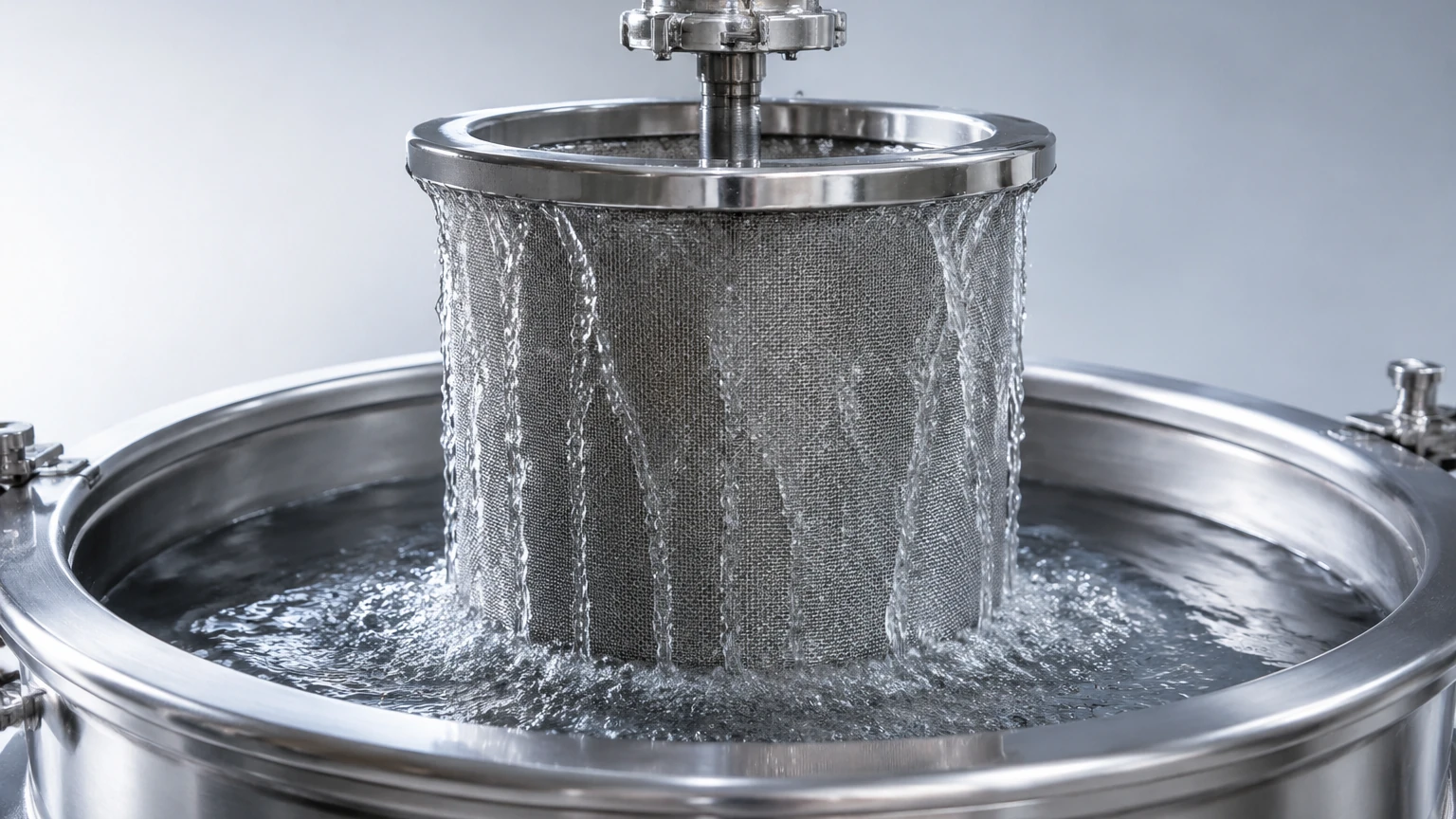
* Mechanical Strength: The medium must withstand the pressure differential without deforming. In vacuum filtration, the "pull" can cause thin cloths to stretch, which is why rigid stainless steel cartridges or reinforced mesh panels are often preferred for industrial-scale operations.
* Flow Rate (Permeability): A higher permeability reduces the energy required by the vacuum pump and increases the overall throughput of the plant.
Types of Vacuum Filtration Equipment
There are several configurations of vacuum filters, each suited to different industrial needs:
* Rotary Drum Vacuum Filters (RDVF): Best for high-volume, continuous processing of slurries with high solids concentrations. The drum rotates through a trough of slurry, and the cake is formed on the exterior surface.
* Vacuum Belt Filters: These are ideal for applications requiring intensive cake washing. The slurry is fed onto a horizontal moving belt, allowing for multiple wash stages in a single pass.
* Nutsche Vacuum Filters: Often used in the pharmaceutical industry for batch processing. These are enclosed vessels that allow for filtration, washing, and drying within a single unit, maintaining a sterile environment.
* Disc Vacuum Filters: These provide a large filtration area in a compact footprint, commonly used in mining and mineral processing.
Maintenance and Troubleshooting for Industrial Filters
To ensure the longevity of a vacuum filtration system, regular maintenance of the filter media is essential. One of the most common issues is "blinding," where fine particles become lodged within the pores of the mesh, drastically reducing the flow rate.
Cleaning Protocols
For stainless steel filters, Clean-in-Place (CIP) systems are often employed. These use high-pressure water jets or chemical cleaning agents to backflush the mesh. Because stainless steel can withstand high temperatures and aggressive chemicals, it is much easier to sanitize than synthetic fabrics.
Monitoring Pressure Drop
Engineers should monitor the pressure drop across the filter medium. A sudden increase in pressure drop usually indicates blinding, while a sudden decrease could indicate a tear or breach in the filter media. Regular inspection of the support grids is also necessary to ensure that no mechanical fatigue is occurring under the cyclic vacuum loads.
Conclusion: Optimizing Your Filtration Process
Understanding how does vacuum filter work is the first step toward optimizing industrial separation. By leveraging the pressure differential between the atmosphere and a vacuum, these systems provide a reliable and scalable solution for dewatering slurries. However, the success of the operation depends heavily on the quality and design of the filter components.
Selecting the right material, micron rating, and structural support can mean the difference between a high-efficiency process and one plagued by frequent downtime. For organizations looking to implement or upgrade their filtration systems, working with a manufacturer that understands the nuances of custom stainless steel fabrication is essential. For technical support and a wide range of industrial filtration solutions, visit the Kaifil Main Page to explore options tailored to your specific engineering requirements.
