


Inline Natural Gas Filter
In industrial gas processing and distribution, the integrity of downstream equipment depends heavily on the purity of the fuel or process gas. An inline natural gas filter serves as a critical line of defense, designed to remove solid particulates, pipe scale, and sometimes liquid aerosols from the gas stream before they reach sensitive components such as turbines, compressors, pressure regulators, and burners. For engineers and procurement teams, selecting the correct filtration solution requires a deep understanding of flow dynamics, material compatibility, and the specific contaminants present in the pipeline.
As a specialized manufacturer, Kaifil provides high-performance stainless steel filtration components tailored for these demanding environments. Understanding the technical nuances of an inline natural gas filter ensures that industrial systems operate at peak efficiency with minimal downtime caused by contamination-related failures.
The Role of Inline Filtration in Natural Gas Systems
Natural gas, while often considered a "clean" fuel, carries various contaminants from the point of extraction through the distribution network. These contaminants typically include iron sulfides, iron oxides (pipeline scale), sand, and various forms of compressor oil or water vapor. If left unfiltered, these particles can cause abrasive wear on valve seats, clog fuel injector nozzles, and erode turbine blades.
An inline natural gas filter is integrated directly into the piping system, allowing for a continuous flow while capturing debris. Unlike larger separator vessels, inline filters are often more compact and designed for specific points of use where high-precision filtration is required. The primary goal is to maintain a low pressure drop while maximizing the dirt-holding capacity of the filter element.
In many industrial settings, these filters are used as "polishing" stages. For instance, before gas enters a high-pressure turbine, it may pass through a series of filters to ensure that no particles larger than 1 to 5 microns remain in the stream. This level of precision is essential for maintaining the manufacturer’s warranty on expensive rotating equipment and for ensuring the safety of the overall operation.
Technical Specifications and Performance Metrics
When evaluating an inline natural gas filter, engineers must look beyond simple dimensions. Several key performance metrics define the effectiveness of the filtration unit:
Micron Rating: Absolute vs. Nominal
In natural gas applications, the distinction between absolute and nominal micron ratings is vital. A nominal rating refers to the filter's ability to capture a certain percentage of particles of a given size. An absolute rating, however, indicates that the filter will capture 99.9% or more of particles at that size. For critical components like gas regulators, an absolute-rated stainless steel mesh filter is often preferred to prevent any possibility of bypass.
Differential Pressure (Delta P)
The pressure drop across the filter element is a primary concern. A high initial pressure drop reduces the overall efficiency of the gas system and may necessitate higher upstream pressures. Engineers must calculate the maximum allowable differential pressure before the filter element requires cleaning or replacement. High-quality stainless steel elements are designed to withstand significant pressure differentials without collapsing, which is a common risk with synthetic or paper-based media.
Flow Rate and Velocity
The velocity of the gas through the filter media affects both the efficiency of particle capture and the lifespan of the element. If the velocity is too high, particles may be forced through the media (media migration) or cause premature erosion of the filter structure. Inline filters must be sized correctly to ensure that the gas velocity remains within the laminar flow regime as much as possible, optimizing the interception and diffusion mechanisms of the filter media.
Material Engineering: Why Stainless Steel is Standard
For industrial natural gas applications, stainless steel is the material of choice for both the filter housing and the internal filter elements. Kaifil specializes in utilizing advanced alloys to meet the rigors of chemical and thermal stress. On our Main Page, we detail the various grades of stainless steel used in our precision filtration components.
Corrosion Resistance
Natural gas often contains trace amounts of hydrogen sulfide (H2S) and carbon dioxide (CO2), which, in the presence of moisture, can become highly corrosive. This is known as "sour gas." Using 304 or 316L stainless steel provides the necessary resistance to sulfide stress cracking and general corrosion, ensuring the filter does not become a point of structural failure.
Temperature Stability
Industrial gas processes can involve extreme temperatures, either from the compression process or environmental conditions in cryogenic or high-heat applications. Stainless steel maintains its mechanical integrity across a wide temperature spectrum, where plastic or composite filters would brittle or melt. This makes stainless steel inline filters ideal for heavy-duty industrial burners and heat treatment facilities.
Cleanability and Durability
Unlike disposable fiberglass or cellulose cartridges, stainless steel wire mesh and sintered metal filters are often cleanable. This is a significant advantage in terms of total cost of ownership. Using ultrasonic cleaning or backwashing techniques, the filter can be restored to near-original performance levels, reducing the frequency of replacement and the environmental impact of waste disposal.
Design Considerations for High-Pressure Environments
Inline natural gas filters are frequently installed in high-pressure lines, sometimes exceeding 1,000 PSI. This environment places unique demands on the filter’s physical design. The structural integrity of the filter element is paramount; it must resist pleat deformation and bypass.
Pleated vs. Cylindrical Elements
To increase the filtration surface area without increasing the overall footprint of the inline filter, manufacturers often use pleated designs. Pleating allows for a much larger area of wire mesh to be packed into a small volume, which significantly lowers the flux rate (flow per unit area) and extends the time between maintenance cycles. For applications with very high particulate loads, a robust cylindrical sintered element may be used for its superior mechanical strength.
End Cap and Seal Integrity
The method by which the filter element is sealed into the housing is a common failure point. Engineers should look for welded constructions rather than those relying on adhesives, which can degrade when exposed to the hydrocarbons and additives found in natural gas. Metal-to-metal seals or high-performance O-rings (such as Viton or Kalrez) are typically specified to ensure no gas bypasses the filtration media.
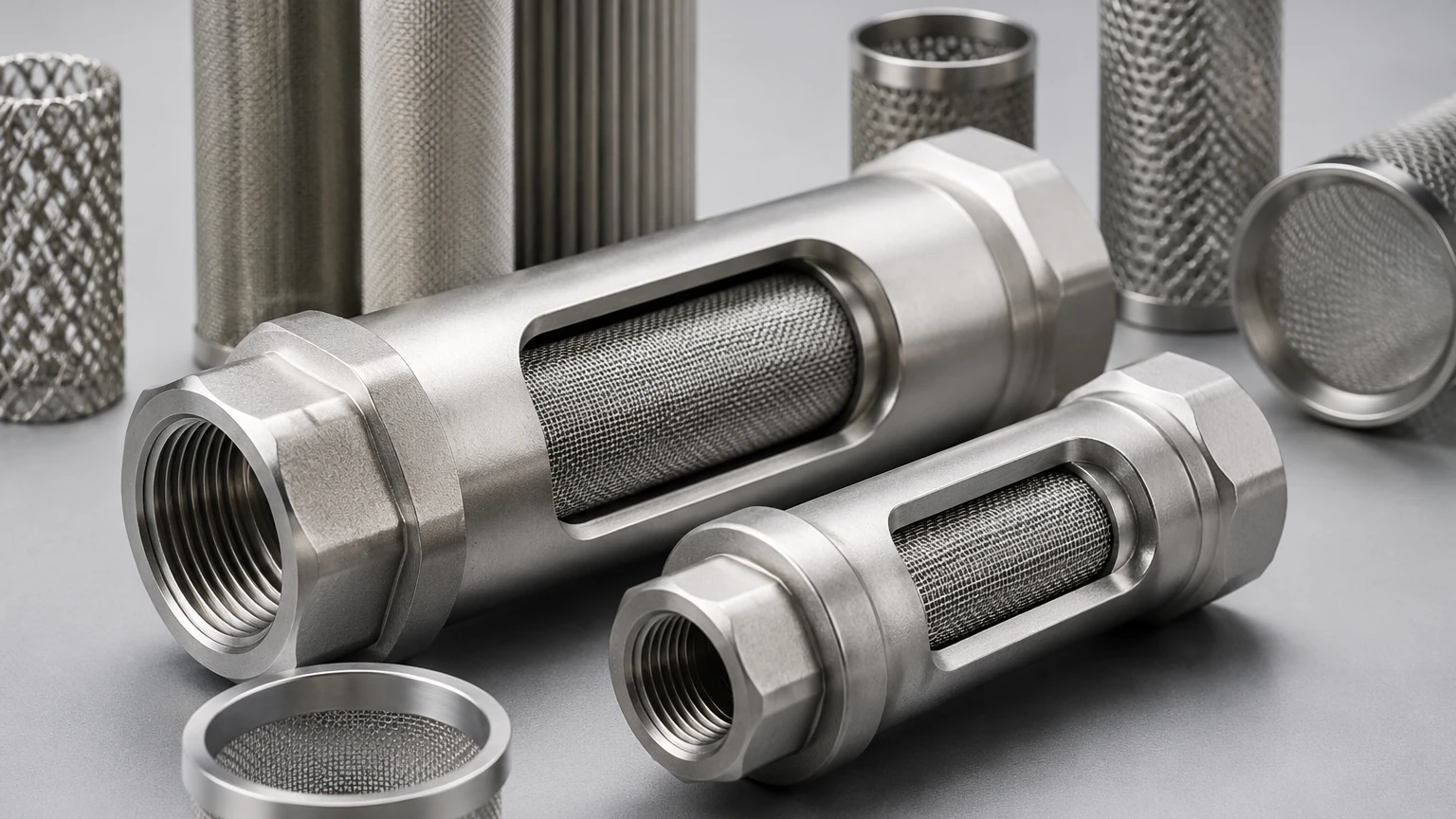
Customization and OEM Integration for Industrial Equipment
Every industrial facility has unique piping layouts and filtration requirements. Standard off-the-shelf filters often fail to meet the specific spatial or technical constraints of a custom-built gas skid or a specialized manufacturing process. This is where OEM customization becomes essential.
Customization options for an inline natural gas filter include:
* Connection Types: Whether the system requires NPT threaded ends, flanged connections (ANSI, DIN), or specialized quick-connect fittings, the filter housing must be engineered to match existing infrastructure.
* Filtration Levels: Depending on the sensitivity of the downstream equipment, the mesh weave can be customized to provide specific filtration from coarse 100-micron protection to ultra-fine 0.5-micron precision.
* Housing Materials: While 316L is standard, some applications may require exotic alloys like Monel or Hastelloy for extreme chemical resistance.
Kaifil works closely with engineering teams to develop bespoke filtration solutions that integrate seamlessly into their equipment designs. By focusing on the specific particulate profile and flow conditions of the application, we help optimize the performance of the entire gas system.
Operational Maintenance and Lifecycle Management
To ensure the long-term reliability of an inline natural gas filter, a proactive maintenance schedule is required. The most effective way to monitor filter health is through the installation of differential pressure gauges or transmitters across the filter housing.
Monitoring Pressure Drop
A gradual increase in differential pressure indicates that the filter is successfully capturing contaminants. However, once the pressure drop reaches a predetermined "terminal" level, the element must be cleaned or replaced. Ignoring this can lead to a "burst" or collapse of the filter media, sending a concentrated slug of contaminants downstream—the very scenario the filter was installed to prevent.
Replacement Cycles
The frequency of maintenance depends on the gas quality. In new pipeline installations, filters may clog quickly due to residual construction debris and mill scale. Over time, the frequency usually stabilizes. For critical applications, redundant filter housings (duplex systems) allow for the cleaning of one filter while the other remains in operation, ensuring zero downtime for the facility.
Total Cost of Ownership (TCO)
When selecting a filter, the initial purchase price is only one factor. Engineers must consider the TCO, which includes the cost of replacement elements, the labor required for maintenance, and the potential cost of downstream equipment damage if the filter fails. Investing in a high-quality, cleanable stainless steel inline natural gas filter often results in lower long-term costs compared to cheaper, disposable alternatives.
Conclusion: Selecting the Right Filtration Partner
Choosing an inline natural gas filter is a technical decision that impacts the safety, efficiency, and longevity of industrial gas systems. By focusing on material quality, precise engineering specifications, and the ability to customize solutions for specific applications, engineers can mitigate the risks associated with gas contamination.
Kaifil’s expertise in stainless steel filtration provides the foundation for reliable gas processing. From material selection to final production, our focus remains on delivering components that meet the rigorous standards of the chemical, power generation, and industrial manufacturing sectors. For more information on our technical capabilities and product range, please visit our Main Page to explore how we can support your specific filtration requirements.
