


Pneumatic Exhaust Muffler
In industrial automation and fluid power systems, the management of compressed air discharge is a critical factor for both operational efficiency and workplace safety. A pneumatic exhaust muffler, often referred to as a pneumatic silencer, is a component designed to reduce the noise levels generated by the rapid release of pressurized air from exhaust ports of valves, cylinders, and manifolds. Beyond noise attenuation, these components serve as essential filtration barriers, preventing contaminants from entering the pneumatic system and protecting the surrounding environment from oil mist or particulate matter often found in compressed air lines.
For engineers and procurement teams, selecting the correct pneumatic exhaust muffler involves more than matching a thread size. It requires a technical understanding of flow dynamics, backpressure limitations, material compatibility, and the specific requirements of the industrial environment. As a specialist in stainless steel filtration solutions, Kaifil provides high-performance components that address these engineering challenges through advanced sintered metal technologies. For more information on custom filtration components, visit the Main Page.
The Engineering Role of Pneumatic Exhaust Mufflers
Pneumatic systems operate by converting the energy of compressed air into mechanical motion. When a pneumatic valve shifts, the air that was used to move an actuator must be vented to the atmosphere. Without a muffler, this air escapes at high velocity, creating a sharp, high-frequency sound that can exceed 100 dB(A). Prolonged exposure to such noise levels is a significant health hazard and often violates OSHA (Occupational Safety and Health Administration) or ISO standards for workplace noise.
A pneumatic exhaust muffler functions by diffusing the high-velocity air stream through a porous medium. This process breaks up the large air mass into smaller, lower-velocity streams, which significantly reduces the sound energy. Additionally, the muffler acts as a final stage filter. In many industrial setups, compressed air contains trace amounts of lubricating oils or fine metallic wear particles. The muffler captures these before they can be released into the cleanroom or factory floor.
Technical Evaluation: Noise Reduction vs. Backpressure
The most significant engineering trade-off in muffler selection is the balance between noise reduction and backpressure. Backpressure occurs when the exhaust air cannot escape the muffler as quickly as it enters, leading to a pressure buildup within the exhaust line.
Impact on Actuator Performance
If a pneumatic exhaust muffler creates excessive backpressure, it directly affects the performance of the pneumatic cylinder or actuator. High backpressure slows down the piston's return stroke, increasing cycle times and reducing the overall throughput of the machine. In precision applications, this can lead to timing inconsistencies and system errors.
Flow Coefficient (Cv)
Engineers should evaluate mufflers based on their Flow Coefficient (Cv). The Cv value indicates the flow capacity of the component; a higher Cv means lower resistance to airflow. When selecting a muffler, the Cv rating should ideally be equal to or greater than the Cv rating of the valve it is attached to. This ensures that the muffler does not become the bottleneck in the pneumatic circuit.
Material Selection and Durability
The choice of material for a pneumatic exhaust muffler determines its longevity and suitability for specific industrial environments. While plastic and sintered bronze are common, stainless steel remains the gold standard for demanding applications.
Sintered Stainless Steel
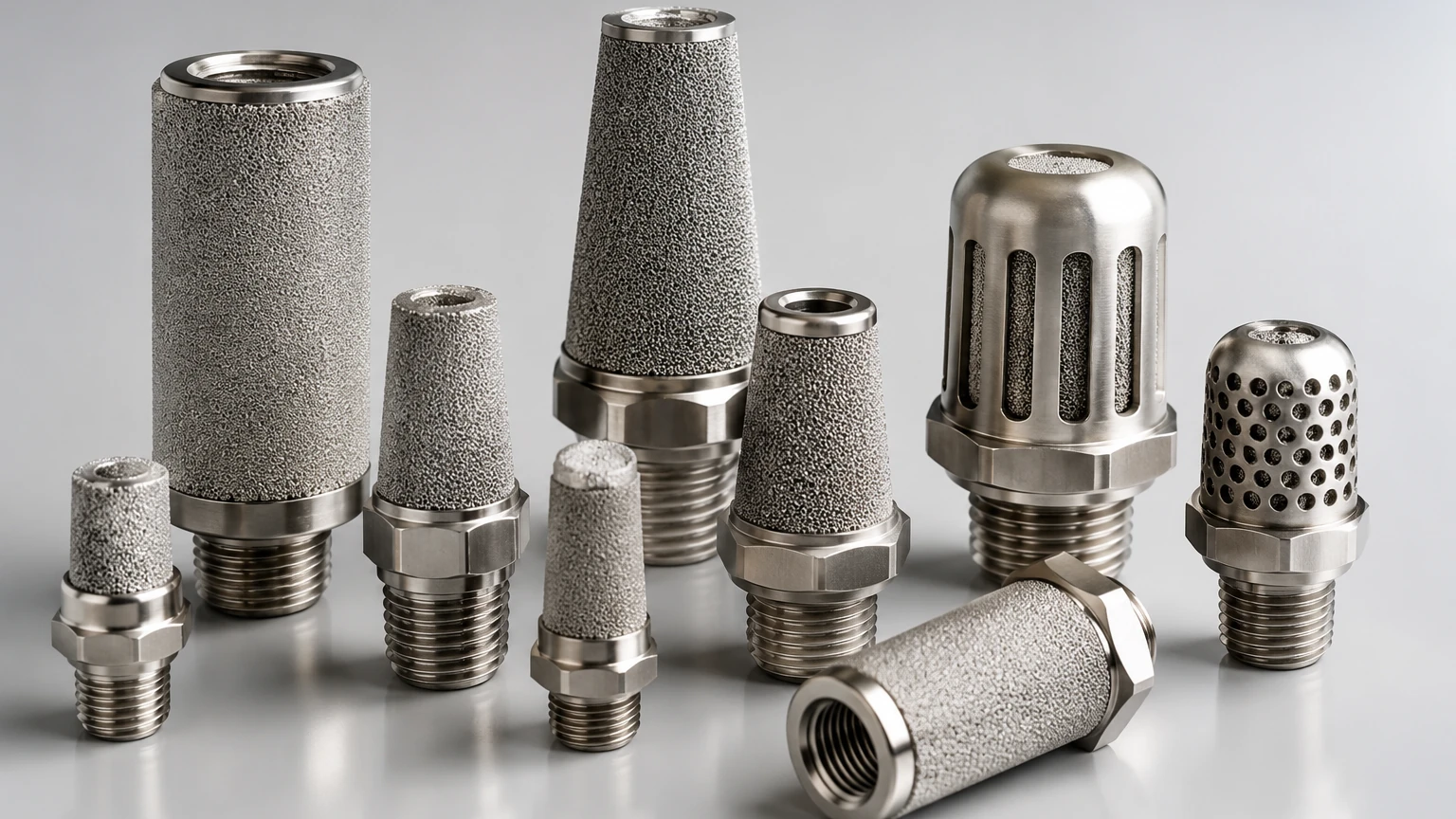
Sintered stainless steel mufflers, such as those manufactured by Kaifil, offer superior mechanical strength and corrosion resistance. Unlike plastic mufflers, which can become brittle and shatter under high-pressure spikes or extreme temperatures, stainless steel components maintain their structural integrity. They are particularly suited for:
* Chemical Processing: Resistance to corrosive vapors and aggressive cleaning agents.
* Food and Beverage: Ability to withstand high-pressure washdowns and meet stringent hygiene standards.
* Pharmaceuticals: Non-shedding properties and high-purity material standards.
* High-Temperature Environments: Maintaining performance in areas where plastic or brass would fail.
Sintered Bronze and Plastic
Sintered bronze is a cost-effective alternative for general-purpose indoor applications where moisture and chemicals are not a concern. However, bronze is susceptible to oxidation and "greening" in humid environments. Plastic mufflers are lightweight and inexpensive but are generally limited to low-pressure applications and are prone to physical damage in rugged industrial settings.
Customization and Integration in OEM Systems
For original equipment manufacturers (OEMs), standard off-the-shelf mufflers may not always meet the spatial or performance requirements of a specific machine design. Customization options for a pneumatic exhaust muffler typically include:
1. Thread Standards: While NPT (National Pipe Thread) is common in North America, BSPP (British Standard Pipe Parallel) and BSPT (British Standard Pipe Taper) are frequently required for international equipment. Custom mufflers can be machined to any required thread specification.
2. Compact Profiles: In manifold blocks where valves are mounted closely together, space is at a premium. Slim-profile or "flat" mufflers allow for high-density valve stacking without physical interference.
3. Integrated Filtration Ratings: Depending on the application, the porosity of the sintered medium can be adjusted. A finer micron rating provides better filtration of oil mist but may increase backpressure, whereas a coarser rating allows for higher flow rates.
4. Integrated Flow Control: Some mufflers incorporate an adjustable needle valve, allowing the operator to control the exhaust flow rate (and thus the speed of the actuator) directly at the exhaust port while still providing noise attenuation.
Maintenance and Replacement Cycles
A pneumatic exhaust muffler is a consumable component. Over time, the porous media will inevitably become clogged with oil, dust, and pipe scale. A clogged muffler increases backpressure, which can lead to sluggish machine performance or even total system failure.
Signs of a Clogged Muffler
* Increased Cycle Times: Actuators moving slower than their original calibrated speed.
* Increased Noise: If the muffler's internal structure is damaged by high pressure, noise levels may suddenly increase.
* Visual Contamination: Visible oil saturation or dark discoloration on the surface of the sintered media.
Cleaning vs. Replacement
While sintered stainless steel mufflers can often be cleaned using ultrasonic baths or chemical solvents, it is frequently more cost-effective in high-volume industrial environments to replace the unit entirely. This ensures that the filtration and noise attenuation properties are restored to factory specifications without the risk of residual contamination.
Total Cost of Ownership (TCO) Considerations
When purchasing pneumatic exhaust mufflers, procurement teams should look beyond the initial unit price. The Total Cost of Ownership (TCO) includes the cost of downtime, the frequency of replacement, and the impact on energy efficiency.
* Energy Efficiency: A high-quality muffler with low backpressure allows the pneumatic system to operate at lower pressures, reducing the load on the air compressor and lowering energy costs.
* Durability: Using a stainless steel muffler in a corrosive environment prevents frequent failures and the labor costs associated with repeated replacements.
* System Protection: By preventing contaminants from entering the valve through the exhaust port during the "inhale" portion of a cycle, a high-quality muffler extends the life of more expensive directional control valves.
Conclusion: Selecting the Right Solution
The selection of a pneumatic exhaust muffler is a vital step in optimizing any compressed air system. By focusing on technical parameters such as Cv ratings, material compatibility, and noise attenuation capabilities, engineers can ensure their systems remain compliant with safety regulations while maintaining peak operational efficiency.
Kaifil specializes in the engineering and manufacture of precision stainless steel filtration components, providing the durability and performance required for the world's most demanding industrial applications. Whether you require standard components or a custom-designed solution for a specific OEM project, understanding the nuances of sintered metal technology is key to a successful implementation. To explore our full range of industrial filtration and pneumatic solutions, please visit our Main Page.
