


Filtri Autopulenti Per Acqua
In industrial water management, maintaining a continuous flow while ensuring the removal of suspended solids is a critical operational requirement. Manual filtration systems, while effective for low-load applications, often lead to significant downtime and increased labor costs when dealing with high-volume or high-debris environments. This is where filtri autopulenti per acqua (self-cleaning water filters) become essential. These systems are engineered to provide automated, uninterrupted filtration, protecting downstream equipment such as heat exchangers, spray nozzles, and membranes from clogging and abrasion.
For engineers and procurement specialists, selecting the right self-cleaning system requires a deep understanding of filtration mechanics, material compatibility, and the specific demands of the industrial environment. As a specialist in stainless steel filtration solutions, Kaifil provides the technical expertise and manufacturing precision necessary to implement these systems effectively across various sectors.
The Engineering Principles of Self-Cleaning Filtration
The primary advantage of filtri autopulenti per acqua is their ability to clean the filter element without interrupting the main process flow. This is typically achieved through a pressure differential ($ΔP$) monitoring system. When the accumulated debris on the filter screen reaches a pre-set pressure limit, the cleaning cycle is triggered automatically.
There are several mechanical approaches to this self-cleaning process:
1. Backwashing (Reverse Flow)
In backwashing systems, a portion of the filtered fluid (or an external clean fluid source) is directed in the opposite direction through the filter element. This reverse flow dislodges particles trapped in the mesh or wedge wire slots and flushes them out through a dedicated discharge valve. This method is highly effective for removing non-fibrous particles and is common in large-scale water treatment.
2. Mechanical Scraper or Brush Systems
These systems use a physical mechanism—either a rotating brush or a stainless steel scraper—to move across the surface of the filter element. As the mechanism traverses the screen, it pushes the accumulated solids toward a collection area at the bottom of the housing. This is particularly useful for handling viscous fluids or sticky contaminants that might not be easily dislodged by backwashing alone.
3. Suction Scanning
A suction scanner uses a rotating assembly with nozzles that move close to the inner surface of the filter screen. When the flush valve opens, a high-velocity vacuum effect is created at the nozzle tips, localized to a small area of the screen. This allows for focused cleaning with minimal water waste, making it an efficient choice for high-precision filtration.
Material Selection and Structural Integrity
The performance of filtri autopulenti per acqua is fundamentally tied to the quality of the filter element. In industrial environments, stainless steel is the gold standard due to its mechanical strength and resistance to corrosion.
Stainless Steel Grades
* Grade 304: Suitable for general industrial water applications where moderate corrosion resistance is required.
* Grade 316L: The preferred choice for more aggressive environments, such as chemical processing or brackish water, due to its superior resistance to pitting and crevice corrosion.
* Duplex Steels: Utilized in high-salinity or high-temperature applications where standard austenitic steels might fail.
Filter Element Construction
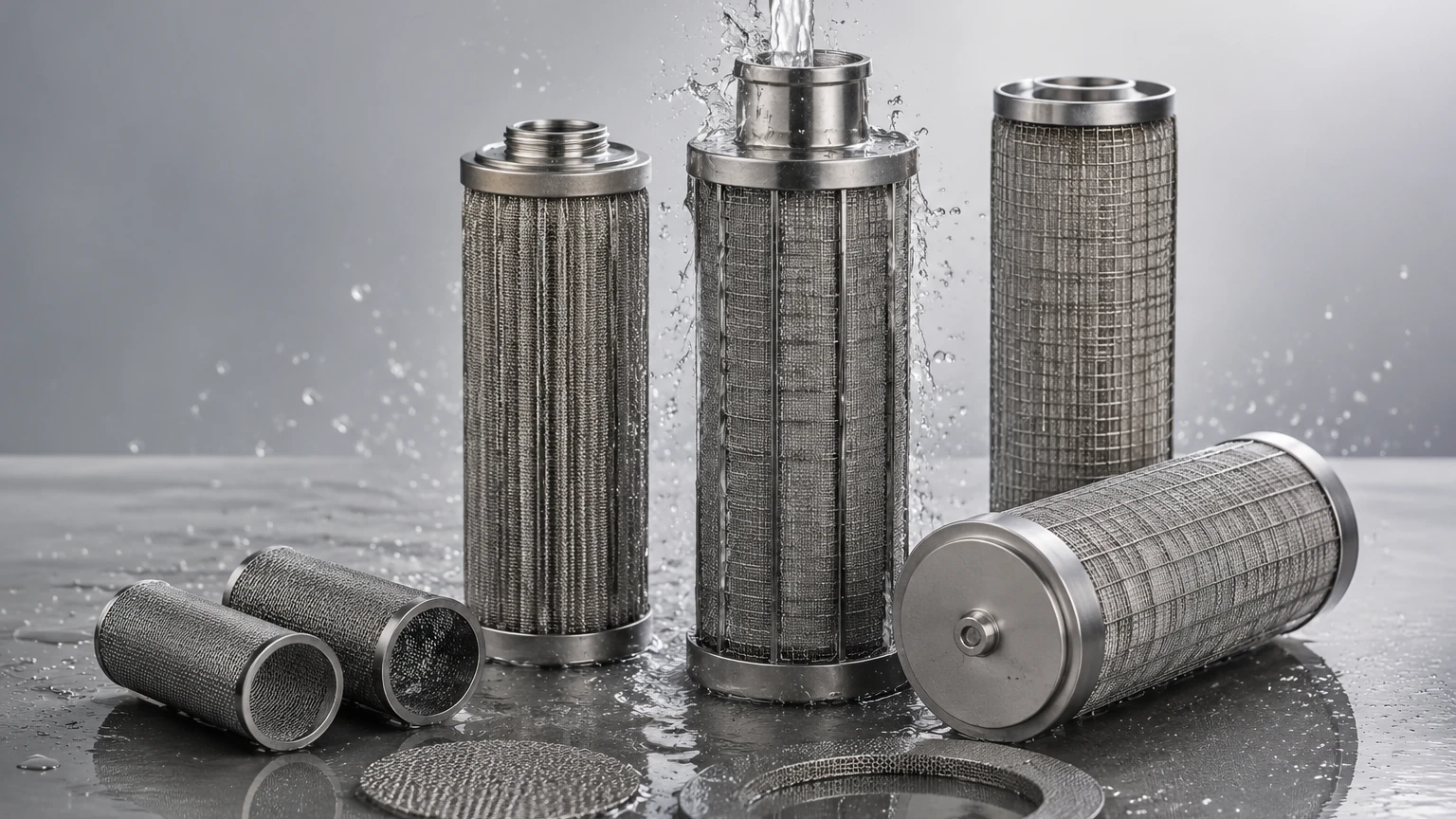
Kaifil specializes in two main types of filter elements used in self-cleaning systems:
* Wedge Wire Screens: These are constructed by welding V-shaped wires onto support rods. The resulting slots are non-clogging because the V-shape creates a widening gap that allows particles to pass through easily once they clear the initial opening. They offer exceptional structural rigidity and are ideal for high-pressure backwashing.
* Sintered Wire Mesh: For finer filtration requirements (down to 1-5 microns), multi-layer sintered mesh provides a stable pore structure and high permeability. This material is resistant to deformation and can withstand repeated cleaning cycles without losing its filtration accuracy.
Key Technical Considerations for Selection
When evaluating filtri autopulenti per acqua for a specific project, engineers must look beyond the initial flow rate. Several variables impact the long-term reliability and total cost of ownership.
Filtration Precision (Micron Rating)
Selecting the correct micron rating is a balance between protection and efficiency. A filter that is too fine will trigger cleaning cycles too frequently, leading to excessive wear and water loss. Conversely, a filter that is too coarse will fail to protect downstream components. It is essential to analyze the particle size distribution (PSD) of the source water before finalizing the specification.
Flow Rate and Pressure Drop
The system must be sized to handle the peak flow rate of the facility while maintaining a low initial pressure drop. A high initial $ΔP$ reduces the available headroom for debris accumulation, leading to short cycle times. Designers should aim for an initial pressure drop of less than 0.2 to 0.3 bar.
Minimum Operating Pressure
Most backwashing and suction-scanning filters require a minimum internal pressure (typically 2 to 3 bar) to drive the cleaning mechanism effectively. If the system pressure is too low, the cleaning cycle may be incomplete, leading to a permanent increase in pressure drop and eventual system failure. In low-pressure applications, a booster pump or a mechanically driven scraper system may be necessary.
Applications Across Industrial Sectors
Filtri autopulenti per acqua are versatile components found in diverse industrial landscapes. Their implementation is often driven by the need to protect sensitive equipment or meet environmental discharge standards.
Cooling Tower Water Filtration
Cooling towers act as large air scrubbers, collecting dust, pollen, and biological growth. If left unfiltered, these solids settle in heat exchangers, reducing thermal efficiency and promoting under-deposit corrosion. Self-cleaning filters maintain the clarity of the cooling loop without requiring manual basin cleaning.
Pre-filtration for Membrane Systems
Reverse Osmosis (RO) and Ultrafiltration (UF) membranes are highly sensitive to suspended solids. Using a self-cleaning filter as a pre-treatment stage significantly extends the life of the expensive membrane elements and reduces the frequency of Chemical-in-Place (CIP) cycles.
Food and Beverage Processing
In this sector, hygiene is paramount. Stainless steel self-cleaning filters allow for the removal of organic debris from process water while maintaining a closed system that prevents external contamination. The ability to integrate these filters into automated CIP processes is a major advantage.
Oil and Gas / Petrochemical
Water used for injection, cooling, or fire protection in the oil and gas industry often contains sand, scale, and hydrocarbons. Robust stainless steel filtri autopulenti per acqua are required to withstand the harsh chemical environments and high-pressure conditions typical of these sites.
Maintenance and Operational Longevity
While the "self-cleaning" label implies a hands-off approach, industrial filters still require periodic inspection to ensure optimal performance. A well-designed system should allow for easy access to internal components.
* Seal Inspection: O-rings and mechanical seals should be checked annually for wear, especially in systems handling abrasive particles.
* Controller Calibration: The differential pressure sensors should be calibrated regularly to ensure the cleaning cycle triggers at the correct threshold.
* Waste Stream Management: The volume of water discharged during the cleaning cycle (the "flush flow") should be monitored. An unexpected increase in flush volume may indicate that the flush valve is not seating correctly or that the filter element is damaged.
By focusing on high-quality materials and precise engineering, facilities can achieve a service life of 10-15 years or more for the main filter housing and internal components.
Why Customization Matters in Filtration
Off-the-shelf filtration solutions often fail to meet the unique constraints of specific industrial sites. Space limitations, unusual piping configurations, or specific chemical exposures require a customized approach. Working with a manufacturer like Kaifil allows for the development of OEM solutions where the filter housing, element type, and control logic are tailored to the application.
Whether it is adjusting the flange orientation to fit a tight mechanical room or selecting a specific wire mesh weave to handle fibrous contaminants, customization ensures that the filtration system integrates seamlessly into the broader process.
Conclusion
Implementing filtri autopulenti per acqua is a strategic investment in process stability and equipment protection. By automating the removal of suspended solids, industrial operators can reduce labor costs, minimize water waste, and prevent costly downtime. The success of these systems depends on the rigorous selection of materials, accurate sizing based on hydraulic parameters, and a clear understanding of the specific contaminants involved.
For technical professionals seeking reliable, high-performance filtration components, partnering with an experienced manufacturer is essential. To explore technical specifications, material options, and customized engineering support for your next filtration project, Review product options and application support on our Main Page.
