


Selecting Reliable Woven Wire Mesh Manufacturers for Industrial Filtration
In the landscape of industrial filtration, the performance of a system often hinges on the precision and durability of its core components. Woven wire mesh serves as a fundamental medium for separation, straining, and filtration across diverse sectors, including chemical processing, pharmaceuticals, and food production. For engineers and procurement specialists, identifying competent woven wire mesh manufacturers is not merely a matter of sourcing a commodity; it is a strategic decision that impacts the efficiency, safety, and longevity of industrial equipment.
Selecting the right manufacturer requires a deep understanding of technical specifications, material science, and the specific demands of the application environment. This guide examines the critical factors involved in evaluating manufacturers and the technical considerations necessary to ensure optimal filtration performance.
The Fundamentals of Woven Wire Mesh Engineering
At its core, Woven Wire Mesh is produced by weaving individual wires over and under each other on industrial looms. While the concept is simple, the execution requires extreme precision to maintain consistent aperture sizes and mechanical integrity. Manufacturers must manage several variables simultaneously: wire diameter, mesh count (the number of openings per linear inch), and the weave pattern.
For industrial applications, the accuracy of the aperture is paramount. A deviation of even a few microns can lead to bypass—where oversized particles pass through the filter—or premature blinding, where the filter clogs too quickly. Professional manufacturers utilize advanced tensioning systems and high-grade alloys to ensure that the mesh remains stable under the high pressures and temperatures typical of hydraulic and chemical processing environments.
Comparing Weave Patterns: Plain, Twill, and Dutch
The choice of weave pattern directly influences the flow rate, filtration accuracy, and mechanical strength of the mesh. When consulting with woven wire mesh manufacturers, it is essential to specify the weave type based on the required micron rating and the nature of the fluid being filtered.
Plain Weave
This is the most common pattern, where each warp wire (running lengthwise) passes over and under each shute wire (running crosswise). It provides a high percentage of open area and is ideal for general-purpose straining and high-flow applications. However, it is generally limited to coarser filtration tasks compared to more complex weaves.
Twill Weave
In a twill weave, each shute wire passes over and under two warp wires. This allows for the use of heavier wires for a given mesh count, increasing the strength and durability of the mesh. It is often used when a manufacturer needs to provide a finer mesh that can still withstand significant mechanical stress.
Dutch Weave (Plain and Twill)
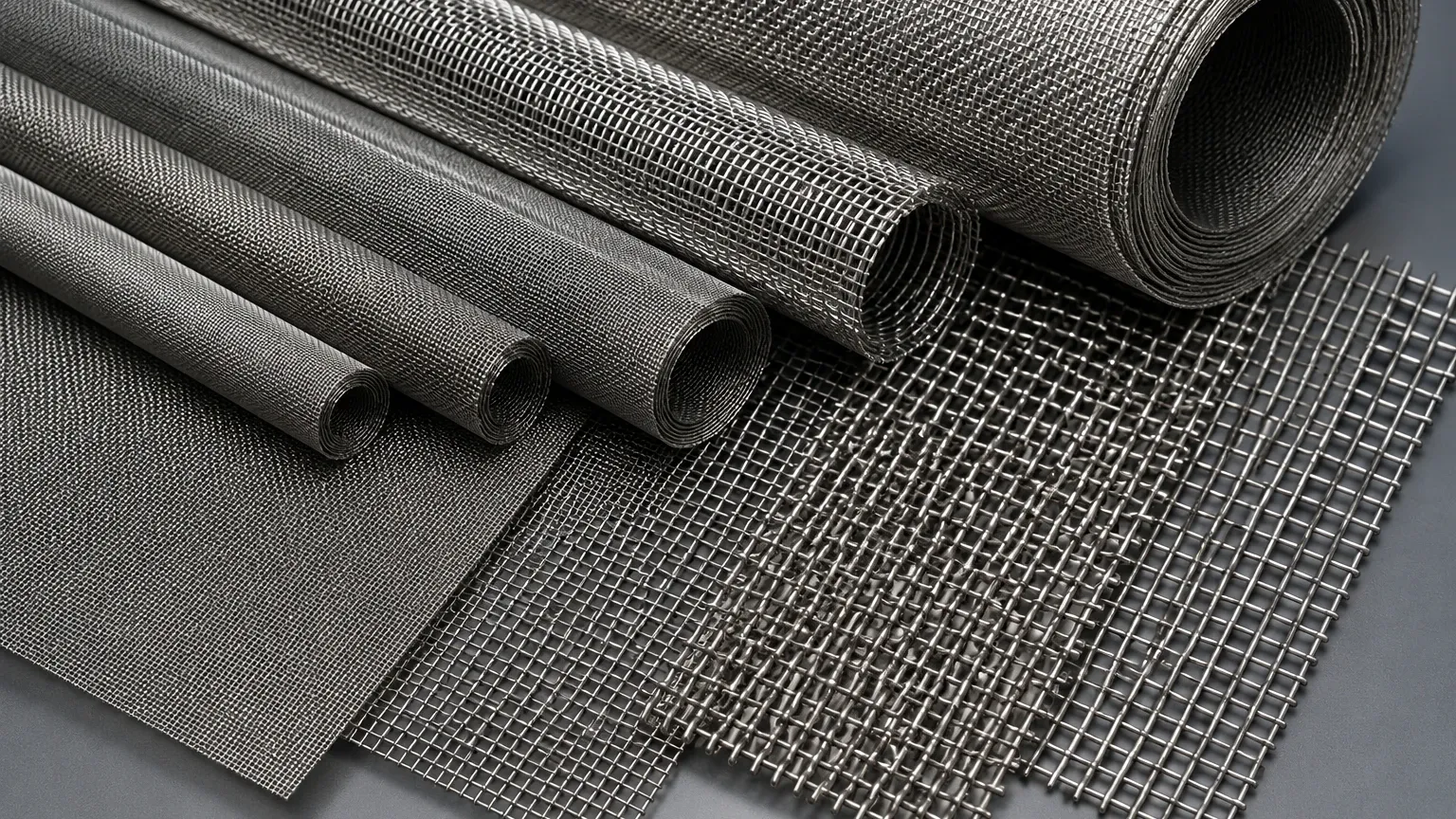
Dutch weaves utilize different wire diameters for the warp and shute. This creates a dense, multi-layered structure that provides superior filtration accuracy. Plain, twill and dutch woven wire mesh in SS304/316L — rolls, cut mesh and framed panels. Send mesh count or micron target for a technical quote. This technical variation is critical for high-pressure applications where fine particle retention (down to 5-10 microns) is required without sacrificing the structural integrity of the filter element.
Material Selection: Balancing Corrosion Resistance and Mechanical Strength
Industrial filtration environments are often harsh. Woven wire mesh must resist chemical attack, oxidation at high temperatures, and physical abrasion. Most reputable woven wire mesh manufacturers specialize in stainless steel alloys due to their versatility and performance characteristics.
1. Stainless Steel 304: The standard industrial grade, offering good corrosion resistance and excellent forming properties. It is suitable for most food and beverage applications and general industrial straining.
2. Stainless Steel 316L: Containing molybdenum and a lower carbon content, 316L provides superior resistance to chlorides and acids. It is the preferred choice for pharmaceutical manufacturing, marine environments, and aggressive chemical processing.
3. High-Nickel Alloys: For extreme environments involving high temperatures or highly corrosive media (such as concentrated sulfuric acid), manufacturers may offer Monel, Inconel, or Hastelloy. These materials require specialized weaving expertise due to their work-hardening properties.
Engineers must also consider the "cleanability" of the material. In the pharmaceutical and food industries, the surface finish of the wire must be smooth to prevent bacterial growth and allow for effective Clean-in-Place (CIP) procedures.
Critical Performance Metrics for Engineers
When evaluating a product from a manufacturer, engineers should look beyond the basic mesh count. Several key metrics define the actual performance of the filter in the field:
* Micron Rating (Nominal vs. Absolute): The nominal rating indicates the particle size that the mesh will stop with a certain efficiency (e.g., 90%), while the absolute rating indicates the size of the largest particle that can pass through the mesh under laboratory conditions. Manufacturers should provide clear data on how these ratings are verified.
* Effective Open Area: This is the ratio of the total area of the openings to the total area of the mesh. A higher open area reduces the pressure drop across the filter and increases the flow rate, but it may also reduce the mechanical strength of the mesh.
* Pressure Drop ($ΔP$): Understanding the initial pressure drop is vital for pump sizing and energy efficiency. High-quality woven mesh is designed to minimize turbulence and resistance to flow.
* Burst Strength: In hydraulic and high-pressure gas applications, the mesh must be able to withstand sudden pressure spikes without deforming or rupturing.
Customization and OEM Capabilities in Wire Mesh Production
A significant advantage of working with specialized woven wire mesh manufacturers like Kaifil is the ability to obtain customized filtration solutions. Standard rolls of mesh are often insufficient for specific industrial equipment designs. Manufacturers provide value-added services that include:
* Precision Cutting and Slitting: Mesh can be cut into specific shapes, discs, or long narrow ribbons for automated assembly lines.
* Sintering: Multiple layers of wire mesh can be sintered (diffusion-bonded) together to create a composite material that combines fine filtration with extreme mechanical strength.
* Framing and Edging: To prevent fraying and facilitate installation, mesh panels can be framed with solid metal borders or spot-welded into cylinders and cones.
* Pleating: For filter cartridges, the mesh is often pleated to increase the total surface area within a compact footprint, significantly extending the time between cleaning cycles.
Total Cost of Ownership and Maintenance Cycles
In a B2B procurement context, the initial purchase price of the woven wire mesh is only one component of the total cost of ownership (TCO). High-quality mesh from experienced manufacturers often results in lower long-term costs due to several factors:
Durability and Lifespan
Cheaply manufactured mesh often suffers from inconsistent wire tension or poor-quality alloys, leading to premature failure under stress. A premium mesh element that lasts twice as long as a budget alternative effectively halves the replacement cost and reduces labor expenses.
Reduced Downtime
Every time a filter needs to be replaced or cleaned, the production line may need to be halted. By selecting a mesh with an optimized open area and high dirt-holding capacity, manufacturers help plants extend their maintenance intervals.
Energy Efficiency
Filters with a high pressure drop force pumps and compressors to work harder, consuming more electricity. Precision-engineered mesh optimizes flow dynamics, contributing to lower operational energy costs over the life of the equipment.
Technical Validation and Quality Assurance
Before finalizing a partnership with a manufacturer, technical teams should confirm the quality control protocols in place. Essential validation steps include:
* PMI (Positive Material Identification): Using X-ray fluorescence (XRF) to verify the chemical composition of the alloy to ensure it meets the 304 or 316L specification.
* Bubble Point Testing: A non-destructive test used to determine the pore size and integrity of the filter medium.
* Mesh Count Verification: Using digital microscopy to ensure the number of wires per inch matches the technical drawing.
* Certifications: Compliance with ISO 9001 standards and, where applicable, FDA or EU regulations for food-contact materials.
Conclusion
The role of woven wire mesh manufacturers in the industrial supply chain is critical. Whether the application involves protecting sensitive hydraulic valves from contaminants or ensuring the purity of a pharmaceutical batch, the quality of the woven mesh is a non-negotiable factor. By focusing on technical specifications—such as weave patterns, material grades, and micron accuracy—and seeking out manufacturers with robust OEM capabilities, engineers can ensure their filtration systems operate at peak efficiency with minimal total cost of ownership.
When specifying requirements for a new project or seeking a replacement for an existing system, providing detailed data on the operating temperature, chemical environment, and desired flow rate will allow manufacturers to recommend the most effective Woven Wire Mesh solution for the task at hand.
