


Rotating Drum Screen
In the landscape of industrial liquid-solid separation, the rotating drum screen stands as a critical component for primary filtration and fine screening. This mechanical self-cleaning filter is engineered to remove suspended solids from various fluid streams, protecting downstream equipment and ensuring process efficiency. For engineers and procurement teams, understanding the technical nuances of drum screen design—from hydraulic capacity to material selection—is essential for optimizing operational uptime and reducing the total cost of ownership.
As a specialized manufacturer of stainless steel filtration solutions, Kaifil provides the precision components and engineering expertise required to integrate these systems into demanding industrial environments. Whether the application involves municipal wastewater, food processing, or chemical manufacturing, the selection of the correct filtration media and structural design determines the long-term success of the installation.
Operating Principles of Rotating Drum Screens
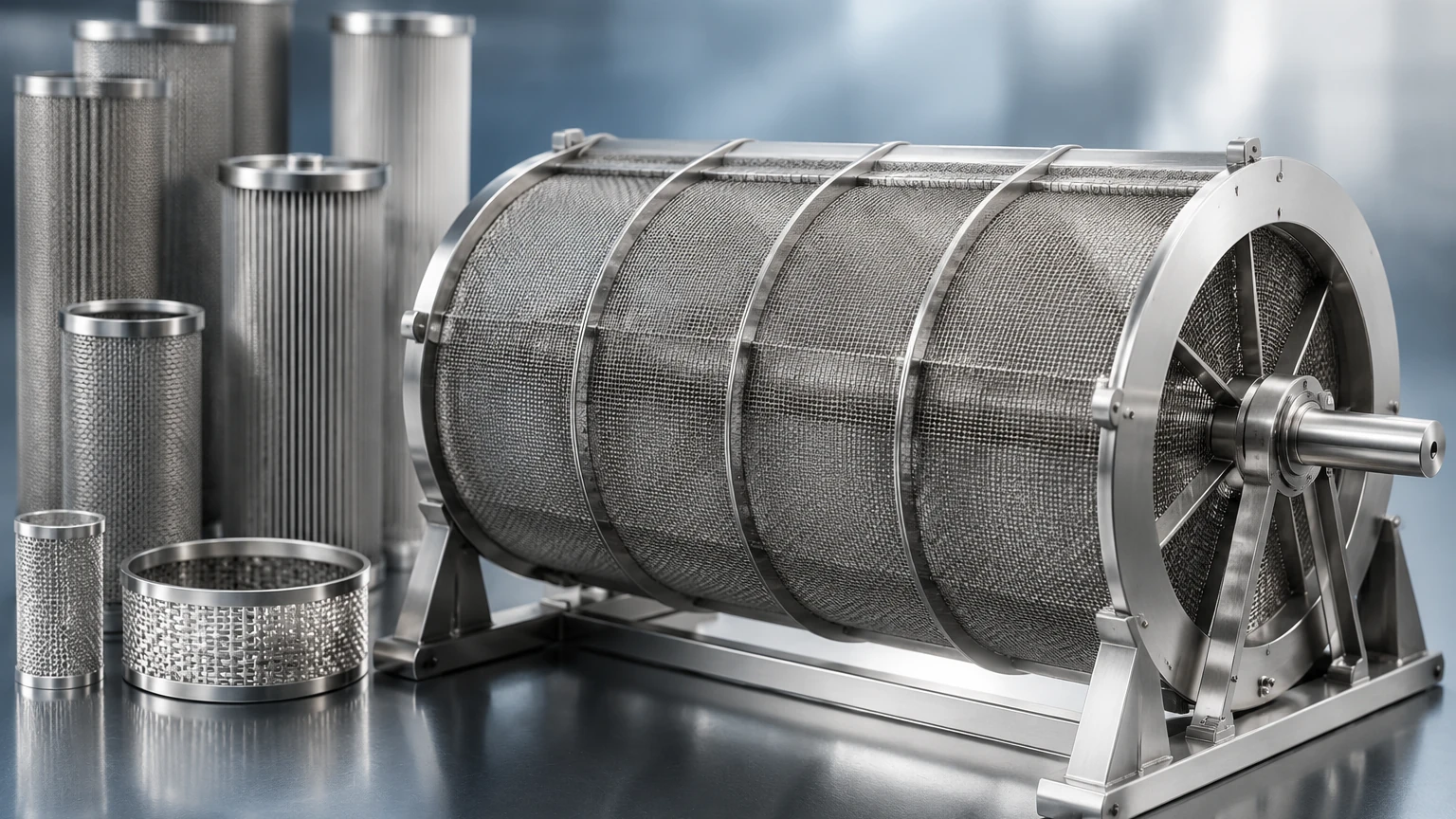
A rotating drum screen operates on a relatively simple yet highly effective mechanical principle. The system consists of a cylindrical drum covered with a filter medium—typically stainless steel wedge wire or woven wire mesh—that rotates on a horizontal or slightly inclined axis. As the influent enters the system, the liquid passes through the screen openings while the solids are captured on the surface.
There are two primary configurations for these systems: internally fed and externally fed drum screens.
Internally Fed Drum Screens
In an internally fed system, the fluid enters the center of the drum through a distribution header. As the drum rotates, the liquid gravitates through the screen, and the captured solids are transported by internal flights or the rotation itself toward the discharge end. This design is particularly effective for high-flow applications where large volumes of water must be processed with a relatively small footprint. The internal flights ensure that solids are continuously moved away from the filtration zone, preventing blinding.
Externally Fed Drum Screens
In externally fed designs, the influent is distributed over the outer surface of the rotating drum. The liquid penetrates the screen into the center of the drum and is discharged through the bottom, while the solids remain on the exterior surface. A scraper blade or doctor blade is typically used to remove the accumulated solids as the drum rotates. This configuration is often preferred for applications with high grease content or sticky solids, as the external surface is easier to access for mechanical cleaning.
Key Engineering Considerations for Selection
When selecting a rotating drum screen for an industrial process, engineers must evaluate several technical parameters to ensure the equipment meets the specific hydraulic and solids-loading requirements of the site. On the Main Page of the Kaifil technical resource center, professionals can find further details on how custom filtration components are engineered to meet these rigorous standards.
Hydraulic Capacity and Flow Rate
The hydraulic capacity of a drum screen is determined by the total open area of the screen media, the drum diameter, and the rotational speed. It is a common mistake to size a screen based solely on the inlet pipe diameter. Instead, engineers must calculate the "effective filtration area," which accounts for the portion of the drum submerged or covered by the influent at any given time. Factors such as head loss (the pressure drop across the screen) must be kept within acceptable limits to prevent overflowing or bypass.
Solids Loading and Particle Characterization
The nature of the solids being removed significantly impacts the choice of screen. For fibrous materials, a woven wire mesh might provide better capture rates, whereas for abrasive or heavy inorganic solids, stainless steel wedge wire is often the superior choice due to its structural rigidity and non-clogging characteristics. The "micron rating" or slot size must be balanced against the required flow rate; smaller openings provide higher filtration accuracy but increase the risk of rapid blinding if the cleaning system is not properly calibrated.
Material Selection and Construction Durability
In industrial filtration, the choice of material is not merely a matter of cost but of survival. The rotating drum screen is constantly exposed to moisture, varying pH levels, and mechanical stress. Kaifil specializes in the manufacture of high-grade stainless steel filter components that address these challenges.
Stainless Steel Grades: 304 vs. 316L
For most general-purpose industrial and municipal applications, Type 304 stainless steel offers excellent corrosion resistance and mechanical strength. However, in environments involving high chloride concentrations, such as seawater filtration or certain chemical processes, Type 316L is the industry standard. The addition of molybdenum in 316L provides superior resistance to pitting and crevice corrosion. For highly aggressive environments, specialized alloys or duplex stainless steels may be required to prevent premature structural failure.
Structural Integrity of the Drum
The drum itself must be engineered to withstand the torque of the drive system and the weight of the wet solids. Precision welding of the support rods and the filtration media is critical. In wedge wire drums, the V-shaped profile of the wire is resistance-welded to support rods at every intersection, creating a robust, one-piece cylindrical structure that maintains its circularity even under heavy loads. This structural stability is vital for maintaining the tight tolerances required between the drum and the seals or scraper blades.
Maintenance and Operational Efficiency
One of the primary advantages of a rotating drum screen is its ability to self-clean during operation. However, the efficiency of this self-cleaning mechanism is a major factor in the system's overall performance and maintenance requirements.
Cleaning Mechanisms: Spray Bars and Brushes
Most drum screens utilize a pressurized spray bar system to dislodge particles from the screen media. The nozzles must be positioned at a specific angle and distance to ensure maximum impact. In applications where solids are particularly persistent, such as in the pulp and paper industry or meat processing, rotating brushes may be added to provide mechanical agitation. Engineers should specify the use of recycled filtered water for the spray bars whenever possible to reduce fresh water consumption, provided the filtration level is sufficient to prevent nozzle clogging.
Wear Parts and Replacement Cycles
While the stainless steel drum is designed for longevity, certain components are considered wear items. These include the drive chain or belt, the trunnion wheels or bearings, and the seals. A well-designed rotating drum screen should allow for easy access to these components. High-quality seals are especially important in externally fed screens to prevent the bypass of unfiltered liquid into the clean water discharge. Regular inspection of the screen surface for signs of mechanical damage or localized corrosion is recommended to prevent a total system failure.
Applications in Industrial Process Water
The versatility of the rotating drum screen makes it an essential tool across a wide range of sectors. By integrating custom filtration media from Kaifil, these systems can be fine-tuned for specific industry needs.
* Food and Beverage: Used for washing water recovery, vegetable processing, and brewery effluent treatment. In these applications, hygiene is paramount, and the use of polished stainless steel surfaces helps prevent bacterial growth.
* Chemical Processing: Drum screens are employed to recover catalysts or remove contaminants from process streams. Material compatibility with various solvents and acids is the primary engineering focus here.
* Pulp and Paper: These screens are used for fiber recovery and raw water intake filtration. The ability to handle high volumes of fibrous material without clogging is the key performance metric.
* Municipal Wastewater: As a primary screening step, they remove debris that could damage pumps and aerators further down the treatment line.
Technical Evaluation for Purchasing
Before finalizing a purchase or design specification, technical professionals should confirm several key data points with their manufacturer. This ensures that the supplied equipment will integrate seamlessly into the existing infrastructure.
1. Total Cost of Ownership (TCO): Beyond the initial capital expenditure, consider the cost of energy for the drive motor, the volume of wash water required, and the expected lifespan of the screen media.
2. Customization Options: Does the application require a specific drum diameter to fit into an existing concrete channel? Can the manufacturer provide custom mesh sizes or wedge wire profiles to optimize capture rates?
3. Automation and Control: Modern systems often include variable frequency drives (VFDs) to adjust drum speed based on influent flow or solids concentration. Integrating these controls into the facility's SCADA system can significantly improve operational efficiency.
4. Performance Guarantees: Request data on expected capture efficiency for the specific particle size distribution of your process fluid. This helps in validating the ROI of the filtration upgrade.
For engineers seeking reliable components and customized designs, the Main Page of Kaifil’s website serves as a gateway to professional product information and application guidance. By focusing on quality manufacturing and precise filtration performance, Kaifil supports the development of durable filtration systems that meet the most demanding industrial standards.
Conclusion
The rotating drum screen is more than just a piece of hardware; it is a dynamic filtration solution that requires careful engineering and high-quality components to function effectively. By understanding the relationship between flow dynamics, material science, and mechanical design, engineers can select a system that provides consistent performance and long-term reliability. Whether you are designing a new treatment plant or upgrading an existing process line, prioritizing the structural integrity and filtration accuracy of the drum screen will lead to more efficient operations and reduced maintenance costs over the life of the equipment.
