


Kiskis 304 Stainless Steel Woven Wire Mesh: A Technical Guide for Industrial Filtration
In the landscape of industrial separation and filtration, the selection of the correct medium is a critical engineering decision that directly impacts system efficiency, maintenance frequency, and the purity of the final product. Among the various materials available, Woven Wire Mesh remains a cornerstone technology due to its structural integrity, precise aperture control, and adaptability to diverse chemical environments. Specifically, the use of kiskis 304 stainless steel woven wire mesh provides a balanced solution for applications requiring moderate corrosion resistance and high mechanical strength at a cost-effective price point.
For engineers and procurement professionals, understanding the technical nuances of 304-grade mesh—from weave patterns to wire diameters—is essential for optimizing filtration performance. This guide examines the engineering considerations, material properties, and selection criteria necessary for implementing stainless steel mesh in demanding industrial sectors.
The Engineering Significance of 304 Stainless Steel
Stainless steel 304 (UNS S30400) is an austenitic alloy containing approximately 18% chromium and 8% nickel. In the context of woven wire mesh, this composition provides several key advantages for industrial users:
1. Oxidation Resistance: 304 stainless steel maintains its structural integrity in temperatures up to 870°C (1600°F) for intermittent service and 925°C (1700°F) for continuous service, making it suitable for high-heat filtration processes.
2. Tensile Strength: The material offers excellent mechanical properties, allowing the mesh to withstand significant differential pressures without deforming the pore structure.
3. Fabrication Versatility: 304 mesh is highly weldable and formable, which is critical for the production of custom filter cartridges, pleated elements, and framed panels.
While 316L stainless steel is often preferred for marine environments or highly acidic chemical processing due to its molybdenum content, kiskis 304 stainless steel woven wire mesh serves as the industry standard for food and beverage, general chemical processing, and hydraulic filtration where extreme chloride exposure is not a primary concern.
Technical Specifications and Weave Variations
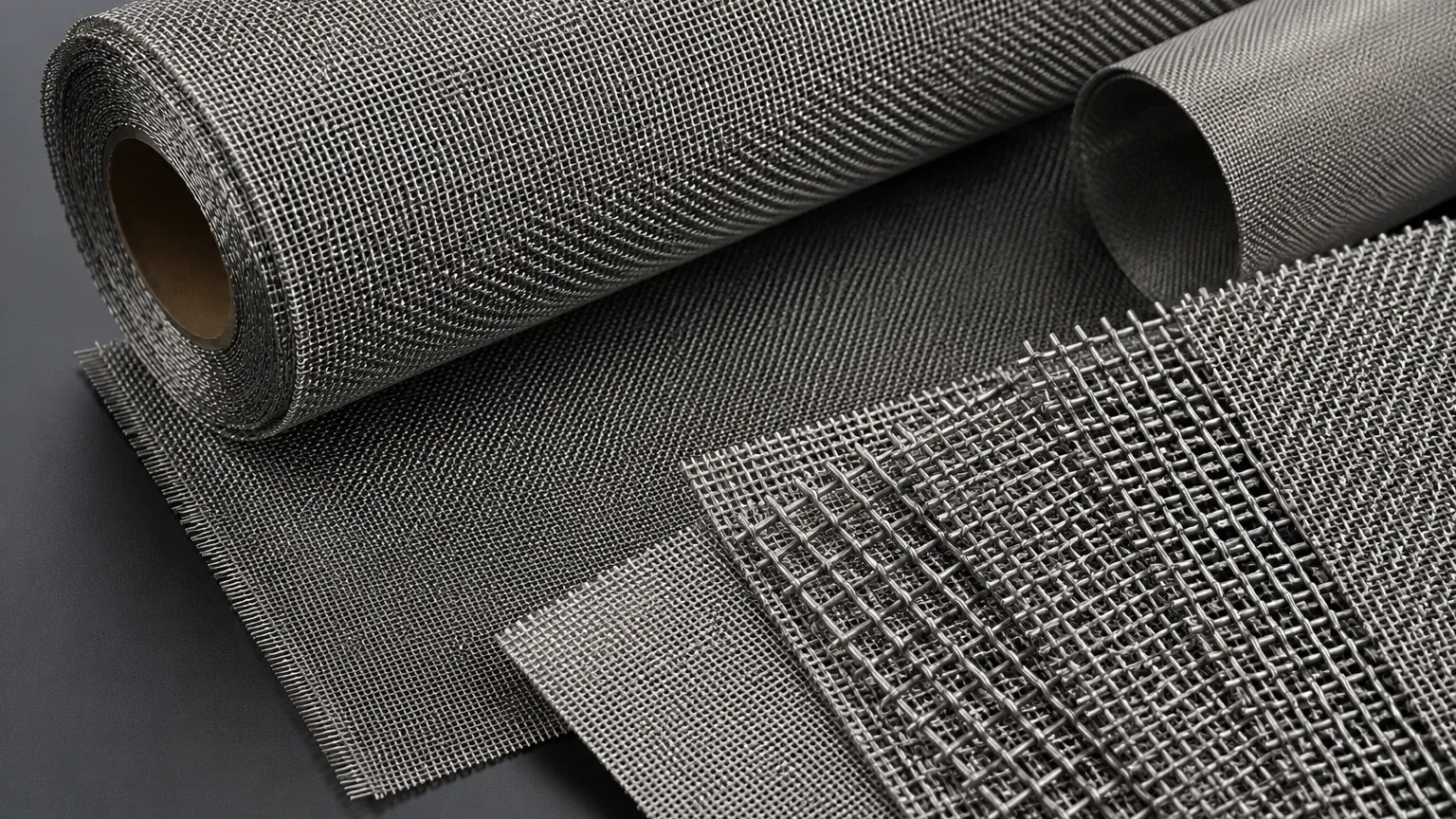
The performance of a woven wire mesh is defined by its weave geometry. The method by which the warp (lengthwise) and shute (crosswise) wires are interlaced determines the mesh's filtration accuracy and flow characteristics.
Plain Weave
This is the most common weave pattern where each shute wire passes over and under one warp wire. It provides a simple, stable structure with square openings. It is ideal for high-flow applications where a low pressure drop is prioritized over ultra-fine filtration.
Twill Weave
In a twill weave, each shute wire passes over and under two warp wires in a staggered pattern. This allows for the use of heavier wires in a given mesh count, increasing the mechanical strength and durability of the mesh. It is often used when the mesh must support heavy loads or resist abrasion.
Dutch Weave (Plain and Twill)
Dutch weaves utilize different diameters for warp and shute wires. The wires are driven closely together to create a dense, wedge-shaped opening rather than a square one. This results in a much finer filtration rating (down to 5-10 microns) and superior pressure resistance. For engineers looking for Plain, twill and dutch woven wire mesh in SS304/316L — rolls, cut mesh and framed panels. Send mesh count or micron target for a technical quote., selecting the correct weave is the first step in ensuring the filter meets the required micron rating.
Key Evaluation Criteria for Filtration Systems
When specifying kiskis 304 stainless steel woven wire mesh, technical teams must evaluate several performance metrics to ensure the component survives the operational lifecycle of the system.
Micron Rating: Absolute vs. Nominal
* Nominal Rating: Indicates the ability of the mesh to retain a majority of particles of a specific size (usually 60-80%).
* Absolute Rating: Refers to the diameter of the largest hard spherical particle that will pass through the mesh under specified test conditions. In critical pharmaceutical or hydraulic applications, the absolute rating is the primary metric for safety and compliance.
Open Area Percentage
The "open area" is the ratio of the total area of the openings to the total area of the mesh. A higher open area results in a lower initial pressure drop and higher flow rates. However, increasing the open area often requires using thinner wires, which can compromise the structural rigidity of the filter element.
Pressure Drop (ΔP)
Engineers must calculate the clean pressure drop to ensure the system pump can maintain required flow rates. As the mesh captures contaminants, the pressure drop increases. Understanding the dirt-holding capacity of the 304 mesh is vital for determining the cleaning or replacement cycle.
Industrial Applications of 304 Woven Mesh
Kaifil’s experience in manufacturing precision metal filter components highlights several sectors where 304 stainless steel mesh is indispensable:
* Food and Beverage Processing: Used in sieving, straining, and filtering juices, oils, and syrups. The non-reactive nature of 304 stainless steel ensures that no metallic flavors or contaminants are introduced into the product.
* Chemical and Petrochemical: Employed in the separation of catalysts and the filtration of process water. The material’s resistance to a wide range of organic and inorganic chemicals makes it a versatile choice.
* Hydraulic and Lubrication Systems: Precision-woven mesh protects sensitive valves and pumps from particulate wear. In these applications, the mesh is often fabricated into pleated cartridges to maximize surface area within a compact housing.
* Water Treatment: Used in intake screens and fine filtration stages to remove suspended solids, protecting downstream membranes and treatment equipment.
Customization and OEM Integration
Standard off-the-shelf mesh rolls rarely meet the specific requirements of complex industrial machinery. Customization is often necessary to achieve the desired filtration efficiency and mechanical fit. Kaifil provides comprehensive OEM capabilities, allowing for the development of tailored filtration solutions.
Dimensional Customization
Mesh can be supplied in continuous rolls, precision-cut circles, or complex geometric shapes. For high-pressure applications, multiple layers of kiskis 304 stainless steel woven wire mesh may be sintered together to create a composite plate that combines fine filtration with extreme structural strength.
Fabrication and Framing
To integrate mesh into existing systems, it often requires framing or support structures. Adding a reinforced edge or a stainless steel frame prevents fraying and ensures a bypass-free seal within the filter housing.
Maintenance, Cleaning, and Total Cost of Ownership
One of the primary advantages of stainless steel woven wire mesh over disposable polymer filters is its cleanability. A well-maintained 304 mesh filter can last for years, significantly reducing the total cost of ownership (TCO).
Cleaning Methods
1. Backwashing: Reversing the flow of the fluid to dislodge particles trapped on the surface of the mesh.
2. Ultrasonic Cleaning: Using high-frequency sound waves in a cleaning solvent to remove fine particulates from the interstitial spaces of a Dutch weave mesh.
3. Chemical Cleaning: Utilizing mild acids or detergents to dissolve organic buildup, provided the chemicals are compatible with the 304 alloy.
Replacement Indicators
Engineers should monitor the rate of pressure increase after cleaning. If the "clean" pressure drop begins to rise over time, it indicates that the mesh is becoming permanently blinded or that the wire structure is degrading. Regular inspection for wire displacement or corrosion pitting is also necessary to prevent downstream contamination.
Conclusion: Selecting the Right Partner
Specifying the correct Woven Wire Mesh involves more than just picking a mesh count. It requires a deep understanding of fluid dynamics, material science, and the specific rigors of the application environment. By focusing on high-quality kiskis 304 stainless steel woven wire mesh, industrial operations can achieve a reliable balance of performance and longevity.
When evaluating suppliers, technical teams should look for manufacturers who offer not just the raw material, but the engineering support to assist in selection and customization. Whether you require standard rolls for general sieving or complex, multi-layered filter cartridges for precision chemical processing, the quality of the weave and the integrity of the alloy are the foundations of a successful filtration strategy.
For those in the process of designing or upgrading filtration systems, confirming the mesh count, wire diameter, and weave type with a technical expert is the most effective way to ensure long-term operational success.
Download Kiskis 304 Stainless Steel Woven Wire Mesh as a PDF
