


Lock Crimp Woven Wire Mesh: Engineering Principles and Industrial Applications
In the field of industrial filtration and material separation, the structural integrity of the filter media is as critical as its filtration accuracy. For applications involving high-pressure flows, heavy mechanical loads, or intense vibrations, standard weave patterns often lack the necessary rigidity to maintain consistent aperture sizes. This is where lock crimp woven wire mesh becomes a vital engineering solution. By utilizing a specialized pre-crimping process, this mesh type ensures that the wires are mechanically locked at every intersection, providing a level of stability that is essential for demanding industrial environments.
As a professional manufacturer, Kaifil specializes in providing high-performance Woven Wire Mesh solutions tailored to specific engineering requirements. Understanding the nuances of lock crimp structures allows purchasing teams and engineers to optimize their filtration systems for durability and precision.
Understanding the Engineering of Lock Crimp Woven Wire Mesh
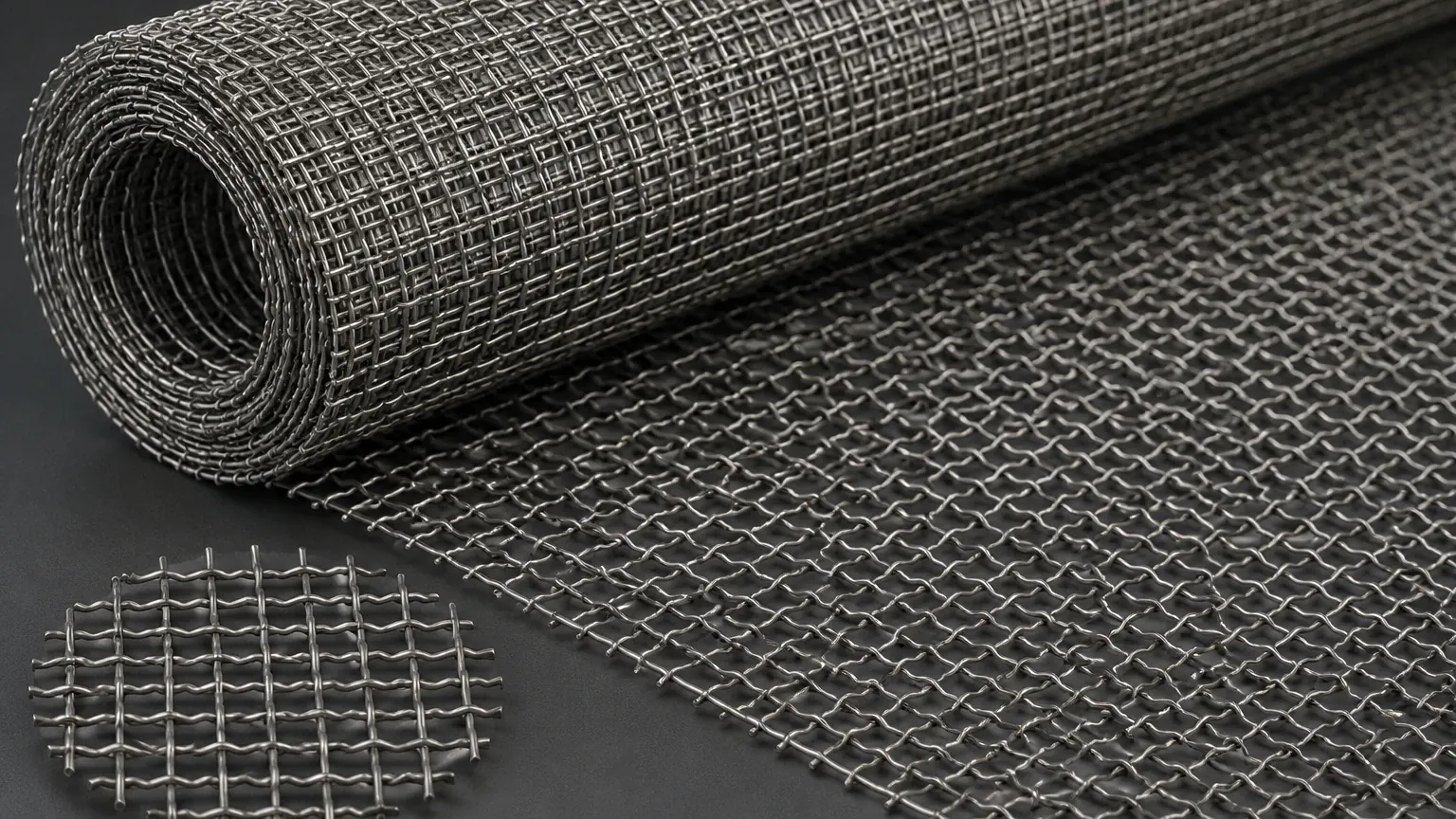
Unlike plain weave mesh where wires are woven directly, lock crimp woven wire mesh is produced through a two-stage process. First, the individual wires are passed through precision-engineered crimping wheels that create distinct depressions or "knuckles" at specific intervals. Second, these pre-crimped wires are woven together.
In a lock crimp pattern, the crimp is characterized by a deep, well-defined notch at the points where the warp and shute (weft) wires intersect. This design ensures that the wires "nest" into one another. Once the mesh is assembled, the wires are physically restricted from shifting or sliding along the length of the wire. This mechanical lock is particularly important when using larger wire diameters or when the mesh is subjected to external forces that would otherwise distort the openings.
The Importance of Aperture Stability
In industrial screening, the "aperture" or "opening size" determines the particle size cutoff. If the wires shift during operation—a common failure mode in lower-quality meshes—the filtration accuracy is compromised. Lock crimp construction effectively eliminates this risk, maintaining a constant open area and ensuring that the filtration performance remains within the specified tolerances throughout the component's lifecycle.
Structural Advantages in Demanding Environments
Lock crimp woven wire mesh is frequently selected for applications where structural rigidity is paramount. Its unique geometry offers several advantages over other crimp styles:
1. Vibration Resistance: In vibrating screens used in mining or chemical processing, the constant motion can cause wires to rub against each other, leading to premature wear or displacement. The locking mechanism minimizes internal friction and prevents the mesh from loosening.
2. High Load-Bearing Capacity: Because the wires are pre-deformed into a stable state, the mesh can support heavier loads without sagging. This makes it an ideal choice for support grids in large-scale filter cartridges or catalyst bed supports.
3. Consistent Tensioning: For framed panels or tensioned screens, the lock crimp ensures that tension is distributed evenly across the surface. This prevents "blinding" (clogging) and ensures efficient throughput.
4. Flatness and Uniformity: The pre-crimping process allows for a very flat finished product, which is essential for automated cleaning systems or scraper-blade filtration setups.
Material Considerations: SS304 vs. SS316L
Material selection is the foundation of any successful filtration project. While lock crimp mesh can be manufactured from various alloys, stainless steel remains the industry standard due to its mechanical properties and corrosion resistance. Kaifil primarily focuses on Plain, twill and dutch woven wire mesh in SS304/316L — rolls, cut mesh and framed panels. Send mesh count or micron target for a technical quote.
Grade 304 Stainless Steel
SS304 is the most common choice for general industrial applications. It offers excellent strength and good corrosion resistance against most oxidizing acids. It is widely used in food processing and architectural applications where extreme chemical exposure is not a primary concern.
Grade 316L Stainless Steel
The addition of molybdenum and a lower carbon content makes 316L the preferred choice for marine environments, pharmaceutical manufacturing, and chemical processing. It provides superior resistance to pitting and crevice corrosion in chloride-rich environments. For engineers designing systems for aggressive fluids or high-temperature steam sterilization, 316L is the authoritative recommendation.
Comparative Analysis: Lock Crimp vs. Other Weave Styles
To make an informed purchasing decision, it is necessary to compare lock crimp woven wire mesh with other common crimp styles available in the market.
Plain Crimp
In plain crimp, the wires are crimped only at the points of intersection. While simpler to manufacture, it lacks the extreme stability of the lock crimp. It is generally used for lighter-duty applications where the wire diameter is relatively small compared to the opening size.
Intermediate Crimp
Intermediate crimp involves extra crimps between the intersections. This is typically used when the mesh has a large opening but uses a relatively thin wire. While it provides better stability than plain crimp, it does not offer the same "locking" security as the lock crimp, which is specifically designed to prevent wire movement in heavy-duty scenarios.
Flat Top Crimp
Flat top crimp is a variation where all the crimping is done on one side of the mesh, leaving the other side completely smooth. This is often used when a smooth flow of material over the surface is required. However, the mechanical lock in a standard lock crimp is often superior for structural support applications.
Technical Selection Criteria for Engineers
When specifying lock crimp woven wire mesh for a project, engineers must define several key parameters to ensure performance expectations are met:
* Mesh Count: The number of openings per linear inch. In lock crimp, this is often lower than in fine twill weaves, as the lock crimp is better suited for coarser, high-strength requirements.
* Wire Diameter: This directly impacts the strength and the open area. A thicker wire increases durability but reduces the percentage of open area, which can affect flow rates and pressure drop.
* Aperture (Opening Size): The clear distance between the wires. This must be calculated precisely based on the particle size that needs to be retained or passed.
* Open Area Percentage: Calculated as `(Aperture^2 / (Aperture + Wire Diameter)^2) x 100`. This value is critical for hydraulic calculations and determining the efficiency of the filtration system.
* Edge Treatment: Depending on the installation, the mesh may require welded edges, hemmed edges, or specialized hooks for tensioning screens.
Application-Specific Implementation
Lock crimp woven wire mesh is utilized across a diverse range of industries, each with specific performance requirements.
Chemical and Petrochemical Processing
In these sectors, mesh is used for catalyst recovery and filtration of aggressive chemicals. The lock crimp provides the necessary rigidity to withstand high differential pressures without deforming the filter element.
Food and Beverage Industry
Hygiene and durability are the priorities here. Stainless steel lock crimp mesh is used in large-scale sifting and dewatering processes. The stability of the mesh ensures that no wires break off into the product stream, which is a critical safety consideration.
Pharmaceutical Manufacturing
Precision is paramount in pharmaceutical applications. Lock crimp mesh is often used as a support layer for finer filter media, providing a rigid backbone that maintains the shape of the filter cartridge during high-pressure sterilization cycles (SIP/CIP).
Hydraulic and Water Treatment
In hydraulic systems, the mesh must withstand rapid pressure fluctuations. The mechanical lock prevents the mesh from "breathing" or shifting, which would otherwise lead to fatigue failure of the wire.
Quality Control and Performance Expectations
When sourcing lock crimp woven wire mesh, technical professionals should confirm the quality standards of the manufacturer. Quality control should include:
* Material Certification: Verification of the alloy composition (e.g., Mill Test Reports) to ensure the mesh will withstand the intended chemical environment.
* Dimensional Accuracy: Precise measurement of the aperture and wire diameter to ensure the mesh meets the filtration specifications.
* Weave Tightness: A physical inspection to ensure the "lock" is secure and there is no movement in the wires.
At Kaifil, we understand that industrial filtration is not a one-size-fits-all field. Our manufacturing process focuses on delivering customized solutions that address the specific challenges of our global customers. Whether you require a specific mesh count for a chemical reactor or a reinforced framed panel for a water treatment plant, our engineering team provides the technical support needed to select the optimal Woven Wire Mesh configuration.
Conclusion: Making an Informed Selection
Lock crimp woven wire mesh represents a sophisticated balance of mechanical engineering and textile manufacturing. Its ability to maintain aperture consistency under duress makes it an indispensable component in modern industrial filtration. By focusing on material grade, wire geometry, and the specific demands of the application, engineers can ensure long-term reliability and cost-effective performance.
When evaluating your next filtration project, consider the total cost of ownership. While a standard weave might have a lower initial cost, the durability and reduced replacement cycles of a high-quality lock crimp mesh often provide better value over the life of the equipment. For technical consultation and customized designs, working with an experienced manufacturer like Kaifil ensures that your filtration components are engineered for success.
