


Filtration De Poussière
In industrial manufacturing and processing, the management of airborne particulates and solid contaminants is a critical engineering challenge. Effective filtration de poussière—or dust filtration—is not merely a matter of environmental compliance; it is a fundamental requirement for protecting sensitive machinery, ensuring product purity, and maintaining operational efficiency. For engineers and procurement specialists, selecting the appropriate filtration medium requires a deep understanding of particle dynamics, material science, and the specific demands of the operating environment.
While many industries rely on disposable fabric or paper filters, demanding industrial applications often necessitate the durability and precision of stainless steel and metal alloy components. This article examines the technical considerations, material selection criteria, and engineering principles behind high-performance dust filtration solutions.
Engineering Principles of Industrial Dust Filtration
The process of filtration de poussière involves the separation of solid particles from a gas stream. Unlike liquid filtration, gas-phase filtration must account for the compressibility of the fluid and the significantly different behavior of small particles in air. To design or select an effective filter, one must consider the four primary mechanisms of particle capture:
1. Inertial Impaction: This occurs when a particle is too large to follow the streamlines of the gas flow as it curves around a filter fiber or wire. Due to its inertia, the particle continues on a straight path and strikes the filter medium. This is the dominant mechanism for particles larger than 1 micron at higher velocities.
2. Interception: This happens when a particle follows a streamline but passes within one particle radius of a filter fiber. The particle makes contact with the fiber and is captured. This mechanism is critical for mid-sized particles.
3. Diffusion (Brownian Motion): For very small particles (typically less than 0.1 microns), the random motion caused by collisions with gas molecules (Brownian motion) increases the likelihood that they will contact a filter fiber. At lower flow velocities, diffusion becomes a highly effective capture mechanism.
4. Sieving (Straining): This is the most intuitive mechanism, where the gap between the filter media is smaller than the particle diameter. While effective, relying solely on sieving often leads to rapid pressure drop increases as the surface becomes blinded.
Understanding these mechanisms allows engineers to specify the correct pore size and media structure for their specific dust profile. For more information on how these principles are applied to custom filter designs, you can visit the Main Page for technical specifications and product overviews.
Material Selection: Why Stainless Steel?
In the context of filtration de poussière, the choice of material is dictated by the temperature, chemical composition, and physical abrasiveness of the dust. While polymer-based media are common, stainless steel (specifically Grades 304, 316, and 316L) offers distinct advantages in industrial B2B environments:
Thermal Stability
Many industrial processes, such as those in chemical processing or metal smelting, involve high-temperature exhaust gases. Standard synthetic filters often fail or degrade at temperatures exceeding 150°C. Stainless steel filter cartridges can operate reliably at temperatures up to 500°C (and higher with specialized alloys), maintaining structural integrity where other materials would melt or become brittle.
Chemical Resistance
In pharmaceutical and chemical industries, the dust being filtered may be corrosive or reactive. 316L stainless steel provides excellent resistance to organic acids, industrial solvents, and many chloride environments. This prevents the filter medium from corroding, which would otherwise lead to bypass or downstream contamination.
Mechanical Strength and Durability
Industrial dust filtration often involves high differential pressures, especially as the filter cake builds up. Metal wire mesh and sintered metal fibers provide the mechanical strength necessary to resist collapsing or deforming under pressure. This durability also allows for the filters to be cleaned and reused, which is a significant factor in total cost of ownership (TCO) calculations.
Structural Configurations of Metal Filters
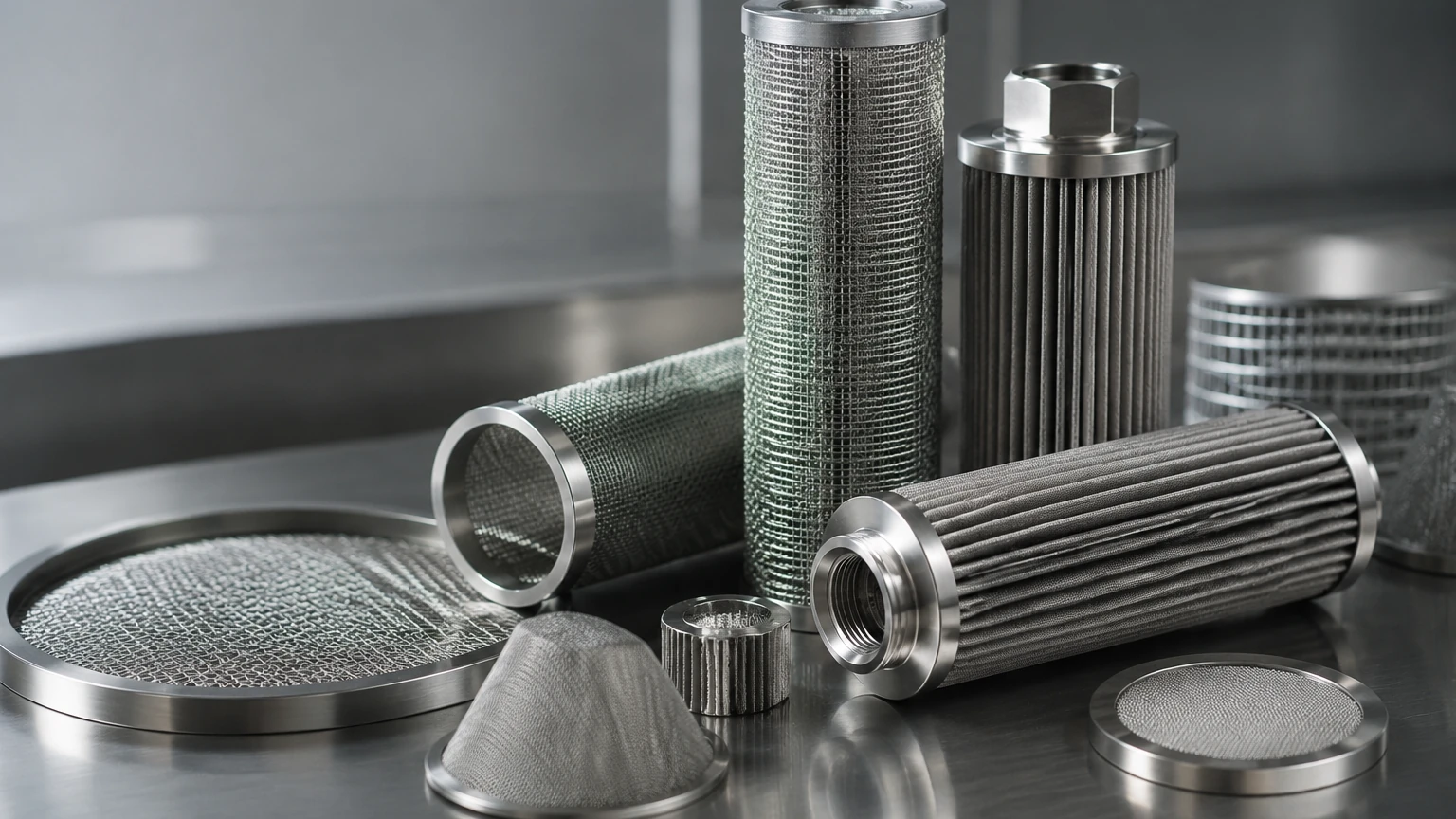
The physical structure of the filter medium significantly impacts the efficiency of filtration de poussière. Depending on the application, engineers may choose between several metal-based structures:
Woven Wire Mesh
Precision-woven stainless steel wire mesh offers a controlled pore size and a uniform surface. It is ideal for surface filtration where particles need to be easily removed during cleaning cycles. Woven mesh can be produced in various weaves, such as plain, twill, or Dutch weave, each offering different balances of flow rate and filtration fineness.
Sintered Metal Fiber Felt
For high-efficiency depth filtration, sintered metal fiber felt is often the preferred choice. This medium consists of thin stainless steel fibers that are randomly laid and then sintered (bonded by heat without melting). This creates a highly porous, three-dimensional structure that provides high dirt-holding capacity and low pressure drop, making it exceptionally effective for fine filtration de poussière.
Pleated Cartridges
To maximize the filtration surface area within a given footprint, filter media are often pleated. A pleated stainless steel cartridge can offer several times the surface area of a cylindrical filter of the same dimensions. This reduces the "face velocity" (the speed at which gas passes through the media), which improves capture efficiency and extends the time between cleaning or replacement cycles.
Performance Metrics and Selection Criteria
When evaluating solutions for filtration de poussière, engineers must look beyond the nominal micron rating. Several key performance indicators (KPIs) should be confirmed before procurement:
* Absolute vs. Nominal Rating: A nominal rating indicates the ability of the filter to capture a percentage of particles of a certain size. An absolute rating, however, implies that 99.9% (or higher) of particles above a specific size will be captured. For critical applications, absolute-rated media are essential.
* Pressure Drop (ΔP): The resistance to flow offered by the filter. A high initial pressure drop reduces the energy efficiency of the system. Engineers must calculate the maximum allowable terminal pressure drop before the filter must be cleaned or replaced.
* Dirt Holding Capacity (DHC): This refers to the total mass of dust the filter can capture before reaching its terminal pressure drop. A higher DHC means longer intervals between maintenance.
* Cleanability: One of the primary benefits of stainless steel filtration is the ability to clean the media via backpulsing, ultrasonic cleaning, or chemical washing. The ability of the medium to withstand repeated cleaning cycles without losing its filtration characteristics is a vital consideration for long-term ROI.
Customization and OEM Integration
No two industrial dust filtration applications are identical. Factors such as the moisture content of the gas, the hygroscopic nature of the dust, and the physical space constraints of the machinery necessitate customized solutions.
Professional manufacturers like Kaifil work closely with OEM partners to develop bespoke filtration components. Customization options often include:
* End Cap Configurations: Adapting the filter to fit existing housings (e.g., 222, 226, or threaded connections).
* Reinforcement Layers: Adding perforated metal cores or outer shrouds to handle extreme pressure surges or mechanical handling.
* Multi-Layer Composites: Combining different mesh counts or fiber diameters to create a graded-density filter that captures larger particles on the outer layers and finer particles toward the center.
For engineers designing new systems, consulting with a manufacturer during the design phase ensures that the filtration de poussière system is optimized for both performance and manufacturability.
Maintenance and Total Cost Considerations
While the initial purchase price of a stainless steel filter is higher than that of a disposable alternative, the total cost of ownership is often lower in the long run. When calculating TCO for filtration de poussière, procurement teams should consider:
1. Replacement Frequency: Disposable filters may need replacement weekly or monthly, whereas a cleaned stainless steel cartridge can last for years.
2. Disposal Costs: Hazardous dust captured in disposable filters creates a large volume of contaminated waste. Metal filters, being cleanable, significantly reduce the volume of waste generated.
3. Downtime: The time required to change out filters can lead to significant production losses. High-capacity metal filters extend the run-time between maintenance windows.
4. Energy Consumption: A filter that maintains a lower average pressure drop over its life cycle reduces the energy required by fans and blowers.
Technical Confirmation Before Purchase
Before finalizing a specification for a filtration de poussière solution, the following technical data should be confirmed with the supplier:
* Gas Stream Compatibility: Ensure the alloy (304 vs 316L) is compatible with any trace chemicals or moisture in the gas.
* Particle Size Distribution (PSD): Provide the supplier with a PSD of the dust to ensure the media is optimized for the specific particle range.
* Flow Rate and Temperature: Confirm the maximum and operating flow rates and temperatures to prevent thermal bypass or structural failure.
* Cleaning Protocol: Establish a clear protocol for how the filters will be cleaned to ensure they return to an acceptable "clean" pressure drop.
In conclusion, effective filtration de poussière is a balance of physics, material science, and economic strategy. By opting for precision-engineered stainless steel solutions, industrial operators can achieve higher levels of reliability, better protection for their equipment, and a more sustainable filtration process. For those seeking specialized guidance on selecting the right components for their specific industrial environment, reviewing the technical resources available on the Main Page is a recommended next step.
