


Basket Filter Strainer
In industrial fluid handling systems, the protection of sensitive downstream equipment is a primary engineering concern. A basket filter strainer serves as a critical line of defense, designed to remove unwanted solids from liquids via a perforated or wire mesh straining element. Unlike simpler filtration components, the basket-style configuration is engineered for applications requiring high flow rates and significant debris-holding capacity. By capturing contaminants before they reach pumps, valves, heat exchangers, or spray nozzles, these strainers prevent mechanical wear, clogging, and unplanned system downtime.
For engineers and procurement teams, selecting the correct basket filter strainer involves more than matching pipe sizes. It requires a deep understanding of fluid dynamics, material compatibility, and the specific filtration requirements of the process. This guide provides a technical overview of basket strainer engineering, selection criteria, and maintenance considerations to ensure optimal performance in demanding industrial environments.
The Role of Basket Filter Strainers in Industrial Piping
The fundamental purpose of a basket filter strainer is the mechanical separation of solids from a liquid stream. In a typical piping circuit, the strainer is installed horizontally. As the fluid enters the strainer housing, it is directed into a removable, basket-shaped element. The fluid passes through the mesh or perforated walls of the basket, while the particulate matter is trapped inside.
One of the defining characteristics of the basket design is its "top-loading" or "side-entry" configuration. This allows the strainer to be serviced without removing the entire unit from the pipeline. Compared to Y-strainers, which are often used for smaller amounts of debris or in vertical lines, basket strainers offer a much larger surface area. This results in a lower initial pressure drop and a longer service interval between cleanings, making them the preferred choice for high-volume liquid applications.
In sectors such as chemical processing and water treatment, the basket filter strainer is indispensable. It protects expensive instrumentation and ensures that the final product meets purity standards. For those exploring comprehensive filtration catalogs, the Main Page of a specialized manufacturer provides a broader view of how these components integrate into larger industrial systems.
Engineering Specifications: Sizing and Flow Dynamics
Properly sizing a basket filter strainer is essential for maintaining system efficiency. If a strainer is undersized, the velocity of the fluid increases, leading to an excessive pressure drop (ΔP) and potential damage to the filter element. Conversely, an oversized strainer may lead to unnecessary costs and space constraints.
Pressure Drop Considerations
Engineers must account for both the "clean" pressure drop and the "dirty" pressure drop. The clean pressure drop is the resistance offered by the strainer housing and a clean basket at a specific flow rate. As debris accumulates, the effective open area of the basket decreases, and the pressure drop rises. Most industrial systems are designed with a maximum allowable pressure drop, at which point the strainer must be cleaned. Calculating the CV factor (flow coefficient) is a standard practice to determine the pressure drop across the unit for a given fluid viscosity and flow rate.
Open Area Ratio
The efficiency of a basket filter strainer is often measured by its open area ratio (OAR). This is the ratio of the total open area of the straining element to the internal cross-sectional area of the inlet pipe. A high OAR (typically 4:1 or 6:1) ensures that the strainer can handle a significant amount of debris before the pressure drop becomes critical. This is particularly important in applications with high solids loading, where frequent maintenance would otherwise disrupt production.
Material Selection for Demanding Environments
The durability of a filtration system depends heavily on the materials used for both the housing and the internal basket. Stainless steel is the industry standard for most high-performance applications due to its corrosion resistance and structural integrity.
1. Type 304 Stainless Steel: Suitable for general industrial use, water treatment, and mildly corrosive environments. It offers excellent mechanical strength and is cost-effective for standard applications.
2. Type 316/316L Stainless Steel: The preferred choice for chemical processing, pharmaceutical, and food and beverage industries. The addition of molybdenum provides superior resistance to chlorides and pitting, which is essential when handling aggressive chemicals or saline solutions.
3. Specialty Alloys: In highly acidic or high-temperature environments, materials like Monel or Hastelloy may be required for the straining element to prevent premature failure.
Beyond the metal itself, the choice of seals and gaskets (such as EPDM, Viton, or PTFE) must be compatible with the process fluid to prevent leaks and ensure the integrity of the pressure vessel.
Comparing Simplex and Duplex Configurations
When specifying a basket filter strainer, engineers must decide between simplex and duplex designs based on the continuity of the process.
Simplex Strainers
A simplex basket strainer is used in systems where the flow can be periodically shut down for cleaning. These are common in batch processing or in systems with redundant piping loops. The simplicity of the design makes them easier to install and maintain, provided the operational schedule allows for downtime.
Duplex Strainers
For continuous processes where shutdown is not an option—such as in cooling water systems for power plants or continuous chemical reactors—a duplex basket strainer is required. A duplex unit consists of two separate strainer chambers connected by a diverter valve. When one basket becomes clogged, the flow is switched to the clean chamber, allowing the operator to remove and clean the dirty basket without interrupting the flow. While more complex and costly, duplex strainers are vital for maintaining 24/7 operational uptime.
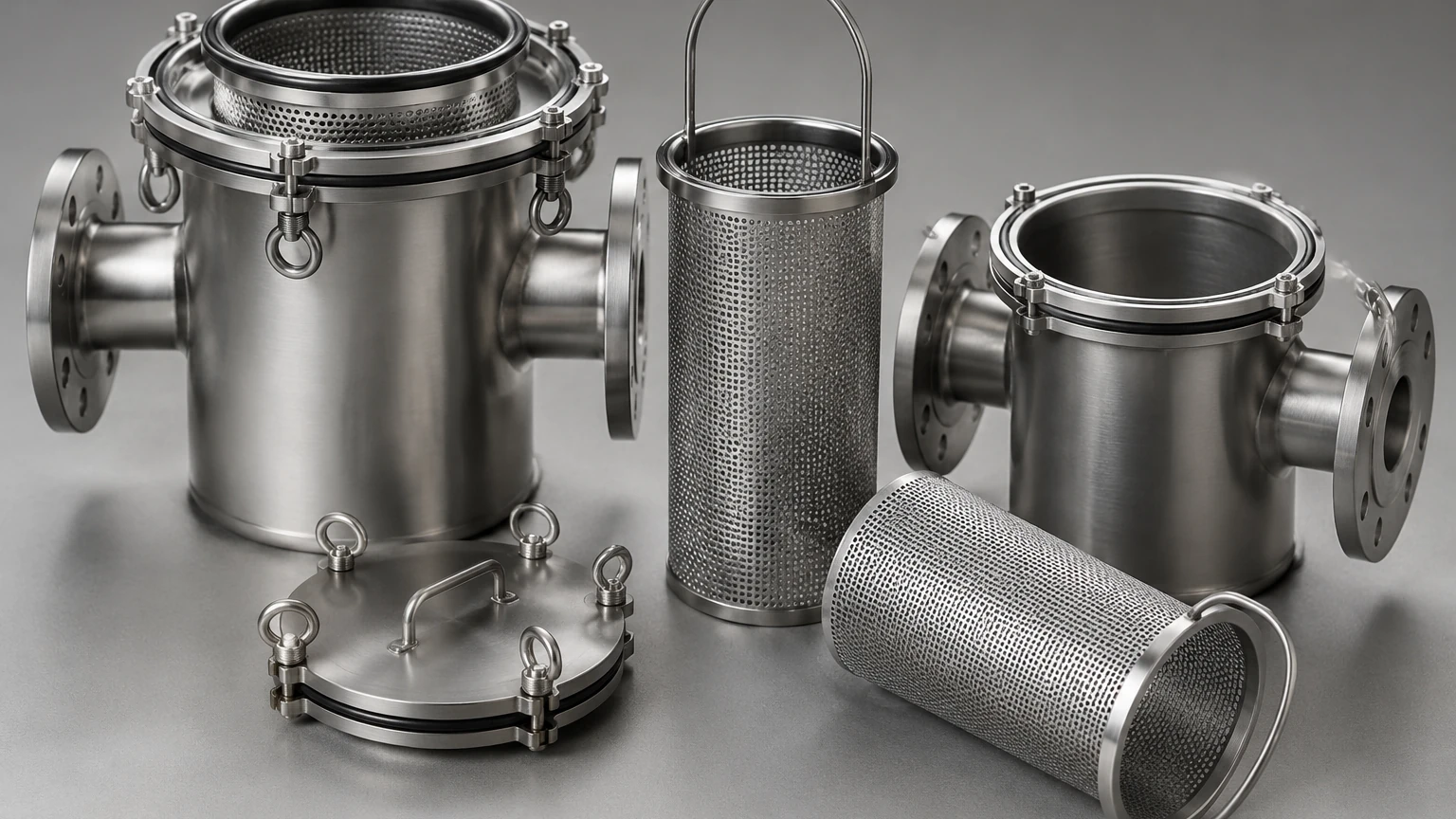
Customization: Tailoring Filtration to Process Requirements
Standard off-the-shelf strainers may not always meet the specific needs of a complex industrial process. Customization is often necessary to optimize filtration performance and ensure seamless integration into existing infrastructure.
Mesh and Perforation Selection
The straining element can be customized with various levels of filtration accuracy. This often involves a multi-layer approach: a heavy-duty perforated metal basket provides structural support, while a fine wire mesh liner (available in various weaves like plain, twill, or dutch weave) determines the micron rating. Customizing the mesh ensures that the strainer captures the specific particle sizes that pose a risk to the system without unnecessarily restricting flow.
Structural Reinforcements
In high-pressure or high-viscosity applications, the basket may be subject to significant mechanical stress. Custom-engineered baskets can include internal or external support cages to prevent the mesh from collapsing or distorting under pressure. This is a critical consideration for hydraulic systems and heavy oil filtration.
Connection Types and Housing Modifications
Depending on the piping standards, strainers can be manufactured with flanged, threaded, or socket-weld connections. Additionally, housings can be modified with features like differential pressure gauges, vent valves, and drain plugs to facilitate easier monitoring and maintenance.
Maintenance Protocols and Performance Monitoring
The longevity of a basket filter strainer is directly tied to the rigor of its maintenance schedule. Neglecting a clogged strainer can lead to basket rupture, allowing contaminants to bypass the filter and potentially causing catastrophic failure of downstream pumps.
Monitoring Differential Pressure
The most effective way to monitor strainer performance is through differential pressure (DP) sensing. By installing gauges at the inlet and outlet, operators can see the exact pressure drop across the basket. A sudden spike in DP indicates a rapid influx of contaminants, while a gradual increase signals the need for routine cleaning.
Cleaning Procedures
When the DP reaches a predetermined limit, the basket must be removed. In stainless steel systems, baskets are typically cleaned using high-pressure water, steam, or ultrasonic baths, depending on the nature of the debris. It is essential to inspect the mesh for signs of fraying or corrosion during every cleaning cycle. Damaged baskets should be replaced immediately to maintain filtration integrity.
Spare Parts Management
To minimize downtime, facilities should maintain an inventory of critical spare parts, including replacement baskets and a full set of seals/gaskets. Because the basket is the primary wear component, having a spare on hand allows for a quick swap, enabling the dirty basket to be cleaned offline while the system continues to operate.
Technical Checklist for Procurement
Before finalizing a purchase for a basket filter strainer, engineering and purchasing teams should confirm several technical parameters to ensure the product is fit for purpose:
* Fluid Characteristics: What is the viscosity, temperature, and chemical composition of the liquid?
* Flow Rate: What are the minimum, normal, and maximum flow rates the strainer must accommodate?
* Filtration Target: What is the smallest particle size (in microns) that must be removed?
* Pressure Rating: Does the housing meet the ASME or ISO pressure standards required for the pipeline?
* Allowable Pressure Drop: What is the maximum ΔP the system can tolerate before performance is compromised?
* Space Constraints: Are there limitations on the footprint or the overhead clearance required to remove the basket?
By addressing these factors, teams can avoid common pitfalls such as rapid clogging or material incompatibility. For detailed product specifications and engineering support, visiting the Main Page of an experienced manufacturer can provide the necessary technical documentation to support the selection process.
In conclusion, the basket filter strainer is a fundamental component for ensuring the reliability of industrial fluid systems. Through careful consideration of materials, sizing, and configuration, engineers can implement a filtration solution that protects equipment, reduces maintenance costs, and optimizes process efficiency. Whether utilizing a standard simplex design or a custom-engineered duplex system, the focus must always remain on the precise requirements of the application and the long-term durability of the filtration media.
