


Liquid Coalescer
In industrial processing, the separation of immiscible liquids is a critical requirement for maintaining product purity, protecting downstream equipment, and ensuring environmental compliance. A liquid coalescer is a specialized filtration and separation device designed to merge small droplets of a dispersed liquid phase into larger droplets, allowing them to be separated from a continuous liquid phase based on density differences. Unlike standard particulate filters that remove solid contaminants, a liquid coalescer addresses the challenges of liquid-liquid emulsions that cannot be resolved by simple gravity settling alone.
For engineers and procurement specialists, understanding the technical nuances of liquid coalescer design—ranging from media selection to the physics of droplet growth—is essential for optimizing process efficiency. This guide explores the engineering principles, material considerations, and application-specific criteria necessary for selecting high-performance coalescing solutions.
The Engineering Principles of Liquid-Liquid Coalescence
The operation of a liquid coalescer relies on a multi-stage mechanical process. When an emulsion (a mixture of two immiscible liquids, such as water in fuel or oil in water) passes through the coalescing media, several physical phenomena occur simultaneously to facilitate separation.
1. Interception and Attachment
As the fluid stream enters the coalescer, the fine droplets of the dispersed phase come into contact with the fibers or mesh of the coalescing media. This contact is governed by the principles of direct interception and inertial impaction. In high-quality stainless steel wire mesh or sintered metal media, the tortuous path created by the structure increases the probability of droplet-to-media contact.
2. Coalescence (Droplet Growth)
Once the droplets are intercepted, they attach to the surface of the media. As more droplets are captured, they migrate along the fibers and collide with one another. Due to the interfacial tension and the specific surface energy of the media, these small droplets merge (coalesce) into larger droplets. This stage is the most critical, as the efficiency of the liquid coalescer is defined by its ability to grow droplets to a size where buoyancy forces overcome the viscous drag of the continuous phase.
3. Release and Phase Separation
When the coalesced droplets reach a sufficient size, the flow of the continuous phase pushes them off the downstream side of the media. Because of the density difference between the two liquids, the larger droplets either sink to the bottom (if they are denser than the continuous phase, like water in oil) or rise to the top (if they are less dense, like oil in water). A secondary separator element, often made of hydrophobic or hydrophilic materials depending on the application, may be used to block the dispersed phase while allowing the continuous phase to pass through freely.
Material Selection: The Role of Stainless Steel in Coalescing
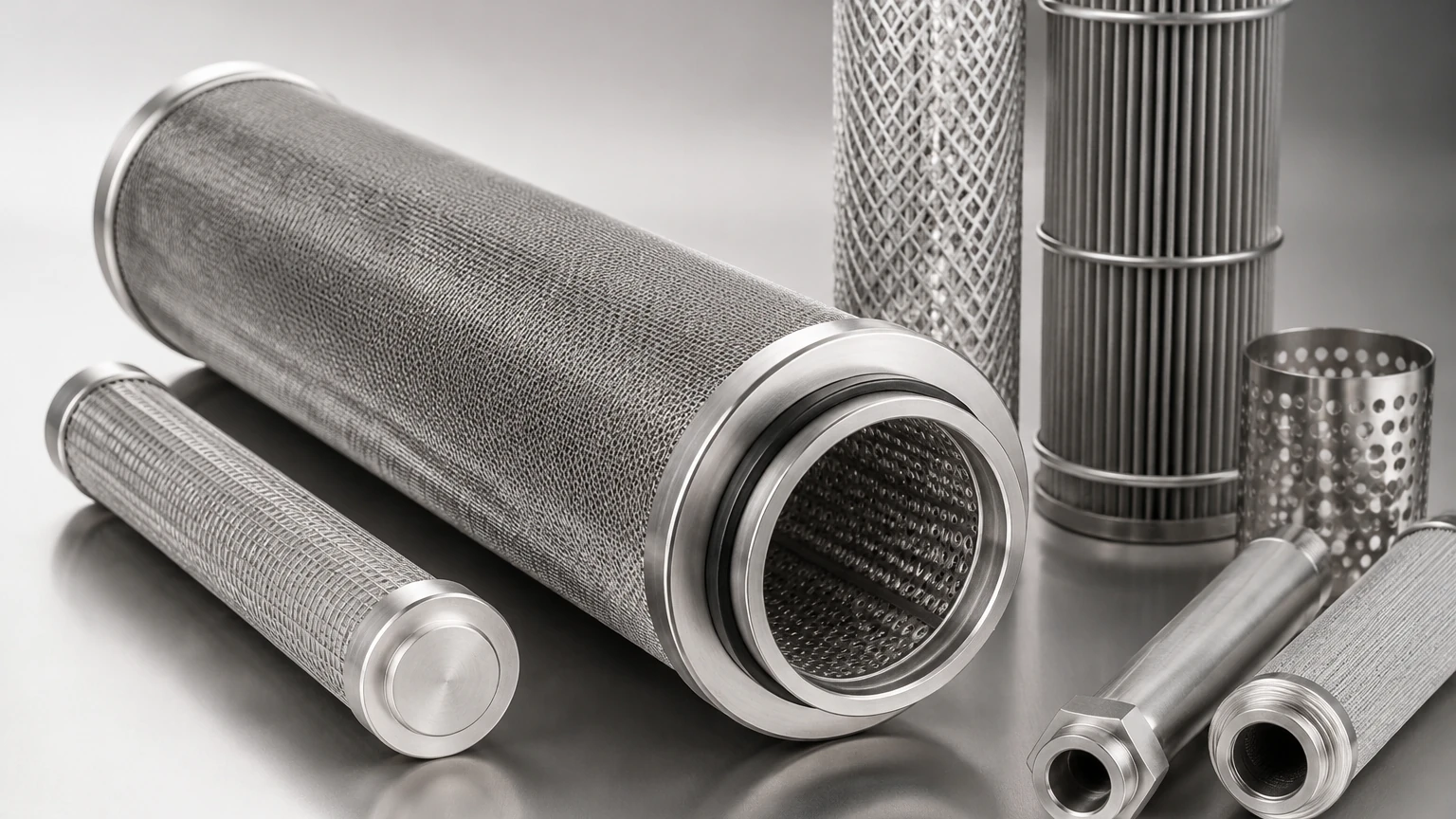
The choice of material for a liquid coalescer is determined by the chemical nature of the fluids, the operating temperature, and the required durability. While synthetic fibers are common in light-duty applications, industrial-grade coalescers frequently utilize stainless steel components due to their superior mechanical properties.
Durability and Chemical Compatibility
In sectors such as chemical processing and oil and gas, the fluids involved can be highly corrosive or processed at elevated temperatures. Stainless steel (typically 304L or 316L) provides the necessary resistance to oxidation and chemical attack. Furthermore, stainless steel wire mesh and sintered metal media can withstand high differential pressures without deforming, ensuring consistent pore geometry and separation efficiency over long service lives.
Surface Energy and Wetting Characteristics
Effective coalescence requires the media to have specific wetting characteristics. The media must be "wetted" by the dispersed phase to encourage droplet attachment and growth. Engineers can modify the surface properties of stainless steel through specialized coatings or by selecting specific weave patterns to optimize the interaction between the metal surface and the liquid phases. This customization is a hallmark of professional manufacturing, allowing the liquid coalescer to be tuned for specific interfacial tensions.
Critical Factors Influencing Coalescer Performance
When evaluating a liquid coalescer for an industrial system, several technical variables must be considered to ensure the unit performs to specification.
Interfacial Tension (IFT)
Interfacial tension is a measure of the force existing at the boundary between two immiscible liquids. High IFT (typically above 20 dynes/cm) makes separation relatively straightforward. However, when surfactants or chemicals are present, the IFT can drop significantly (below 10 dynes/cm), resulting in a "tight" emulsion with very small droplets. In these cases, a precision-engineered liquid coalescer with finer media and higher surface area is required to break the emulsion.
Fluid Viscosity and Density Difference
According to Stokes' Law, the settling velocity of a droplet is directly proportional to the square of its diameter and the difference in density between the two phases, and inversely proportional to the viscosity of the continuous phase. If the continuous phase is highly viscous, it resists the movement of the coalesced droplets, necessitating a larger vessel or more specialized media to achieve the desired separation.
Flow Velocity and Residence Time
Liquid coalescers are sensitive to flow rates. If the velocity is too high, the shear forces can break apart the coalesced droplets before they have a chance to settle, a phenomenon known as re-entrainment. Proper sizing ensures that the flux (flow per unit area) remains within the laminar flow regime, providing sufficient residence time for phase separation to occur.
Industrial Applications of Liquid Coalescers
Liquid coalescers are indispensable in any process where liquid purity is paramount. Their application spans across multiple heavy industries:
* Petrochemical and Refineries: Removing water from hydrocarbons (such as diesel, jet fuel, and gasoline) is essential to prevent corrosion in storage tanks and ensure the efficiency of downstream refining catalysts.
* Hydraulic and Lube Oil Systems: Water contamination in hydraulic fluids can lead to component wear, valve sticking, and fluid degradation. A liquid coalescer integrated into the filtration loop maintains the oil in a "bone-dry" state, extending the life of the machinery.
* Chemical Processing: In solvent extraction processes, coalescers are used to recover expensive solvents or to remove aqueous contaminants from organic product streams.
* Wastewater Treatment: Separating free and dispersed oils from industrial discharge is a regulatory requirement. Coalescers provide a more compact and efficient alternative to large API separators or dissolved air flotation (DAF) units.
Selection and Procurement: What Engineers Need to Confirm
To specify the correct liquid coalescer, purchasing and engineering teams should provide detailed application data to the manufacturer. This ensures the solution is not only effective but also cost-efficient over its total lifecycle. Key information includes:
1. Fluid Properties: Specific gravity, viscosity, and chemical composition of both the continuous and dispersed phases.
2. Contamination Levels: The concentration of the dispersed phase (in ppm or percentage) and the presence of any solid particulates that might plug the coalescing media.
3. Operating Conditions: Maximum and minimum flow rates, operating temperature, and design pressure.
4. Target Purity: The required effluent quality (e.g., reducing water content from 5,000 ppm to less than 10 ppm).
For those seeking customized filtration components and technical support for complex separation challenges, visiting the Main Page of a specialized manufacturer like Kaifil provides access to engineering expertise and a broad range of stainless steel filtration solutions.
Maintenance and Total Cost of Ownership (TCO)
While the initial capital expenditure of a liquid coalescer is a factor, the total cost of ownership is largely determined by maintenance requirements and the longevity of the media.
Differential Pressure Monitoring
As a liquid coalescer operates, it may also trap residual solid contaminants. This leads to an increase in differential pressure (ΔP). Monitoring ΔP is the primary method for determining when a coalescer element needs cleaning or replacement. High-quality stainless steel elements offer the advantage of being cleanable in many applications, significantly reducing the recurring costs associated with disposable glass-fiber cartridges.
System Integration
To protect the coalescing media from premature fouling, it is standard engineering practice to install a pre-filter upstream of the liquid coalescer. This pre-filter removes solid debris, allowing the coalescer to focus solely on phase separation. This configuration extends the service intervals and ensures that the separation efficiency remains high throughout the production cycle.
Conclusion
The liquid coalescer is a sophisticated tool in the industrial filtration arsenal, moving beyond simple particle removal to solve complex phase separation problems. By leveraging the physical properties of stainless steel and the principles of fluid dynamics, these systems provide reliable, long-term solutions for maintaining fluid purity. Whether the goal is to protect high-value equipment or to meet stringent product specifications, selecting a coalescer based on rigorous engineering data and high-quality manufacturing standards is the key to operational success.
