


Where Is Compressed Air Stored
In industrial environments, compressed air is often referred to as the "fourth utility." Unlike electricity, water, or natural gas, compressed air is generated on-site, requiring a robust infrastructure for production, treatment, and, crucially, storage. Understanding where compressed air is stored and how that storage is managed is essential for maintaining system pressure, reducing energy costs, and protecting downstream equipment from contamination. For engineers and facility managers, the storage strategy directly impacts the total cost of ownership and the reliability of the pneumatic system.
Air Receiver Tanks: The Primary Storage Vessel
The most common answer to where is compressed air stored is the air receiver tank. These pressure vessels serve several critical functions beyond simple containment. An air receiver acts as a buffer between the air compressor and the demand side of the system, smoothing out the pressure pulsations from reciprocating compressors and providing a reserve of energy during periods of peak demand.
Primary vs. Secondary Receivers
Air receiver tanks are generally categorized based on their location within the system:
1. Primary Receivers: Located near the compressor room, these tanks handle the bulk of the storage. They provide a large volume of air to prevent the compressor from "short-cycling," which occurs when a compressor turns on and off too frequently, leading to premature motor failure and excessive energy consumption.
2. Secondary Receivers: These are smaller tanks located near specific pieces of equipment or at the end of long distribution lines. They are used to meet sudden, high-volume air requirements without causing a pressure drop throughout the entire facility. This is particularly important in applications like large-scale filtration backwashing or heavy pneumatic tool operation.
Material Considerations
Most industrial receiver tanks are constructed from carbon steel; however, in industries where hygiene or corrosion resistance is paramount—such as pharmaceutical or food and beverage processing—stainless steel tanks are preferred. These environments often utilize advanced filtration components, such as those provided on the Main Page of specialized manufacturers like Kaifil, to ensure that the air stored within these vessels remains free of particulates and moisture.
Wet vs. Dry Storage: Strategic Placement
When designing a compressed air system, engineers must decide where to place the storage relative to the air treatment equipment (dryers and filters). This leads to the distinction between "wet" and "dry" storage.
Wet Storage
Wet storage refers to a receiver tank located before the air dryer. In this configuration, the tank serves as a preliminary cooling vessel. As the hot, compressed air enters the tank, it cools, causing water vapor to condense into liquid. This reduces the moisture load on the downstream dryer. However, wet storage requires high-quality moisture separators and internal coatings to prevent corrosion.
Dry Storage
Dry storage involves placing the receiver tank after the air dryer. The air stored here is already treated, meaning there is a lower risk of internal corrosion and no risk of liquid water being pushed downstream during a sudden surge in demand. Most efficient systems utilize a combination of both wet and dry storage to maximize both cooling efficiency and pressure stability.
Distribution Piping as a Storage Medium
While tanks are the primary vessels, the distribution piping itself acts as a secondary storage medium. In large industrial facilities with miles of piping, the total internal volume of the network can be significant.
Loop Systems vs. Header Systems
A well-designed "loop" distribution system allows air to flow in multiple directions to reach a point of use, effectively doubling the storage capacity of the pipe compared to a single-line "header" system. The diameter of the pipe is a critical engineering factor; undersized pipes increase the velocity of the air, leading to excessive pressure drops and reducing the effective storage capacity of the network. Engineers often calculate the "storage volume" of the piping to determine how much air is available to dampen the impact of sudden demand spikes.
High-Pressure Cylinders and Specialized Storage
In specific applications where very high pressures are required—such as scuba tank filling, laboratory testing, or aerospace applications—compressed air is stored in high-pressure cylinders or "banks." These are typically rated for pressures far exceeding standard industrial levels (often 3,000 to 6,000 PSI).
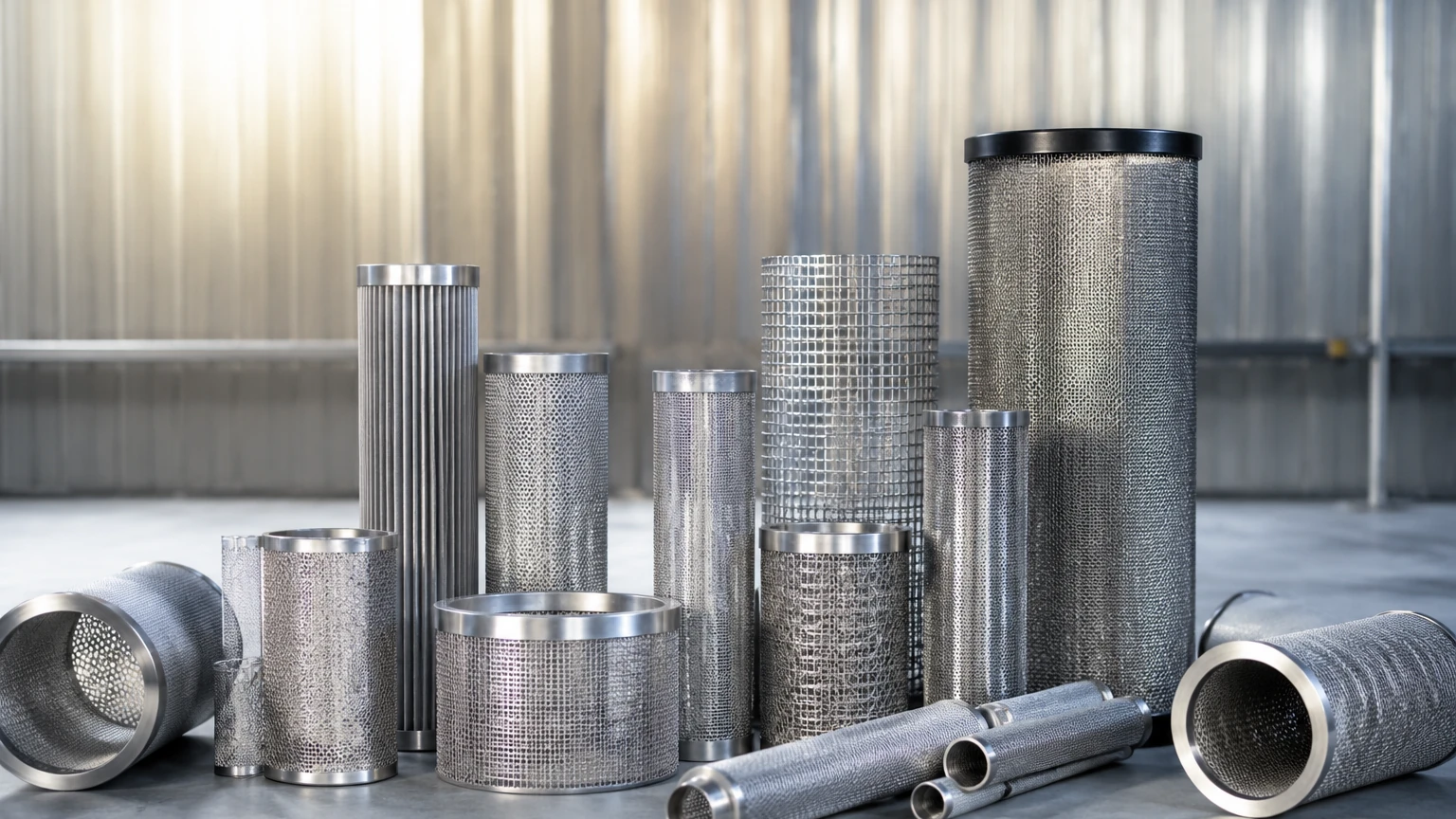
Because high-pressure storage is more susceptible to the dangers of moisture-induced corrosion and particulate friction, the filtration requirements are significantly more stringent. Sintered metal filters and high-precision wire mesh components are often integrated into the manifold systems of these storage banks to prevent micro-particulates from compromising valve seals or downstream equipment.
Sizing the Storage: Engineering Calculations
Determining where is compressed air stored is only half the challenge; the other half is determining how much storage is needed. Sizing a receiver tank is not a matter of guesswork but a calculation based on the compressor's output, the system's pressure range, and the duration of peak demand.
The standard formula used by engineers is:
**V = (t * (C – S) * Pa) / (P1 – P2)**
* V = Receiver volume in cubic feet
* t = Time allowed for the pressure drop to occur (minutes)
* C = Air demand (CFM)
* S = Compressor capacity (CFM)
* Pa = Absolute atmospheric pressure (PSIA)
* P1 = Initial tank pressure (PSIG)
* P2 = Minimum required pressure (PSIG)
Proper sizing ensures that the stored air can sustain the facility's operations without forcing the compressor into an inefficient operating state.
The Role of Filtration in Storage Integrity
Storage vessels are notorious for accumulating contaminants. Even with high-efficiency compressors, the process of compression concentrates atmospheric dust, oil aerosols, and water vapor. If these are not managed, the storage tank becomes a breeding ground for rust and sludge.
Protecting the Receiver
To maintain the integrity of where compressed air is stored, filtration must be applied at multiple stages:
* Inlet Filtration: High-quality intake filters prevent large particulates from entering the compressor.
* Coalescing Filters: Placed before the receiver tank (in wet storage) or after the compressor, these filters remove oil aerosols and water droplets.
* Particulate Filters: Stainless steel wire mesh or sintered filters are used downstream of the storage tank to catch any pipe scale or desiccant dust that may have migrated from the dryer or the tank walls.
Kaifil specializes in these types of custom stainless steel filtration solutions, providing the durability required for high-pressure and high-temperature storage environments. Using corrosion-resistant materials in filtration components is vital when dealing with the condensate that naturally forms in storage vessels.
Maintenance of Storage Systems
Regardless of where compressed air is stored, the storage system requires regular maintenance to remain safe and efficient.
Condensate Management
The most critical maintenance task is the removal of condensate. Every receiver tank must be equipped with a drain—either manual, timed-electronic, or zero-loss demand drains. If water is allowed to build up, it reduces the effective volume of the tank and can lead to internal corrosion, which eventually thins the walls of the pressure vessel, creating a significant safety hazard.
Pressure Relief and Inspection
Because they are pressurized vessels, storage tanks are subject to strict regulatory standards (such as ASME Section VIII in the United States). They must be equipped with calibrated pressure relief valves (PRVs) to prevent over-pressurization. Periodic ultrasonic thickness testing is also recommended for older tanks to ensure that corrosion has not compromised the vessel's structural integrity.
Conclusion: Optimizing Your Storage Strategy
Understanding where compressed air is stored is fundamental to designing a high-performance industrial system. While the air receiver tank is the primary component, the entire infrastructure—from the distribution piping to the high-pressure cylinders—plays a role in energy storage and pressure stabilization.
For engineers, the goal is to balance storage volume with air quality. This is achieved through precise sizing, strategic placement of wet and dry receivers, and the integration of robust filtration systems. By utilizing high-quality stainless steel filter cartridges and precision metal components, facilities can protect their storage investment and ensure that the air delivered to the point of use is clean, dry, and at the correct pressure. For more information on specialized filtration components that support industrial air systems, technical professionals can consult the resources available on the Main Page of industry experts like Kaifil.
