


Woven Wire Mesh Manufacturers in India: A Technical Selection Guide
In the industrial filtration landscape, selecting the right material and supplier for filtration media is a critical decision that impacts operational efficiency, product purity, and long-term maintenance costs. For many procurement teams and engineers, exploring the market of woven wire mesh manufacturers in India is a logical step due to the country's significant manufacturing footprint and established export infrastructure.
However, navigating the technical nuances of woven wire mesh requires more than just identifying a supplier. It involves a deep understanding of material grades, weave patterns, and the specific engineering requirements of the application. This guide provides a factual overview of the Indian manufacturing landscape, technical evaluation criteria, and the critical factors that industrial buyers must confirm before finalizing a supply agreement.
The Landscape of Woven Wire Mesh Production in India
India has developed a robust ecosystem for wire weaving, primarily concentrated in industrial hubs such as Gujarat (Ahmedabad and Vadodara), Maharashtra (Mumbai and Pune), and parts of Haryana and West Bengal. These manufacturers range from small-scale workshops producing standard commercial-grade mesh to large-scale industrial units equipped with automated looms capable of producing high-precision industrial mesh.
Historically, the Indian wire mesh industry served domestic sectors such as agriculture and basic construction. Over the last two decades, however, significant investment in stainless steel processing has allowed many woven wire mesh manufacturers in India to pivot toward higher-specification products for the pharmaceutical, chemical processing, and food and beverage industries. These manufacturers often specialize in bulk production of standard rolls, though a subset offers specialized fabrication services for custom filtration components.
Technical Specifications and Material Standards
When evaluating any manufacturer, the first point of technical verification is the material composition. In industrial filtration, the choice of alloy determines the mesh's resistance to corrosion, temperature, and mechanical stress.
Material Grades
Most industrial applications require stainless steel. The two most common grades found among woven wire mesh manufacturers in India are:
1. SS304 (AISI 304): The standard "18-8" stainless steel. It offers excellent corrosion resistance in most atmospheric conditions and is widely used in food processing and general industrial filtration. It is cost-effective but may struggle in high-chloride environments.
2. SS316L (AISI 316L): The "L" denotes low carbon, which improves weldability and prevents sensitization. The addition of molybdenum provides superior resistance to pitting and crevice corrosion, making it the preferred choice for pharmaceutical and chemical applications where aggressive cleaning agents or acidic environments are present.
Weave Types and Their Applications
The geometry of the weave dictates the filtration accuracy (micron rating) and the mechanical strength of the mesh. Buyers should be familiar with the following standard configurations:
* Plain Weave: The most common and simplest weave where each warp wire crosses over and under each shute wire. It provides a consistent opening size and is ideal for basic sifting and liquid filtration.
* Twill Weave: Each shute wire passes successively over and under two warp wires. This allows for a heavier wire diameter to be used for a given mesh count, increasing the strength and durability of the mesh for high-pressure applications.
* Dutch Weave (Plain and Twill): Characterized by a limited number of warp wires and a maximum number of shute wires knocked up closely together. This creates a dense, strong mesh with very fine filtration capabilities, often used in hydraulic systems and fuel filtration.
For engineers requiring specific performance metrics, Plain, twill and dutch woven wire mesh in SS304/316L — rolls, cut mesh and framed panels. Send mesh count or micron target for a technical quote. provides a benchmark for comparing the technical tolerances offered by various global suppliers.
Evaluating Quality in the Indian Market
One of the primary challenges for international buyers sourcing from woven wire mesh manufacturers in India is ensuring consistency across large batches. Quality in wire mesh is not just about the final appearance; it is about the precision of the aperture and the integrity of the wire.
1. Aperture Consistency
In filtration, the "nominal" micron rating is less important than the "absolute" rating. If a mesh is rated at 50 microns but has irregular openings due to poor loom tension, the entire filtration process is compromised. Buyers should request data on aperture tolerance and ask how the manufacturer monitors tension during the weaving process.
2. Wire Diameter Accuracy
The diameter of the wire affects both the open area (flow rate) and the mechanical strength. A manufacturer using sub-standard or undersized wire may offer a lower price, but the resulting mesh will have a shorter lifespan and may fail under pressure. Verification of wire gauge through micrometer testing is a standard requirement for industrial-grade mesh.
3. Surface Treatment and Cleanliness
For the pharmaceutical and food industries, the mesh must be free of lubricants, oils, and metallic burrs. Many manufacturers in India offer ultrasonic cleaning or passivation as value-added services. It is essential to confirm that these processes meet the required hygiene standards (such as FDA or EU food contact regulations).
Engineering Considerations for Custom Filtration
While many woven wire mesh manufacturers in India excel at producing standard rolls, industrial applications often require more than just raw material. Engineers must consider how the mesh will be integrated into the final filtration system.
Customization and Fabrication
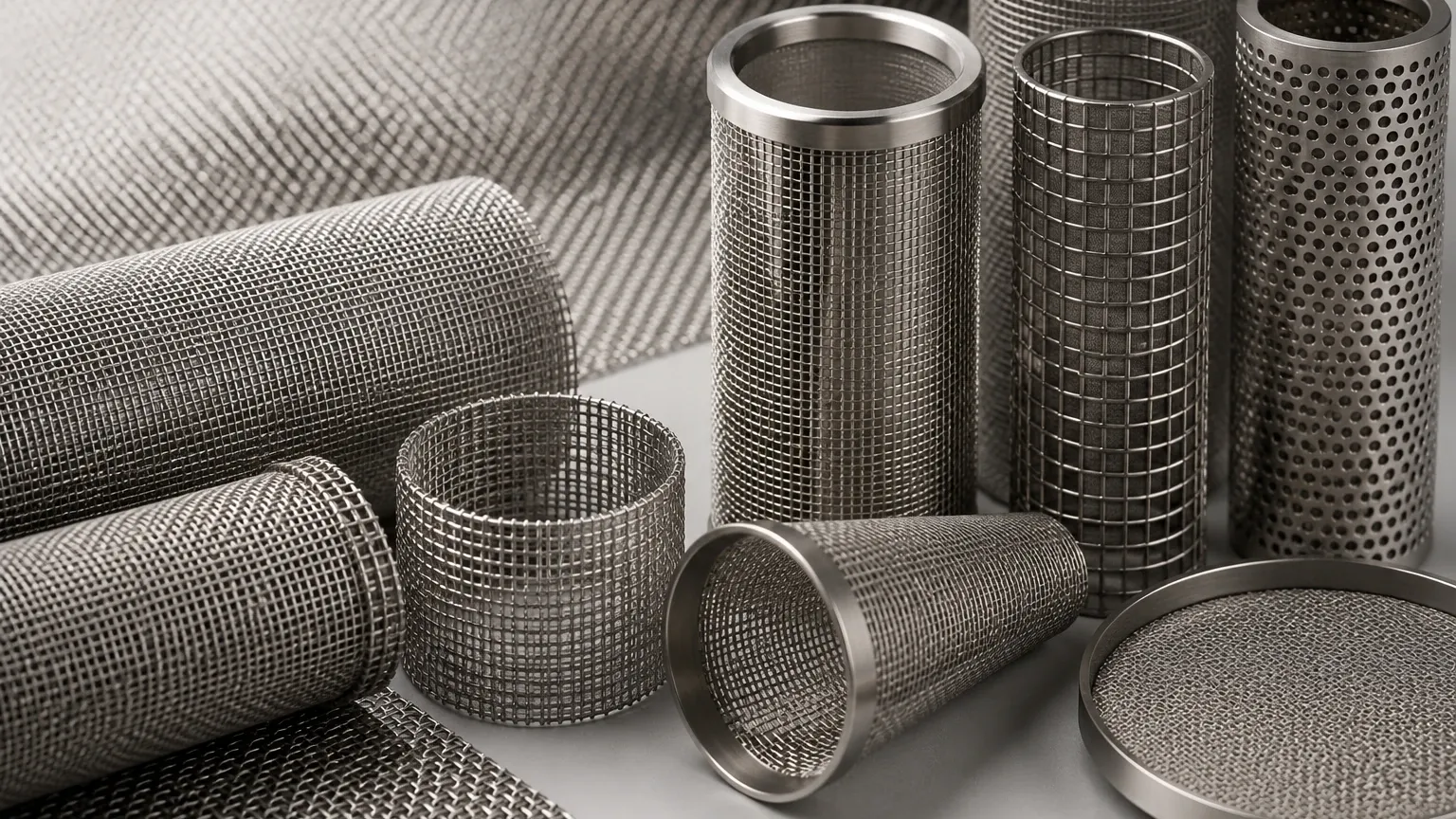
Standard rolls usually come in widths of 1 meter, 1.2 meters, or 1.5 meters. If your application requires specific shapes, such as circular discs, pleated cartridges, or framed panels, you must determine if the manufacturer has the in-house capability for precision cutting and welding.
At Kaifil, the focus is on providing tailored solutions where the mesh is just one part of a complex assembly. This includes specialized welding techniques like TIG or plasma welding to ensure that the mesh-to-frame bond is as strong as the mesh itself, preventing bypass in high-pressure environments.
Mesh Count vs. Micron Rating
A common point of confusion in procurement is the difference between mesh count and micron rating.
* Mesh Count: The number of openings per linear inch.
* Micron Rating: The size of the largest particle that can pass through the mesh.
Two meshes can have the same mesh count but different micron ratings if the wire diameters differ. When communicating with woven wire mesh manufacturers in India, always specify both the mesh count and the required micron rating to ensure the resulting open area meets your flow rate requirements.
Supply Chain Risks and Mitigation
Sourcing from international markets involves inherent risks related to lead times, logistics, and communication. When dealing with woven wire mesh manufacturers in India, consider the following:
* Lead Times: While production costs may be lower, shipping from India to Europe or North America can take several weeks. This must be factored into the total project timeline. For urgent maintenance or repair (MRO) needs, local or more agile global suppliers might be necessary.
* Material Certification: Always insist on a 3.1 Material Test Report (MTR). This document tracks the chemical composition of the stainless steel back to the original melt. Without this, there is no guarantee that the "SS316L" you purchased actually contains the required molybdenum levels.
* Minimum Order Quantities (MOQ): Many large-scale manufacturers in India have high MOQs for custom weaves. If your project requires a specialized alloy or a non-standard weave in a small quantity, you may need to look for a supplier that specializes in low-volume, high-complexity production.
Total Cost of Ownership (TCO)
The purchase price of woven wire mesh is often only a small fraction of its total cost of ownership. A lower-quality mesh that requires frequent replacement or cleaning can lead to significant downtime and lost production.
When evaluating quotes from woven wire mesh manufacturers in India, engineers should ask:
1. What is the expected lifespan of the mesh in this specific chemical environment?
2. How easily can the mesh be backwashed or ultrasonically cleaned?
3. What is the risk of wire migration (wires coming loose and entering the product stream)?
High-quality manufacturers use advanced weaving techniques to ensure wire stability, which is critical in preventing downstream contamination.
Conclusion: Making an Informed Choice
The market for woven wire mesh manufacturers in India offers a wide range of options for industrial buyers. For standard applications where cost is the primary driver, many Indian suppliers provide excellent value. However, for critical filtration processes where precision, material traceability, and custom fabrication are paramount, the selection process must be rigorous.
Before taking the next step, confirm the manufacturer’s technical capabilities, request physical samples for laboratory testing, and verify their ability to provide comprehensive material documentation. By focusing on technical integrity rather than just price, engineers can ensure that their filtration systems operate at peak performance with minimal risk of failure.
For those seeking a partner capable of translating complex filtration requirements into high-performance metal components, Kaifil provides the engineering support and manufacturing precision necessary for the most demanding industrial environments. Whether you need standard Woven Wire Mesh or a custom-engineered filter cartridge, understanding the technical boundaries of the material is the first step toward a successful installation.
