


Witches Hat Strainers
In the landscape of industrial fluid management, the protection of downstream equipment during the critical phases of system startup and commissioning is paramount. Witches hat strainers, technically known as temporary conical strainers, serve as the primary line of defense against construction debris, weld slag, and scale that can catastrophically damage pumps, valves, and instrumentation. These components are essential for ensuring the integrity of newly installed or modified piping systems across the chemical, pharmaceutical, and food and beverage sectors.
As a specialized manufacturer of stainless steel filtration solutions, Kaifil provides precision-engineered conical strainers designed to meet the rigorous demands of industrial environments. Understanding the technical nuances of these components—from material selection to flow dynamics—is vital for engineers and procurement teams tasked with maintaining system reliability. This guide examines the engineering principles, selection criteria, and operational considerations for witches hat strainers.
Understanding Witches Hat Strainers in Industrial Piping
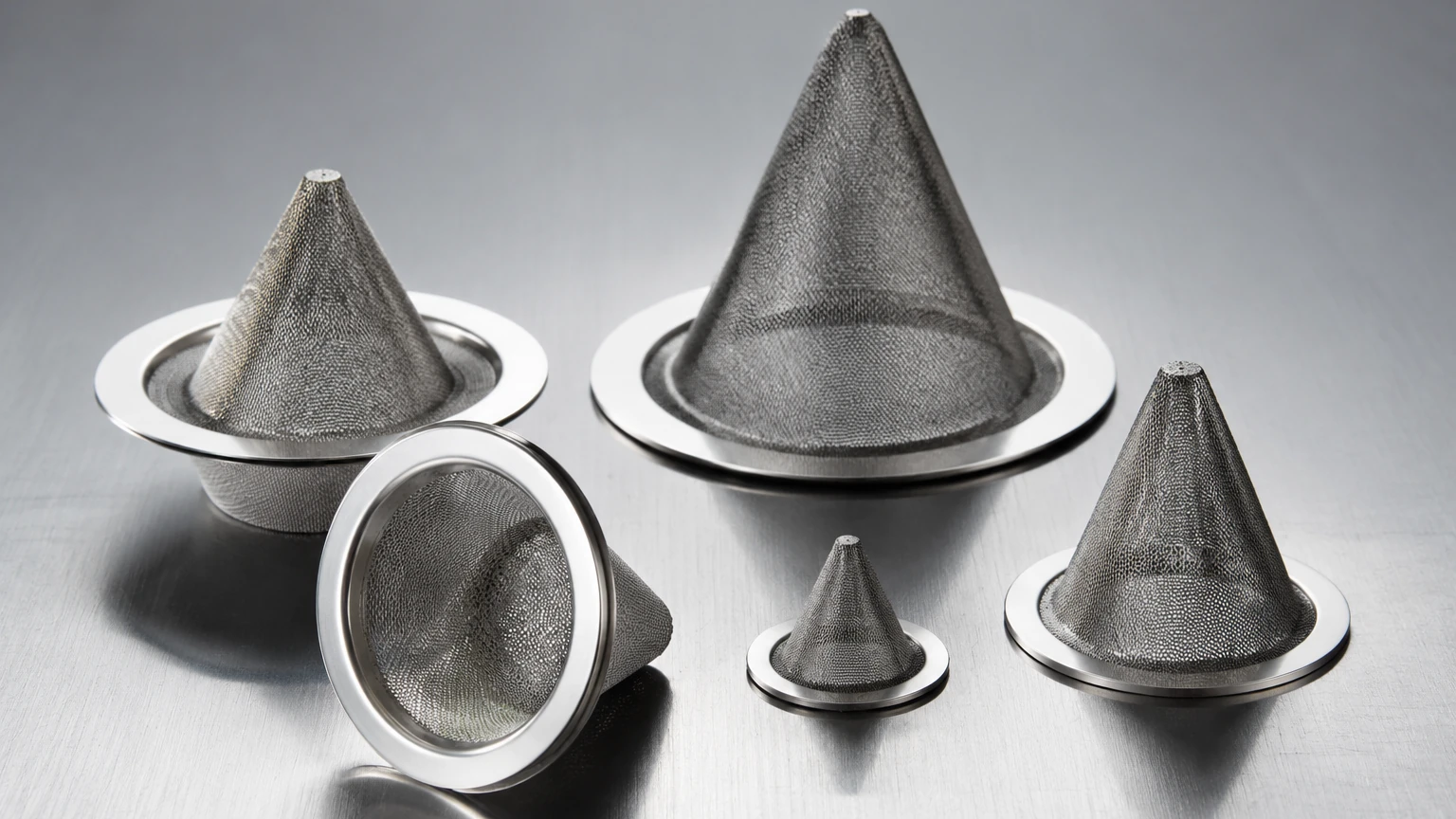
Witches hat strainers derive their name from their distinct conical shape. They are categorized as temporary filtration devices, typically installed between two pipe flanges within a process line. Their primary function is to capture large particulate matter during the initial "run-in" period of a plant or after significant maintenance work has been performed on the piping network.
Unlike permanent basket strainers or Y-strainers, which are housed in dedicated cast or fabricated bodies, witches hat strainers are designed for ease of insertion and removal. They consist of a conical filtration element attached to a flat ring or flange plate. This plate is sandwiched between gaskets and secured by the flange bolts of the existing piping. This design allows for high-velocity filtration without the need for permanent structural modifications to the system.
In many industrial applications, these strainers are removed once the system has been flushed and the fluid is verified to be free of startup contaminants. However, in specific low-solids applications where space is at a premium, they may remain as a cost-effective, long-term filtration solution, provided they are monitored for pressure differential and structural integrity.
Engineering and Design Specifications
The performance of a witches hat strainer is dictated by its geometry, material composition, and structural reinforcement. When specifying these components for industrial use, several engineering factors must be evaluated to ensure they can withstand the mechanical stresses of the flow.
Material Selection
Stainless steel is the industry standard for conical strainers due to its superior corrosion resistance and mechanical strength. Common grades include:
* AISI 304: Suitable for general industrial applications, water treatment, and mildly corrosive environments.
* AISI 316/316L: Preferred for chemical processing, pharmaceutical, and marine applications where resistance to pitting and chloride-induced corrosion is required.
* Specialty Alloys: For highly aggressive media, materials like Monel or Hastelloy may be utilized to prevent premature failure.
Structural Construction
A standard witches hat strainer often utilizes a dual-layer construction. The outer layer typically consists of a perforated metal plate which provides the necessary mechanical rigidity to prevent the cone from collapsing under high differential pressure. The inner layer (or outer layer, depending on flow direction) consists of a fine stainless steel wire mesh that determines the filtration accuracy.
For applications involving high flow rates or viscous fluids, the cone may be reinforced with longitudinal ribs or a heavier gauge perforated plate. The "tail" of the cone—the apex—can also be reinforced or left flat (truncated) to manage the turbulence and stress concentration at the tip.
Geometry and Length-to-Diameter Ratios
The length of the cone relative to the pipe diameter significantly impacts the available filtration area. Standard designs often feature a 100%, 150%, or 200% open area ratio relative to the cross-sectional area of the pipe. A longer cone (the "long-style" witches hat) provides a larger surface area, which results in a lower initial pressure drop and a longer service life before cleaning is required. Engineers must balance the desire for maximum surface area with the physical space available in the piping run.
Filtration Performance and Selection Factors
Selecting the correct witches hat strainer requires a detailed analysis of the process fluid and the specific particles that need to be removed. Over-specifying filtration (choosing a mesh that is too fine) can lead to rapid clogging and excessive pressure drop, while under-specifying can allow damaging debris to pass through.
Micron Rating and Mesh Size
Filtration accuracy is defined by the mesh count or micron rating. In industrial commissioning, the goal is usually to remove "macro" contaminants such as weld beads and metal shavings. Common mesh sizes range from 10 mesh (approx. 2000 microns) for coarse debris to 100 mesh (approx. 150 microns) for finer protection. If finer filtration is required, multiple layers of mesh may be sintered or bonded to the support structure. For more information on precise filtration capabilities, technical teams can Review product options and application support to match mesh specifications with process requirements.
Open Area Ratio
The open area ratio is the ratio of the total area of the holes in the strainer to the cross-sectional area of the inlet pipe. A ratio of 100% means the strainer has the same open area as the pipe, but this does not account for the restriction caused by the mesh. In practice, most engineers specify a 150% to 300% open area ratio to ensure that even as the strainer begins to collect debris, the pressure drop remains within acceptable limits for the pump or system design.
Flow Direction
While most witches hat strainers are designed for "inside-to-outside" flow—where debris is captured within the cone—some applications require "outside-to-inside" flow. The direction of flow must be specified during the design phase to ensure the reinforcement (perforated metal) is placed on the downstream side of the wire mesh. If the flow direction is reversed against an unsupported mesh, the mesh will likely tear or bypass.
Application Scenarios: Beyond Startup
While primarily known as temporary startup strainers, witches hat strainers are utilized in various scenarios across different industries due to their simplicity and low cost.
* Chemical Processing: Used during the commissioning of new reactors and heat exchangers to prevent debris from fouling sensitive surfaces.
* Food and Beverage: Employed in lines where batch changes occur, and temporary protection is needed to ensure no foreign objects enter the mixing or filling stages.
* Hydraulic Systems: Installed in large-scale hydraulic return lines during the initial flushing of the system to capture assembly-related contaminants.
* Water Treatment: Used in the protection of membrane systems and fine filters during the initial startup of a plant when the intake piping may still contain sand or silt.
In these applications, the durability of the stainless steel construction provided by Kaifil ensures that the strainer does not become a source of contamination itself, which is a critical risk with lower-quality carbon steel or plastic alternatives.
Installation and Operational Best Practices
Proper installation is critical to the performance and safety of a witches hat strainer. Because these components are held in place by the compression of pipe flanges, several factors must be considered during the installation process.
Flange Alignment and Gasketing
The strainer plate must be centered accurately between the flanges. Misalignment can lead to uneven stress on the flange bolts and potential leaks. It is standard practice to use gaskets on both sides of the strainer plate to ensure a bubble-tight seal. The thickness of the strainer plate (usually 1/8" to 1/4") must be accounted for in the piping layout to ensure the flanges can be closed without overstressing the pipe hangers.
Monitoring Differential Pressure
The most common cause of failure for a witches hat strainer is a collapse due to excessive differential pressure (DP). As the strainer collects debris, the resistance to flow increases. If the DP exceeds the structural limit of the cone, it can buckle or "blow through," sending both the debris and the fragments of the strainer downstream into the very equipment it was meant to protect.
Engineers should install pressure gauges upstream and downstream of the strainer location. A maximum allowable DP should be established (typically 5 to 10 psi for temporary strainers), and the strainer should be removed and cleaned once this limit is reached.
Cleaning and Maintenance
Because they are temporary, witches hat strainers are often designed to be cleaned and reused during the commissioning phase. Stainless steel mesh can be cleaned using high-pressure water, steam, or ultrasonic baths, depending on the nature of the contaminants. However, if the mesh shows signs of fraying or the perforated support is deformed, the strainer must be replaced immediately.
Customization and OEM Capabilities
Many industrial systems have unique constraints that standard off-the-shelf strainers cannot accommodate. This is where the value of a specialized manufacturer like Kaifil becomes evident. Customization options for witches hat strainers include:
1. Non-Standard Dimensions: Custom cone lengths and diameters to fit into tight piping configurations or to meet specific open-area requirements.
2. Reinforced Apexes: Adding heavy-duty caps to the tip of the cone to handle high-velocity impact from large solids.
3. Specific Flange Faces: Machining the ring plate to match specialized flange faces, such as Ring Type Joint (RTJ) or Tongue and Groove.
4. Multi-Stage Filtration: Combining different mesh sizes in a single conical unit to provide graduated filtration.
By working with an OEM partner, engineering teams can ensure that the filtration component is perfectly matched to the fluid dynamics and chemical compatibility of their specific process.
Total Cost of Ownership and Procurement Considerations
When evaluating the cost of witches hat strainers, it is a mistake to look only at the initial purchase price. The "total cost" includes the potential risk of equipment failure if a low-quality strainer fails. A high-quality stainless steel strainer from a reputable manufacturer prevents expensive downtime and repairs to pumps and valves that can cost thousands of dollars.
Procurement teams should verify the following before finalizing a purchase:
* Material Certification: Ensure the stainless steel grade is verified (MTRs – Material Test Reports).
* Welding Quality: Inspect the longitudinal seam of the cone; it should be a continuous, high-quality weld (TIG or plasma) to prevent bypass.
* Lead Times: Since these are often needed for critical project milestones, reliable delivery schedules are essential.
In conclusion, while witches hat strainers may appear to be simple components, their role in industrial system protection is vital. By selecting high-quality stainless steel constructions, adhering to proper engineering specifications, and following rigorous installation protocols, industrial operators can safeguard their infrastructure during the most vulnerable stages of operation. For technical support and customized filtration solutions, visiting the Main Page of Kaifil provides access to the expertise required for demanding industrial applications.
