


High Pressure Oil Filter
In industrial hydraulic and lubrication systems, the high pressure oil filter serves as the primary line of defense for sensitive downstream components. Positioned between the pump and critical actuators or valves, these filters must withstand extreme structural stresses while maintaining precise filtration efficiency. For engineers and maintenance professionals, selecting the correct high pressure oil filter is not merely a matter of matching port sizes; it requires a deep understanding of fluid dynamics, material fatigue, and the specific contamination challenges of high-pressure environments.
As systems evolve toward higher power densities and tighter tolerances, the demand for robust filtration solutions has increased. A failure in a high-pressure line can lead to catastrophic component damage, unscheduled downtime, and significant safety risks. This guide examines the technical requirements, engineering considerations, and selection criteria for high-pressure filtration components in demanding industrial applications.
The Role of High Pressure Oil Filters in Industrial Systems
High pressure oil filters are specifically designed to operate on the discharge side of the hydraulic pump. Unlike suction filters, which protect the pump from large debris, or return-line filters, which clean fluid before it enters the reservoir, high-pressure filters protect the most expensive and sensitive parts of the system, such as servo valves, proportional valves, and high-precision cylinders.
In a typical circuit, the pump generates flow, and the system resistance generates pressure. This pressure can range from 1,000 psi to over 6,000 psi (70 to 420 bar) in heavy industrial machinery. The high pressure oil filter must be capable of handling these pressures without housing deformation or element collapse. Its primary role is to intercept "built-in" contaminants from the pump—such as wear particles—before they reach the rest of the system.
Furthermore, these filters provide "point-of-use" protection. Even if the main reservoir fluid is relatively clean, internal pump wear can introduce metallic particulates directly into the high-pressure stream. Without a robust filter in place, these particles can cause "stiction" in valves or abrasive wear in actuators, leading to a rapid decline in system performance.
Engineering Considerations for High-Pressure Environments
Designing or selecting a high pressure oil filter requires balancing several conflicting engineering requirements: filtration fineness, pressure drop, and structural integrity.
Fatigue and Pressure Pulsations
Industrial hydraulic systems are rarely static. They are subject to frequent pressure pulsations and flow surges as valves open and close. A filter housing and its internal element must be engineered to withstand millions of pressure cycles. Fatigue life is a critical metric; a housing rated for 6,000 psi static pressure may fail prematurely if subjected to constant 5,000 psi pulsations if its fatigue limit is not properly calculated. Engineers should look for filters that have undergone rigorous impulse testing to ensure long-term reliability.
Differential Pressure ($ΔP$)
Every filter introduces a resistance to flow, known as pressure drop or differential pressure. In high-pressure systems, an excessive $ΔP$ can lead to energy loss and heat generation. More importantly, as the filter element becomes loaded with contaminants, the $ΔP$ increases. The element must be structurally sound enough to resist the maximum possible differential pressure before the bypass valve opens or the element collapses. Typical collapse ratings for high-pressure elements range from 300 psi to over 3,000 psi, depending on whether a bypass valve is integrated into the system.
Material Selection: Why Stainless Steel Dominates High-Pressure Applications
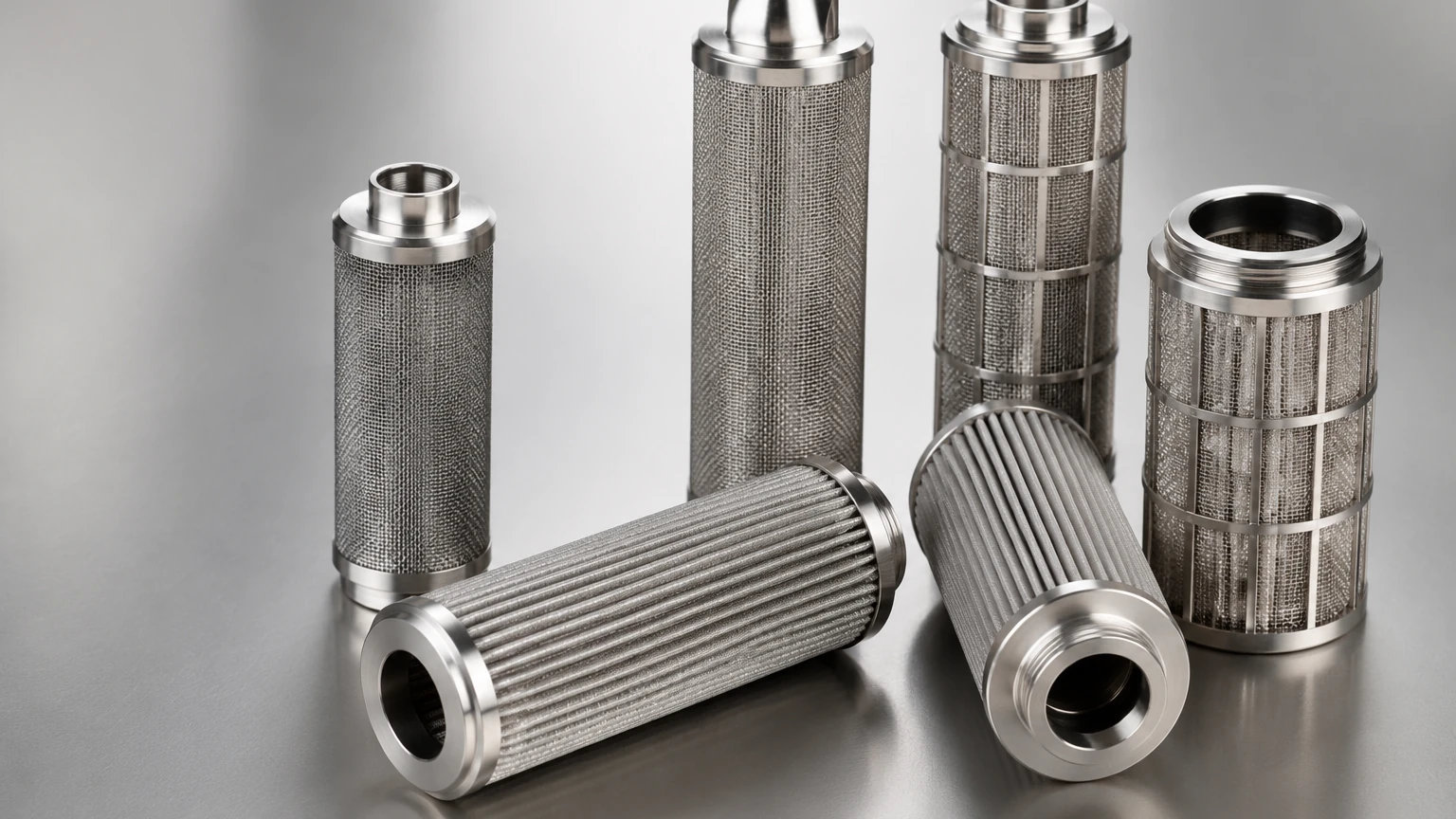
The choice of material for the filter element is paramount in high-pressure applications. While cellulose and synthetic fibers are common in low-pressure return lines, stainless steel wire mesh and sintered metal fibers are the preferred choices for high-pressure oil filters in critical industrial processes.
Structural Integrity
Stainless steel provides the mechanical strength necessary to resist pleat bunching and deformation under high flow velocities. In high-pressure circuits, fluid velocity can be significant, and the physical force exerted on the filter media is substantial. Stainless steel wire mesh, often reinforced with support layers, maintains its geometric integrity, ensuring that the filtration area remains effective throughout the service life.
Chemical and Thermal Compatibility
High-pressure systems often operate at elevated temperatures, which can degrade organic filter media. Stainless steel is inert to most hydraulic fluids, including synthetic oils, water-glycols, and high-temperature phosphate esters. This makes it the standard for chemical processing and power generation applications where fluid chemistry and temperature fluctuate.
Cleanability and Reusability
Unlike disposable glass fiber elements, stainless steel wire mesh filters can often be cleaned and reused, depending on the nature of the contaminant. This is particularly advantageous in remote industrial sites or in processes where the cost of specialized replacement elements is high. However, the cleaning process must be validated to ensure the pore structure is not damaged and that the original filtration rating is restored.
Understanding Filtration Efficiency and Beta Ratings
When evaluating a high pressure oil filter, the "micron rating" is often the first specification checked, but it can be misleading if not accompanied by a Beta Ratio (β). The Beta Ratio, derived from the ISO 16889 multi-pass test, provides a more accurate picture of a filter's efficiency.
* Absolute vs. Nominal: A nominal rating is an arbitrary micrometer value indicated by the manufacturer, often representing a 50% to 95% efficiency. An absolute rating typically refers to an efficiency of 99.5% or higher (β ≥ 200) at a given micron size.
* The Beta Ratio (βx): This is the ratio of the number of particles greater than a given size (x) in the upstream fluid to the number of particles of the same size in the downstream fluid. For example, if a filter has a β10 = 1000, it means that for every 1,000 particles of 10 microns entering the filter, only one passes through.
For high-pressure systems protecting servo-valves, a high Beta ratio (βx ≥ 1000) at a low micron rating (e.g., 3μm or 5μm) is often required to maintain the fluid cleanliness levels specified by ISO 4406 codes.
Critical Components of a High Pressure Oil Filter Assembly
A complete high-pressure filter assembly consists of more than just the filter media. Each component must be engineered for the specific demands of the application:
1. The Filter Head and Bowl: Usually constructed from high-strength ductile iron or carbon steel, though stainless steel is used for corrosive environments. The threaded or flanged connection between the head and bowl must be designed to prevent leaks under high-pressure spikes.
2. The Filter Element: This is the heart of the assembly. It often features a pleated design to maximize surface area, a perforated inner support tube (core), and protective outer wrapping.
3. Bypass Valve: In many designs, a bypass valve is included to protect the system from oil starvation if the filter becomes completely clogged. However, in some critical "non-bypass" applications, the filter element is designed with a high collapse pressure (e.g., 3,000 psi) to ensure that no unfiltered oil ever reaches the downstream components, even if the filter is blocked.
4. Clogging Indicators: These devices monitor the differential pressure across the element. They can be visual (a pop-up button), electrical (a switch that sends a signal to a PLC), or both. They provide the necessary data for predictive maintenance.
5. Seals: O-rings and gaskets must be compatible with the fluid and the operating temperature. Viton (FKM) is frequently used in high-pressure oil filters due to its wide chemical resistance and high-temperature stability.
Common Failure Modes and Risk Mitigation
Understanding how a high pressure oil filter can fail is essential for engineering a reliable system. Common failure modes include:
* Element Collapse: If the differential pressure exceeds the element's structural limit, the media can tear or the center tube can crush. This usually happens during cold starts when oil viscosity is high, or if a clogging indicator is ignored.
* Fatigue Cracking: Repeated pressure cycles can cause the filter housing to develop micro-cracks, eventually leading to a high-pressure leak or burst. This is mitigated by selecting housings with appropriate fatigue ratings.
* Channeling: If the filter media is not properly supported, high-velocity fluid can create "channels" through the media, allowing contaminants to pass through unfiltered.
* Bypass Leakage: If the bypass valve is poorly designed or stuck partially open, a portion of the fluid will always remain unfiltered, leading to a slow but steady increase in system contamination.
To mitigate these risks, it is vital to work with a manufacturer that understands the nuances of custom filtration. For those looking to explore specific configurations and engineering data, you can Review product options and application support on our Main Page.
Selection Guide for Engineers and Purchasing Teams
When specifying a high pressure oil filter for a new project or as a replacement in an existing system, use the following checklist to ensure all technical requirements are met:
1. Maximum Operating Pressure: Ensure the housing is rated for the peak system pressure, including potential surges. Confirm the fatigue pressure rating if the system has high-frequency cycles.
2. Flow Rate and Viscosity: Calculate the pressure drop at the maximum expected flow rate and the highest expected oil viscosity (usually at the lowest operating temperature). The $ΔP$ should typically not exceed 10-15 psi with a clean element at operating temperature.
3. Filtration Rating: Identify the ISO 4406 cleanliness level required by the most sensitive downstream component. Select a filter with a Beta ratio that can achieve and maintain that level.
4. Fluid Compatibility: Confirm that all materials in the filter (media, seals, adhesives, and housing) are compatible with the hydraulic fluid.
5. Environment: Consider external factors such as ambient temperature, exposure to salt spray (offshore applications), or the presence of corrosive chemicals.
6. Installation Space: High-pressure filters can be bulky. Ensure there is enough clearance to remove the bowl and replace the element during maintenance.
7. Customization Requirements: Does the application require non-standard port sizes, specific mounting brackets, or specialized indicators? OEM manufacturers like Kaifil specialize in tailoring these components to specific industrial footprints.
Maintenance and Monitoring Strategies
The effectiveness of a high pressure oil filter is only as good as the maintenance program supporting it. Because these filters are located in the high-pressure line, maintenance must be performed with extreme care.
Differential Pressure Monitoring
The most reliable way to determine when to change a filter element is by monitoring the differential pressure. Changing elements on a fixed time schedule often leads to either premature replacement (wasted cost) or delayed replacement (increased risk of bypass or collapse). Modern systems utilize electronic sensors that provide real-time data to a central control system, allowing for "just-in-time" maintenance.
Cold Start Considerations
In many industrial environments, hydraulic oil is thick when the machine is first started. This high viscosity creates a high differential pressure that might trigger a clogging indicator or open a bypass valve. Engineers should specify filters with "thermal lockout" indicators that ignore pressure spikes caused by cold oil, or ensure the system has a warm-up cycle before full flow is directed through the high-pressure filter.
Oil Analysis
While the filter removes particles, regular oil analysis is necessary to monitor the overall health of the fluid. An increase in specific types of metallic particles can indicate that a pump or motor is beginning to fail, even if the high pressure oil filter is successfully capturing the debris. The filter and the oil analysis report work together to provide a complete picture of system health.
Conclusion
A high pressure oil filter is a critical investment in the longevity and reliability of industrial machinery. By selecting an element with the correct structural strength—such as stainless steel wire mesh—and a housing rated for the appropriate fatigue life, engineers can significantly reduce the risk of component failure.
Whether you are designing a new hydraulic power unit or optimizing an existing chemical processing line, understanding the technical boundaries of filtration is essential. For professional guidance on material selection, filtration accuracy, and customized designs for demanding industrial environments, technical teams should consult with experienced manufacturers who can provide reliable OEM solutions tailored to specific application requirements.
