


Amar Equipments Continuous Flow Reactors Hastelloy
In the landscape of modern chemical engineering, the transition from batch processing to continuous flow chemistry represents a significant shift toward operational efficiency, safety, and scalability. Among the leading solutions in this space are the systems developed by Amar Equipments, particularly those constructed from high-performance alloys like Hastelloy. For engineers and technical professionals, understanding the integration of these reactors with precision filtration components is essential for maintaining process integrity and achieving consistent output. This guide explores the technical considerations surrounding Amar Equipments continuous flow reactors Hastelloy, focusing on material science, engineering requirements, and the critical role of filtration in high-corrosion environments.
The Evolution of Continuous Flow Reactors
Continuous flow reactors, often referred to as plug flow reactors (PFR) or tubular reactors, allow for the constant movement of reactants through a controlled thermal and pressurized environment. Unlike batch reactors, where all ingredients are processed in a single vessel over a set time, continuous flow systems offer superior heat transfer and mixing capabilities. This is particularly advantageous for exothermic reactions or processes involving hazardous intermediates.
Amar Equipments has established a reputation for providing robust continuous flow solutions that cater to laboratory, pilot, and industrial scales. When these systems are specified with Hastelloy, they become capable of handling some of the most aggressive chemical environments known in the pharmaceutical, petrochemical, and specialty chemical industries. The choice of material is not merely a preference but a technical necessity driven by the thermodynamics and chemistry of the intended application.
Material Science: Why Hastelloy is Critical
Hastelloy is a family of nickel-based superalloys designed for high resistance to corrosion and high temperatures. In the context of continuous flow reactors, where fluids are often moving at high velocities under significant pressure, the risk of erosion-corrosion and localized pitting is heightened.
Corrosion Resistance
Common grades such as Hastelloy C-276, C-22, and B-3 are frequently utilized in the construction of reactor bodies and internal components. These alloys contain high percentages of nickel, molybdenum, and chromium, which provide a stable passive layer even in the presence of reducing and oxidizing acids. For processes involving hydrochloric acid, sulfuric acid, or chloride-rich environments, Hastelloy outperforms standard 316L stainless steel by several orders of magnitude in terms of longevity and safety.
Thermal Stability
Continuous flow reactions often operate at elevated temperatures to accelerate kinetics. Hastelloy maintains its mechanical strength and creep resistance at temperatures where other metals might soften or fail. This allows for thinner reactor walls (improving heat transfer) without compromising the pressure rating of the system.
Integration of Filtration in Continuous Flow Systems
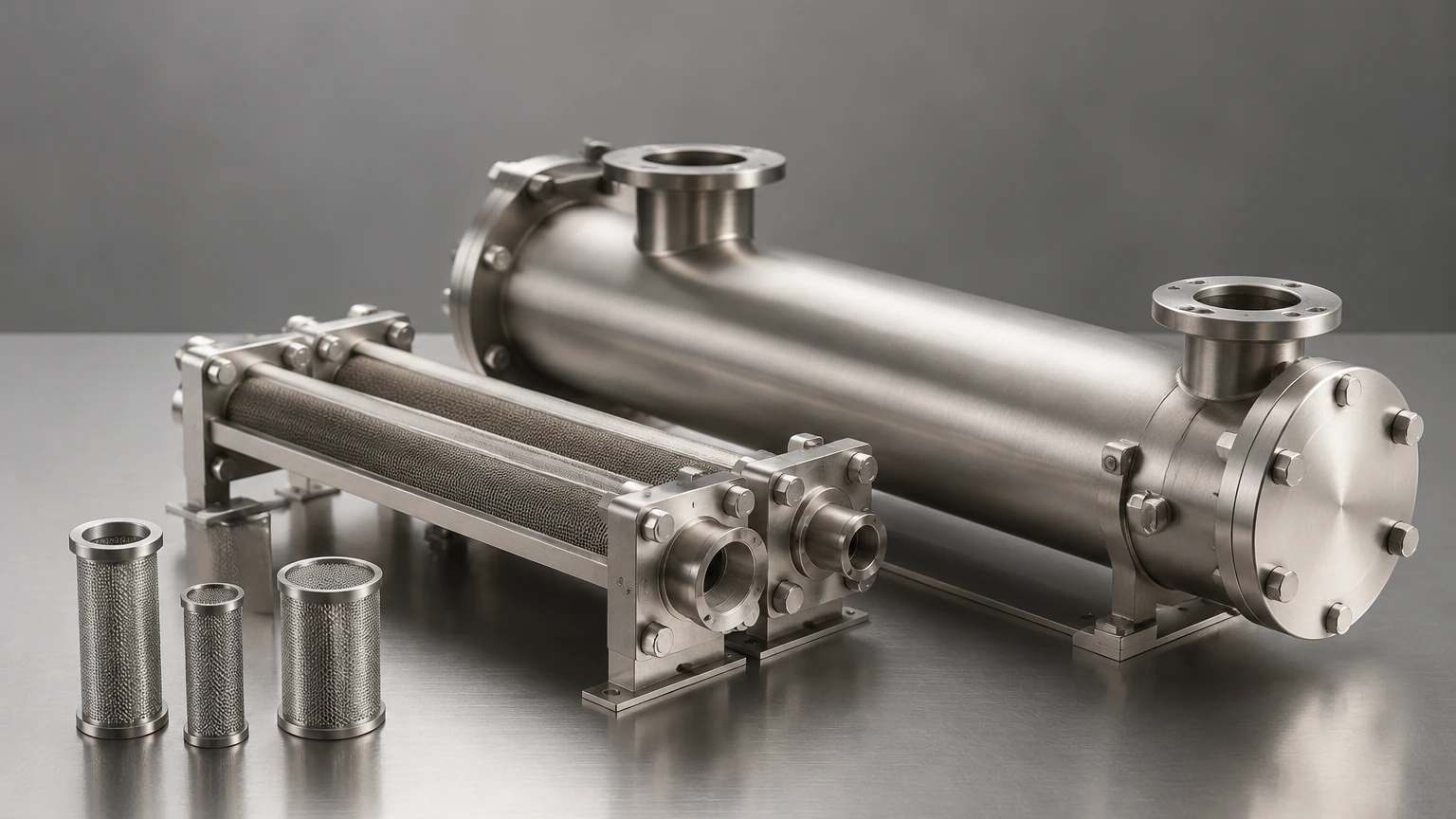
A critical yet often overlooked component of a successful continuous flow setup is the filtration system. Whether the process involves catalyst recovery, the removal of precipitated byproducts, or the protection of sensitive downstream analytical equipment, the filtration hardware must match the reactor's material specifications.
As a manufacturer specializing in custom stainless steel and metal filtration solutions, Kaifil provides the necessary components to ensure these reactors operate without interruption. For more information on our full range of industrial filtration products, you can visit our Main Page.
Catalyst Retention and Recovery
Many continuous flow processes utilize heterogeneous catalysts. If the catalyst particles escape the reactor zone, they can clog downstream valves, contaminate the final product, or cause damage to pumps. Sintered metal filters or precision wire mesh components are integrated into the flow path to retain these catalysts. When the reactor is made of Hastelloy, the filter elements must also be constructed from compatible materials to prevent galvanic corrosion and ensure uniform chemical resistance.
Engineering Considerations for Amar Equipments Continuous Flow Reactors Hastelloy
When specifying or evaluating Amar Equipments continuous flow reactors Hastelloy, engineers must consider several technical variables to ensure the system meets the specific needs of their process.
1. Pressure Drop Management
In a continuous system, the pressure drop across the reactor and its associated filters is a primary performance metric. Excessive pressure drop can lead to pump cavitation or system shutdowns. Filtration components must be designed with high porosity and optimized surface area—often through pleating or multi-layer sintering—to minimize resistance while maintaining high filtration efficiency.
2. Residence Time Distribution (RTD)
The efficiency of a flow reactor depends on the residence time of the reactants. Any dead zones within the reactor or the filtration housing can lead to secondary reactions or product degradation. Engineering custom filter housings that minimize hold-up volume is essential for maintaining a tight RTD and high product purity.
3. Scaling from Lab to Production
A major benefit of continuous flow technology is the relative ease of scaling. However, scaling up requires a thorough understanding of the fluid dynamics. Amar Equipments provides systems that allow for seamless transition, but the filtration requirements often change as volumes increase. Larger flow rates may necessitate larger filter surface areas or automated backwashing systems to prevent frequent maintenance cycles.
Selection Criteria for Filtration Components
When integrating filtration into a Hastelloy-based flow system, the selection of the filter media is as important as the reactor itself. Engineers should evaluate the following criteria:
* Micron Rating: Determining the absolute vs. nominal filtration required for the process. In pharmaceutical applications, sub-micron filtration may be necessary, whereas industrial chemical processes might only require 10-50 micron retention.
* Material Compatibility: Ensuring that every component—from the mesh to the support structures and gaskets—is compatible with the process fluid. While the reactor might be Hastelloy, some internal filter supports might be made from other high-nickel alloys depending on the mechanical requirements.
* Cleaning Protocols: In continuous systems, downtime is costly. Filters should be designed for easy cleaning, whether through ultrasonic baths, chemical cleaning (CIP), or back-pulsing.
Kaifil specializes in manufacturing these precision components, offering OEM and customized designs that align with the rigorous standards of industrial flow chemistry. By focusing on durability and precise filtration performance, we support the operational goals of facilities using advanced reactor technology.
Common Risks and Mitigation Strategies
Operating Amar Equipments continuous flow reactors Hastelloy involves managing specific risks associated with high-pressure and high-temperature chemistry.
Fouling and Clogging
Fouling is the most common cause of failure in flow reactors. It can be caused by the precipitation of salts, polymerization of reactants, or the accumulation of catalyst fines. Implementing a dual-filter system (duplex arrangement) allows for the switching of flow to a clean filter without stopping the reaction, ensuring continuous operation.
Thermal Shock
Rapid changes in temperature can cause mechanical stress on the reactor and its internal components. Hastelloy has a specific coefficient of thermal expansion that must be accounted for in the design of filter supports and seals to prevent leaks or structural failure.
Chemical Degradation of Seals
While the metal components are resistant to corrosion, the elastomeric seals (O-rings) are often the weak point. In Hastelloy systems, high-performance polymers like PTFE or FFKM (Kalrez) are typically used. Engineers must verify that these seals can withstand the same chemical and thermal loads as the Hastelloy reactor body.
The Role of Customization in Industrial Filtration
No two chemical processes are identical, and off-the-shelf filtration solutions often fall short in specialized flow chemistry applications. Customization allows for the optimization of filter geometry, material thickness, and pore structure.
For instance, in a reactor system where space is limited, a custom-designed sintered metal cartridge can provide the necessary surface area within a compact footprint. Furthermore, the ability to specify the exact grade of Hastelloy for the filter media ensures that the entire system has a uniform expected lifespan, preventing premature failure of the filtration stage.
Conclusion: Optimizing the Flow Process
The use of Amar Equipments continuous flow reactors Hastelloy represents a high-tier investment in chemical processing infrastructure. To realize the full benefits of these systems—namely increased safety, higher yields, and consistent quality—the supporting filtration infrastructure must be equally robust.
By understanding the interplay between material science and fluid dynamics, engineers can design systems that minimize downtime and maximize throughput. Whether you are developing a new pilot plant or optimizing an existing industrial line, selecting the right filtration partner is essential. Kaifil remains committed to providing the technical expertise and high-quality metal filtration components required to support these demanding applications.
For technical support or to review our product options and application support, please visit our Main Page and consult with our engineering team to develop a solution tailored to your specific reactor configuration and process requirements.
Download Amar Equipments Continuous Flow Reactors Hastelloy as a PDF
