


Centrifuge Beer Filtration
In the modern brewing industry, achieving consistent clarity and shelf stability while maintaining high throughput is a primary engineering challenge. Centrifuge beer filtration has emerged as a cornerstone technology for breweries looking to optimize their clarification processes. Unlike traditional sedimentation or depth filtration methods that rely solely on gravity or consumable media, centrifugation utilizes mechanical force to accelerate the separation of solids from liquids. This process is often integrated with high-precision stainless steel filtration components to ensure the final product meets stringent quality standards.
For engineers and production managers, understanding the technical nuances of centrifuge beer filtration—and the role of supporting filtration hardware—is essential for optimizing yield and protecting the sensory profile of the beer.
Understanding the Fundamentals of Centrifuge Beer Filtration
Centrifuge beer filtration operates on the principle of centrifugal force, which is significantly more powerful than gravity. In a typical brewery setting, a disk-stack centrifuge is employed. As the beer enters the rotating bowl, it is subjected to high G-forces, often exceeding 5,000 to 8,000 Gs. This force causes denser particles, such as yeast cells, hop resins, and large protein complexes (trub), to move outward against the disks and eventually settle on the periphery of the bowl.
The clarified beer, being less dense, moves toward the center of the bowl and is discharged through a paring disk or similar mechanism. This mechanical separation is governed by Stokes' Law, which describes the settling velocity of particles in a fluid. By increasing the gravitational constant (G) through rotation, the centrifuge allows for rapid separation that would otherwise take days in a fermentation or conditioning tank.
From an engineering perspective, centrifuge beer filtration offers several advantages:
* Reduced Processing Time: It eliminates the need for long cold-crashing periods, allowing for faster tank turnover.
* Increased Yield: Centrifuges can recover more beer from the bottom of the tank compared to traditional racking methods, where a significant amount of liquid is lost with the yeast slurry.
* Consistency: Mechanical separation provides a predictable level of turbidity (measured in NTU or EBC), regardless of the initial solids loading.
Integrating Centrifugation with Mechanical Filtration Systems
While a centrifuge is highly effective at removing the bulk of yeast and solids, it is rarely the sole filtration step in a professional brewery. To achieve "bright beer" or to meet microbiological stability requirements, centrifugation is typically paired with stainless steel wire mesh filters or cartridge systems. These components serve as critical safeguards and polishing stages.
Pre-filtration and Protection
Before beer enters the centrifuge, it may pass through a coarse stainless steel mesh filter. This step is vital for protecting the internal components of the centrifuge from large debris, such as whole hop cones or hardware fragments, which could cause imbalance or damage the high-speed rotating assembly. Kaifil’s custom wire mesh solutions are often designed for these high-flow, high-pressure environments, ensuring that only the intended process fluid reaches the centrifuge bowl.
Post-Centrifuge Polishing
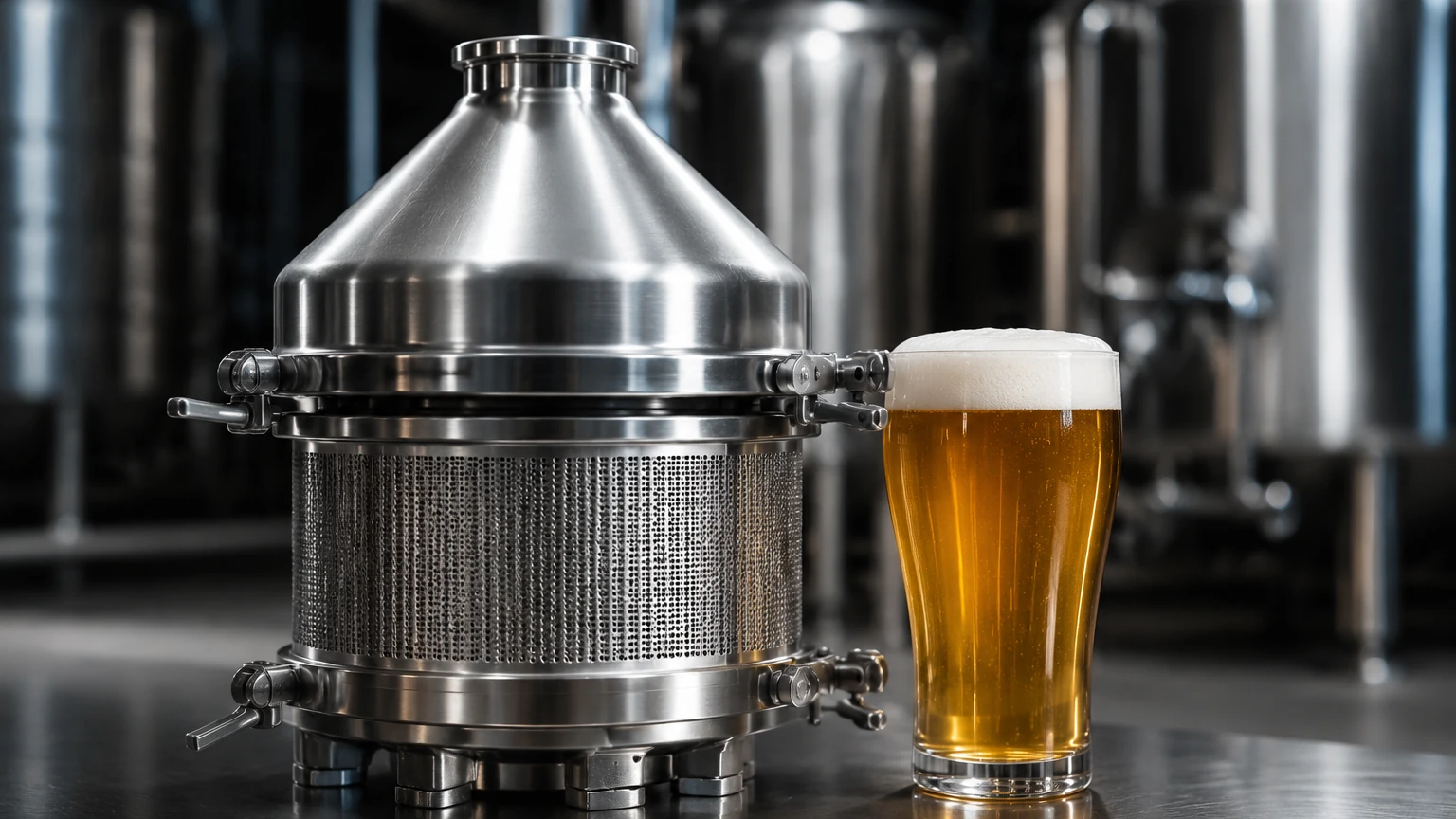
Even the most efficient centrifuge may leave behind fine particles or “dust” yeast. In many production lines, a secondary filtration stage using stainless steel filter cartridges follows the centrifuge. These cartridges, often utilizing pleated wire mesh or sintered metal media, provide a definitive micron rating to ensure the beer meets final clarity specifications. This hybrid approach—centrifuge for bulk removal and metal filters for final polishing—reduces the load on the secondary filters, significantly extending their service life and reducing the frequency of Clean-in-Place (CIP) cycles.
Engineering Considerations for Efficient Beer Clarification
When implementing centrifuge beer filtration, several technical factors must be managed to prevent product degradation. Engineers must balance separation efficiency with the physical properties of the beer.
Dissolved Oxygen (DO) Management
One of the greatest risks in beer filtration is the pickup of dissolved oxygen. Oxygen exposure leads to rapid staling and the development of off-flavors (such as trans-2-nonenal, or "cardboard" notes). Modern centrifuges are designed with hermetic seals or hydro-hermetic inlets to prevent air from entering the process stream. Supporting filtration components, including the housings and connectors provided by manufacturers like Kaifil, must also feature high-integrity seals and sanitary finishes to ensure the entire system remains anaerobic.
Temperature and Shear Stress
The mechanical action within a centrifuge can generate heat. Because beer is sensitive to temperature fluctuations, cooling jackets or heat exchangers are often integrated into the loop. Furthermore, high shear forces can rupture yeast cells (autolysis), releasing unwanted enzymes and lipids into the beer. Engineering the flow rates and bowl speeds is a delicate balance to achieve separation without compromising the biological integrity of the yeast or the foam stability of the beer.
Solids Discharge and Turbidity Control
Centrifuges are categorized as either "solid-bowl" (requiring manual cleaning) or "self-cleaning" (automatic solids discharge). In high-volume B2B environments, self-cleaning models are standard. These units use a hydraulic system to periodically open the bowl and eject the collected solids. Monitoring the turbidity at the outlet allows the PLC (Programmable Logic Controller) to adjust the discharge frequency, ensuring consistent clarity even if the yeast concentration in the feed fluctuates.
Selecting Stainless Steel Filter Media for Brewery Applications
The choice of material for the filtration components surrounding the centrifuge is critical for long-term reliability. Stainless steel is the industry standard due to its corrosion resistance and ability to withstand rigorous sanitation protocols.
Material Grades: 304 vs. 316L
For most brewery applications, Grade 304 stainless steel is sufficient. However, in environments where aggressive cleaning chemicals or high-salinity water are used, Grade 316L is preferred. 316L contains molybdenum, which provides superior resistance to pitting and crevice corrosion. At Kaifil, we emphasize the use of high-quality alloys to ensure that filter cartridges and mesh components do not leach metallic ions into the beer, which could catalyze oxidation.
Micron Ratings and Filtration Accuracy
Selecting the correct micron rating for post-centrifuge filtration depends on the desired end product:
* Rough Filtration (5–10 microns): Used for removing residual yeast while maintaining some haze, common in certain craft styles.
* Fine Filtration (1–2 microns): Removes almost all yeast and large proteins for a clear, stable product.
* Sterile Filtration (0.45–0.65 microns): Required for shelf-stable bottled beer to remove spoilage bacteria and wild yeast.
Stainless steel wire mesh filters offer a distinct advantage here: they provide a fixed pore size that does not migrate or unload under pressure pulses, unlike some disposable depth filters.
Maintenance and CIP Protocols for Filtration Components
To maintain the efficiency of centrifuge beer filtration, a robust Clean-in-Place (CIP) regimen is mandatory. Filtration components must be designed to withstand high-temperature caustic (sodium hydroxide) and acid (phosphoric or nitric acid) washes.
Thermal and Chemical Resistance
Stainless steel filter cartridges are ideal for CIP because they do not degrade when exposed to the 80°C+ temperatures required for effective sanitation. Unlike polymer-based filters, metal mesh can be backwashed and reused hundreds of times, provided the cleaning protocol is followed. This durability is a key factor in the total cost of ownership for a brewery.
Inspection and Integrity Testing
Regular inspection of the filter media is necessary to check for signs of fatigue or blinding (permanent clogging). In a centrifuge setup, the secondary filters often act as an early warning system; if the filters clog faster than usual, it may indicate that the centrifuge is not operating at peak efficiency or that the solids discharge timing needs adjustment.
Evaluating Total Cost of Ownership in Industrial Filtration
While the initial capital expenditure (CAPEX) for a centrifuge and high-quality stainless steel filtration system is significant, the long-term operational expenses (OPEX) often justify the investment.
1. Reduced Consumables: By replacing Kieselguhr (diatomaceous earth) or disposable sheet filters with a centrifuge and cleanable metal filters, breweries eliminate the cost of purchasing and disposing of filter aids.
2. Labor Savings: Automated centrifuge systems require far less manual intervention than plate-and-frame filters.
3. Product Recovery: Even a 1% increase in beer recovery can translate to tens of thousands of dollars in annual revenue for a mid-sized brewery.
When evaluating suppliers for these systems, engineers should look for partners who provide detailed technical specifications and customization options. For those seeking to Review product options and application support, it is important to confirm that the filtration components are compatible with existing centrifuge flow rates and pressure requirements.
Custom OEM Solutions for Specialized Brewing Equipment
Every brewery has a unique footprint and specific production goals. Standard off-the-shelf filtration hardware may not always fit the piping constraints or the specific flow dynamics of a particular centrifuge model. Customization is often necessary to optimize the interface between the centrifuge and the rest of the cellar equipment.
Kaifil specializes in providing OEM and customized filtration solutions, including specialized filter cartridges and precision metal components tailored to the brewing industry. Whether it is a unique housing design to minimize footprint or a specific mesh weave to handle high-protein adjunct brews, custom engineering ensures that the filtration system supports the centrifuge rather than acting as a bottleneck.
Before finalizing a filtration strategy, technical teams should confirm:
* Flow Rate Compatibility: Ensure the filter housing and media can handle the maximum discharge rate of the centrifuge.
* Pressure Drop (Delta P): Calculate the expected pressure drop across the filter to ensure the centrifuge’s outlet pump can maintain the required flow.
* Sanitary Standards: Verify that all components meet 3-A or EHEDG sanitary design principles to prevent microbial harborages.
By focusing on these technical details, breweries can implement a centrifuge beer filtration system that enhances product quality, improves operational efficiency, and provides a rapid return on investment. For more information on high-performance filtration components, visit the Main Page to explore technical resources and product specifications.
