


Waste Water Purification
In the modern industrial landscape, waste water purification has transitioned from a regulatory obligation to a critical operational requirement. As global water scarcity increases and environmental standards become more stringent, industrial facilities must implement robust filtration systems to manage effluent effectively. For engineers and facility managers, the challenge lies in selecting filtration components that can withstand the harsh chemical and physical environments typical of industrial wastewater while maintaining high throughput and precise filtration accuracy.
High-performance filtration is the cornerstone of any effective purification strategy. By removing suspended solids, particulate matter, and contaminants at the source, facilities can protect downstream equipment, ensure compliance with discharge permits, and even facilitate water recycling processes. To explore a comprehensive range of industrial filtration components designed for these demanding environments, professionals can visit the Main Page for detailed technical specifications and product options.
The Role of Mechanical Filtration in Industrial Waste Water Purification
Waste water purification typically involves a multi-stage process: primary, secondary, and tertiary treatment. Mechanical filtration plays a pivotal role in the primary and tertiary stages. In the primary stage, coarse filtration removes large debris and suspended solids that could damage pumps or clog sensitive biological treatment systems. In the tertiary stage, fine filtration is employed to polish the water, removing microscopic particles to meet specific purity standards for reuse or safe environmental discharge.
Stainless steel wire mesh and sintered metal filters are preferred in these applications due to their structural integrity. Unlike polymer-based filters, metal filtration components do not deform under high pressure or degrade when exposed to the volatile organic compounds (VOCs) and varying pH levels often found in industrial effluent. The selection of the correct mesh weave and micron rating is essential to balance filtration efficiency with the required flow rate.
Engineering Advantages of Stainless Steel Filter Media
When designing a system for waste water purification, the choice of material significantly impacts the system's longevity and total cost of ownership. Stainless steel, particularly grades 304 and 316L, offers several engineering advantages:
Corrosion and Chemical Resistance
Industrial wastewater often contains corrosive agents, including acids, alkalis, and salts. Grade 316L stainless steel, containing molybdenum, provides superior resistance to pitting and crevice corrosion in chloride-rich environments. This ensures that the filter media maintains its pore geometry and structural strength over long operational cycles.
Thermal Stability
Many industrial processes discharge wastewater at elevated temperatures. Synthetic filter media may soften or lose their mechanical properties under thermal stress. Stainless steel components remain stable at temperatures exceeding several hundred degrees Celsius, making them ideal for steam-cleaned systems or high-temperature effluent streams.
Mechanical Strength and Durability
Waste water purification systems often operate under high differential pressures, especially as the filter cake builds up. Metal filters offer the rigidity necessary to prevent media migration or collapse. This durability allows for high-pressure backwashing, a critical feature for extending the service life of the filter without requiring frequent manual intervention.
Selecting Filtration Accuracy for Diverse Contaminants
Filtration accuracy, measured in microns (μm), defines the smallest particle size the filter can reliably capture. In the context of waste water purification, selecting the appropriate micron rating requires a detailed analysis of the particle size distribution (PSD) within the effluent.
1. Coarse Filtration (100μm – 1000μm+): Used for removing sand, scale, and large organic matter. This stage protects sensitive downstream components like high-pressure pumps and fine membranes.
2. Fine Filtration (5μm – 100μm): Employed for removing finer suspended solids and precipitates. This is often the final stage before the water is discharged or moved to a chemical treatment phase.
3. Ultra-Fine Filtration (Sub-5μm): Utilized in specialized applications where water must be reused for cooling or boiler feed. Sintered metal felt or multi-layered wire mesh is often required to achieve this level of precision while maintaining adequate flow.
Engineers must also consider the "absolute" versus "nominal" rating. For critical purification tasks, an absolute rating—ensuring 99.9% retention of the specified particle size—is necessary to prevent bypass and ensure consistent water quality.
Customization and OEM Solutions for Large-Scale Systems
Industrial waste water purification systems are rarely "one-size-fits-all." Factors such as space constraints, existing piping configurations, and specific flow requirements necessitate customized filtration components. Customization options often include:
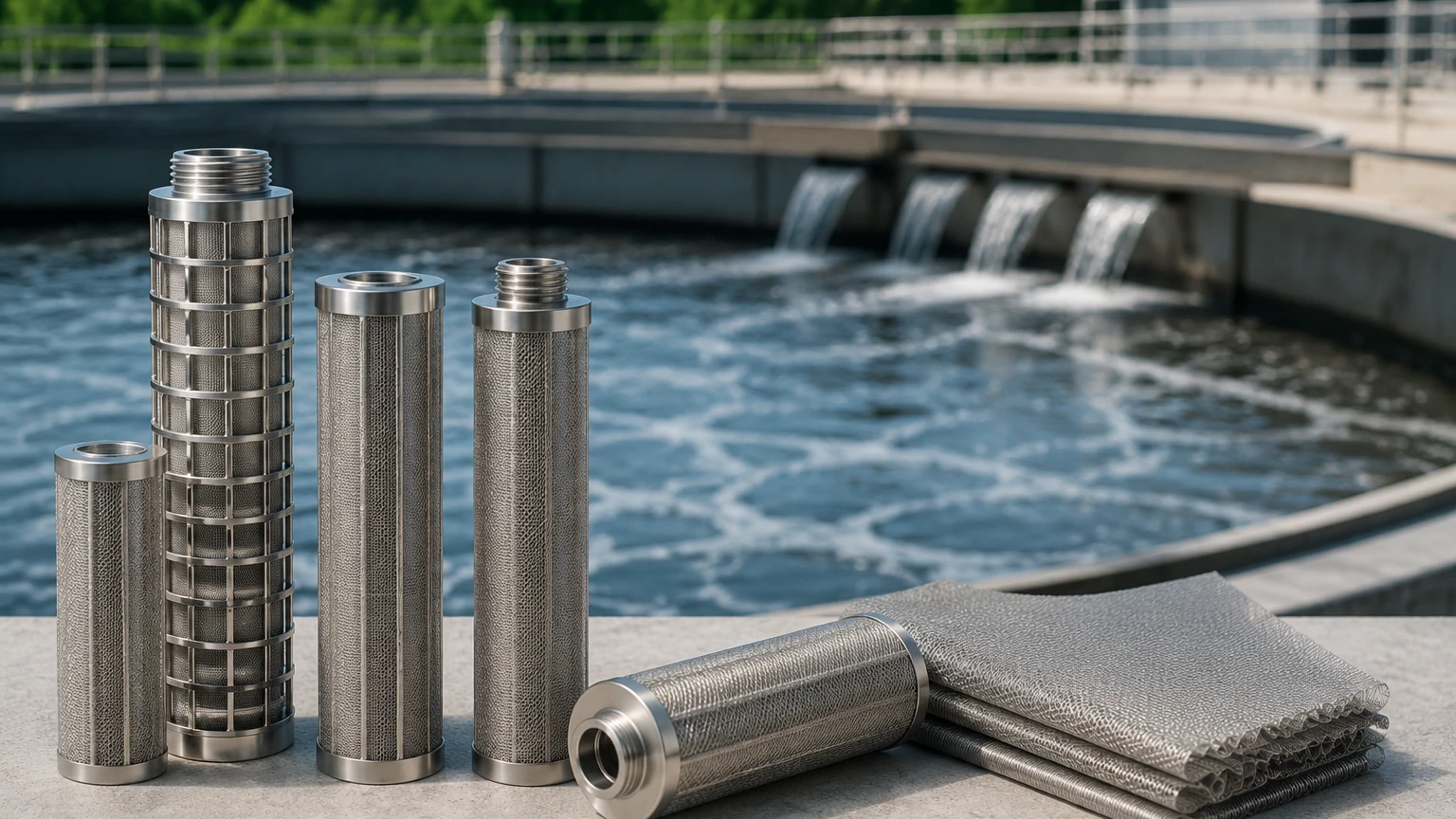
* Filter Geometry: Beyond standard cylindrical cartridges, filters can be engineered as pleated elements to increase surface area, or as flat discs and conical strainers for specific housing designs.
* End Cap Configurations: Compatibility with existing housings is achieved through custom-machined end caps (e.g., 222, 226, or threaded connections) ensuring a leak-proof seal.
* Reinforcement Layers: For high-pressure applications, wire mesh can be sintered with perforated metal or coarser mesh layers to provide additional mechanical support without significantly increasing pressure drop.
Working with an OEM manufacturer allows engineering teams to develop filtration solutions that are optimized for the specific rheology and contaminant load of their waste water stream, leading to higher efficiency and reduced downtime.
Operational Efficiency: Cleaning Cycles and Maintenance
The efficiency of a waste water purification system is heavily dependent on how the filter media handles fouling. As particles accumulate on the surface or within the depth of the media, the differential pressure (ΔP) across the filter increases. Managing this process involves several strategies:
Backwashing and Back-pulsing
One of the primary benefits of stainless steel wire mesh filters is their ability to be cleaned in-situ. Backwashing involves reversing the flow of clean fluid through the filter to dislodge the filter cake. Because metal filters are rigid, they can withstand the high-pressure pulses required to effectively clear the pores, restoring the flow rate to near-original levels.
Ultrasonic Cleaning
For deep-seated contaminants that backwashing cannot remove, metal filter cartridges can be removed and cleaned using ultrasonic baths. This process uses high-frequency sound waves to create cavitation bubbles that scrub the mesh surfaces, significantly extending the total lifespan of the component compared to disposable filters.
Monitoring and Replacement Cycles
Engineers should establish a baseline differential pressure for clean filters. A replacement or intensive cleaning cycle is typically triggered when the ΔP reaches a pre-defined limit (e.g., 1.5 to 2.0 bar). By monitoring these trends, maintenance teams can predict filter life and avoid unplanned system shutdowns.
Economic Considerations in Waste Water Purification Systems
While the initial capital expenditure (CAPEX) for stainless steel filtration components is higher than for plastic or fabric alternatives, the long-term operational expenditure (OPEX) is significantly lower. The total cost of ownership (TCO) analysis for waste water purification should include:
* Reduced Replacement Frequency: Metal filters can last for years, whereas polymer filters may need replacement every few weeks or months.
* Waste Reduction: Using permanent, cleanable filters eliminates the cost and environmental impact of disposing of contaminated filter cartridges.
* Process Protection: High-quality filtration prevents the fouling of expensive downstream equipment, such as Reverse Osmosis (RO) membranes or ion exchange resins, which are costly to replace and sensitive to particulate damage.
* Energy Efficiency: Optimized filter designs with lower initial pressure drops reduce the energy required by pumps to move fluid through the system.
Technical Confirmation Before Implementation
Before finalizing a filtration solution for waste water purification, engineers and purchasing teams should confirm several technical parameters with their supplier:
1. Fluid Compatibility: Ensure the alloy (e.g., 304, 316, or 316L) is compatible with the specific chemical profile of the wastewater.
2. Flow Rate Requirements: Define the maximum and minimum flow rates to ensure the filter area is sized correctly to prevent excessive velocity through the media.
3. Contaminant Characteristics: Identify if the particles are rigid, deformable, or fibrous, as this influences the choice of weave type (e.g., Plain, Twilled, or Dutch weave).
4. Pressure Limits: Confirm both the operating pressure and the maximum allowable differential pressure the element can withstand.
By addressing these factors, industrial facilities can implement a waste water purification strategy that is not only compliant with environmental regulations but also contributes to the overall operational efficiency and sustainability of the plant. Precision-engineered metal filtration components provide the reliability and performance necessary to handle the complexities of modern industrial effluent, ensuring that water is treated as a valuable resource rather than a waste product.
