


Mechanically Woven Wire Mesh: An Engineering Guide to Industrial Filtration
In industrial filtration and separation processes, the structural integrity and precision of the filter medium are paramount. Woven Wire Mesh serves as a foundational component in sectors ranging from chemical processing to aerospace engineering. While wire mesh can be produced through various methods, mechanically woven wire mesh represents the industry standard for applications requiring high repeatability, uniform aperture sizes, and significant mechanical strength.
For engineers and procurement professionals, understanding the nuances of how these materials are manufactured, specified, and deployed is critical to optimizing system performance and reducing the total cost of ownership. This guide explores the technical considerations of mechanically woven wire mesh, focusing on material selection, weave patterns, and performance metrics relevant to demanding industrial environments.
The Engineering Behind Mechanically Woven Wire Mesh
The production of mechanically woven wire mesh involves high-precision looms that interlace longitudinal (warp) wires and transverse (shute or weft) wires. Unlike manual or semi-automated weaving, mechanical weaving utilizes sophisticated tensioning systems and automated controls to ensure that every wire is positioned with micron-level accuracy.
Loom Tension and Consistency
One of the primary advantages of mechanical weaving is the ability to maintain constant tension across the entire width of the loom. Inconsistent tension leads to "wire migration" or variations in aperture size, which can compromise the filtration rating of the finished product. Mechanically woven wire mesh ensures that the pore size remains stable even under the high pressures typical of hydraulic systems or high-viscosity chemical filtration.
Repeatability in Large-Scale Production
For OEM applications, repeatability is essential. When a manufacturer specifies a 40-micron filter, every batch must perform identically. Mechanical weaving processes allow for the mass production of mesh with tight tolerances, ensuring that the physical properties—such as tensile strength and open area—remain consistent from the first meter to the last.
Material Selection for Corrosive and High-Temperature Environments
The performance of mechanically woven wire mesh is heavily dependent on the alloy used. While various metals can be woven, stainless steel remains the most prevalent choice due to its balance of mechanical strength and chemical resistance.
SS304 vs. SS316L
* Stainless Steel 304: The most common grade, offering excellent strength and basic corrosion resistance. It is suitable for food and beverage applications and general industrial filtering where extreme chemical exposure is not expected.
* Stainless Steel 316L: Containing molybdenum, 316L provides superior resistance to chlorides and pitting. This is the preferred material for marine environments, pharmaceutical manufacturing, and aggressive chemical processing.
Specialized Alloys
In specific cases, engineers may require exotic alloys such as Hastelloy, Inconel, or Monel. These materials are selected when the mesh must withstand extreme temperatures (exceeding 800°C) or highly acidic/alkaline environments where standard stainless steel would fail prematurely.
Comparing Weave Patterns: Plain, Twill, and Dutch Weaves
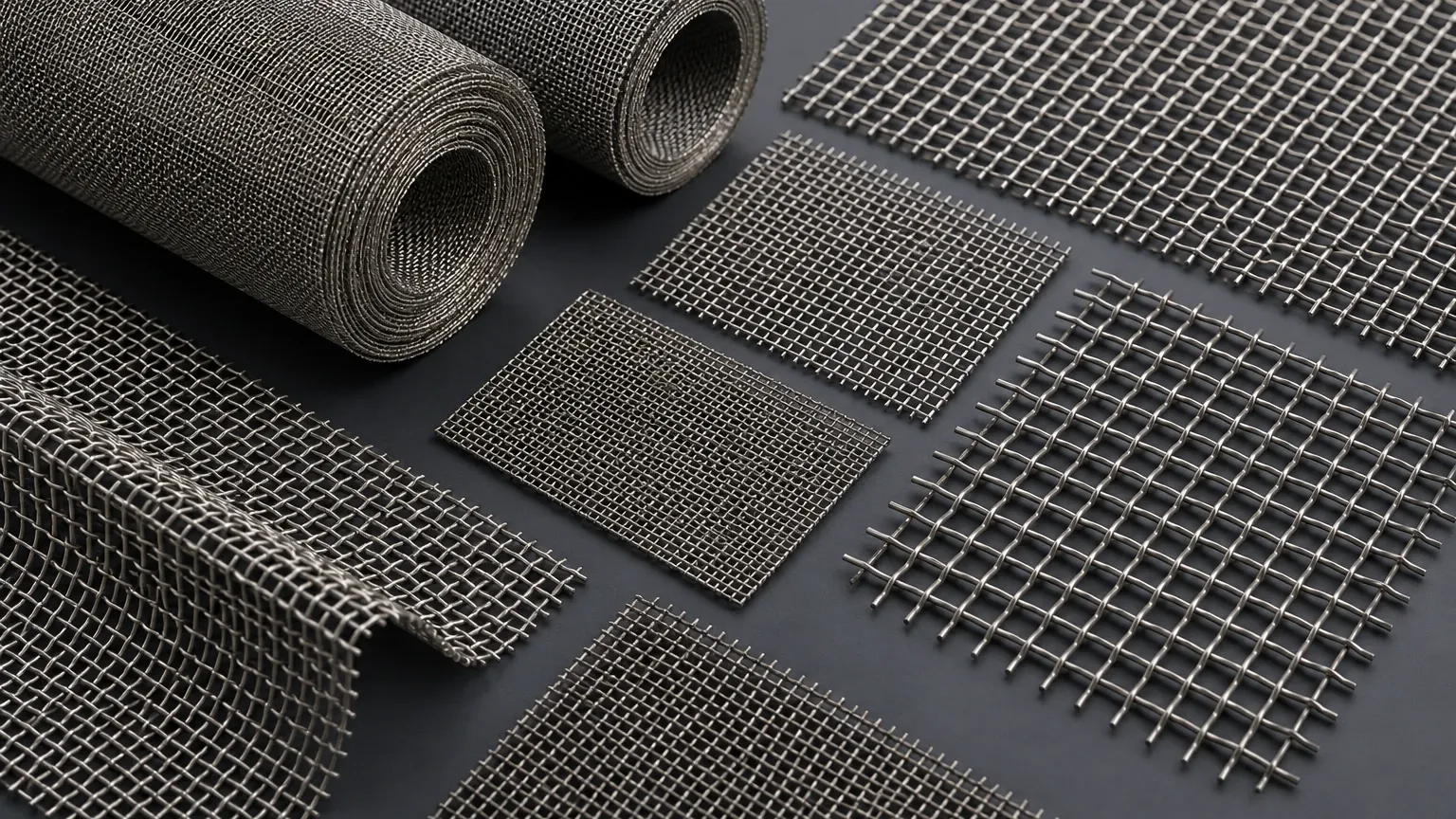
The geometry of the weave determines the mesh’s filtration characteristics, including flow rate, particle retention, and cleaning ability. Plain, twill and dutch woven wire mesh in SS304/316L — rolls, cut mesh and framed panels. Send mesh count or micron target for a technical quote. is available in several configurations to meet specific engineering needs.
Plain Weave
This is the simplest and most common weave pattern. Each warp wire crosses over and under each shute wire. It provides a square opening and is ideal for general-purpose sieving and low-pressure filtration. The primary limitation of plain weave is that the wire diameter must be relatively small compared to the aperture, which can limit its use in high-pressure applications.
Twill Weave
In a twill weave, each warp wire passes over and under two shute wires. This allows for the use of heavier wires in a given mesh count, resulting in a stronger and more durable mesh. Twill weaves are often used when a fine filtration rating is required but the mesh must also withstand significant mechanical stress.
Dutch Weave (Plain and Twill)
Dutch weaves utilize different diameters for warp and shute wires. Typically, the shute wires are driven closer together, creating a "zero-aperture" mesh where the openings are not visible when looking directly through the mesh. Instead, the fluid must pass through a tortuous path.
* Plain Dutch Weave: Offers high flow rates and moderate filtration precision.
* Twill Dutch Weave: Provides the finest filtration ratings (down to 1–5 microns) and maximum strength, making it the standard for high-pressure hydraulic and fuel filtration.
Critical Performance Metrics: Mesh Count and Micron Rating
When specifying mechanically woven wire mesh, engineers must distinguish between mesh count and micron rating, as they describe different aspects of the material’s geometry.
Mesh Count
Mesh count refers to the number of openings per linear inch. For example, a 100-mesh screen has 100 openings per inch. While mesh count is a useful shorthand, it does not account for wire diameter. Two different 100-mesh screens can have vastly different filtration properties if their wire diameters differ.
Micron Rating (Aperture Size)
The micron rating defines the actual size of the particles that the mesh will retain. In precision filtration, the "absolute" micron rating is often more important than the "nominal" rating. The absolute rating refers to the largest spherical particle that can pass through the mesh under specific test conditions. For mechanically woven wire mesh, the uniformity of these apertures is what defines the quality of the product.
Open Area Percentage
The percentage of open area determines the flow capacity and pressure drop across the filter. A higher open area allows for higher flow rates but may reduce the structural integrity of the mesh. Calculating the balance between wire diameter and aperture size is a critical step in the design phase to ensure the filter does not become a bottleneck in the system.
Industrial Applications and OEM Customization
Mechanically woven wire mesh is utilized across a broad spectrum of industries, each with unique requirements for customization and compliance.
Chemical and Petrochemical Processing
In these environments, mesh is used for catalyst recovery, filtration of aggressive solvents, and as support structures for finer filter media. The mesh must resist both chemical attack and the high temperatures associated with refining processes.
Food, Beverage, and Pharmaceuticals
For these sectors, hygiene and cleanability are the priorities. Mechanically woven wire mesh used here must be free of surface defects where bacteria could reside. Manufacturers like Kaifil provide mesh that meets stringent regulatory standards, ensuring that the material does not leach contaminants into the product stream.
Hydraulic and Aerospace Systems
Precision is non-negotiable in hydraulic systems. Even small particles can cause catastrophic failure in high-pressure valves. Twill Dutch woven mesh is frequently employed here to provide sub-10-micron filtration while maintaining the structural strength to resist pressure surges.
Customization Options
Beyond the roll of mesh, many industrial applications require custom-fabricated components. This includes:
* Multi-layer Sintered Mesh: Bonding multiple layers of mesh together for increased strength and finer filtration.
* Framed Panels: Mesh cut to size and welded into rigid frames for easy installation in vibrating screens or filter presses.
* Cylindrical and Conical Filters: Mesh formed and seamed into specific shapes for use in inline strainers or centrifugal separators.
Procurement and Quality Assurance Considerations
Selecting a supplier for mechanically woven wire mesh involves more than comparing price per square meter. Engineers should evaluate the following factors to ensure long-term reliability:
1. Material Certification: Reliable suppliers provide mill test reports (MTRs) to verify the chemical composition of the alloy. This is crucial for ensuring the mesh will survive in corrosive environments.
2. Aperture Uniformity Testing: Advanced manufacturers use digital imaging and bubble point testing to verify that the aperture sizes are consistent across the entire production run.
3. Cleaning and Degreasing: In many high-purity applications, the mesh must be ultrasonically cleaned to remove residual lubricants from the weaving process.
4. Total Cost of Ownership: While high-quality mechanically woven wire mesh may have a higher upfront cost, its durability and ability to be cleaned (backwashed) often result in a lower total cost compared to disposable polymer filters.
Conclusion
Mechanically woven wire mesh is a versatile and robust solution for complex industrial filtration challenges. By selecting the appropriate weave pattern, alloy, and specification, engineers can achieve precise separation results even in the most demanding conditions. Whether you are designing a new filtration system or optimizing an existing process, focusing on the technical integrity of the mesh—ensured by the mechanical weaving process—is the key to operational efficiency.
As a professional manufacturer, Kaifil specializes in providing these high-performance filtration components, offering the technical expertise and manufacturing precision required to meet specific industrial mandates. From material selection to final fabrication, understanding the engineering boundaries of woven wire mesh ensures that your filtration solution is both reliable and cost-effective.
