


Polymer Filters
In the production of high-quality plastic resins, fibers, and films, polymer filters serve as a critical checkpoint for ensuring product purity and process stability. Industrial polymer filtration, often referred to as melt filtration, involves the removal of contaminants from molten polymers before they are extruded or spun into final products. For engineers and procurement teams, selecting the appropriate filtration media is not merely a matter of choosing a micron rating; it requires a deep understanding of rheology, metallurgy, and the mechanical stresses inherent in high-pressure extrusion environments.
As a specialized manufacturer, Kaifil provides precision-engineered stainless steel filtration solutions designed to withstand the rigorous demands of polymer processing. By focusing on durability and filtration accuracy, these components help manufacturers minimize downtime and maintain consistent product quality. For detailed specifications on available filtration components, technical teams can refer to the Main Page to explore the full range of custom manufacturing capabilities.
The Role of Polymer Filters in Melt Processing
Polymer melt filtration is performed at high temperatures and pressures. Depending on the specific resin—such as PET, PP, PE, or Nylon—the molten polymer can exhibit high viscosity and non-Newtonian flow characteristics. The primary objective of polymer filters is to capture various types of contaminants, including:
1. Inorganic Impurities: Sand, metal particles, or catalyst residues that may have entered the raw material stream during synthesis or transport.
2. Degraded Polymer: "Black specks" or carbonized material resulting from localized overheating or long residence times in the extruder.
3. Gels: Partially cross-linked polymer chains that have different refractive indices or melting points than the bulk material, which can cause visual defects in films or breakage in fine fibers.
Failure to effectively remove these contaminants leads to downstream issues such as die plugging, fiber breakage in spinning packs, and surface imperfections in high-clarity packaging. Consequently, the filter must provide a stable pressure drop and high dirt-holding capacity to ensure long production runs.
Engineering Material Selection: Why Stainless Steel?
While some low-end applications might use disposable media, the vast majority of industrial polymer filters rely on stainless steel. The choice of material is dictated by the need for thermal stability, chemical resistance, and the ability to undergo multiple cleaning cycles.
Stainless Steel 304 and 316L
Stainless steel 316L is the industry standard for most polymer applications due to its superior corrosion resistance, particularly against the additives and flame retardants often found in polymer formulations. The "L" denotes low carbon content, which is essential for components that undergo welding, as it prevents carbide precipitation and ensures the integrity of the filter structure under high heat.
Sintered Metal Fiber (Felt)
For high-performance polymer filters, sintered metal fiber felt is often preferred over simple wire mesh. This medium is produced by sintering fine stainless steel fibers into a non-woven web. The resulting structure provides high porosity (up to 80%), which translates to a lower initial pressure drop and a significantly higher dirt-holding capacity. In the context of polymer filtration, the depth-loading characteristics of sintered felt are particularly effective at capturing deformable contaminants like gels.
Multi-Layer Wire Mesh
In applications where surface filtration is sufficient, multi-layer sintered wire mesh provides excellent mechanical strength. By bonding multiple layers of mesh together, engineers can create a filter medium that combines a fine filtration layer with coarser support layers, preventing the media from deforming under the high differential pressures typical of polymer extrusion.
Filter Configurations and Designs
The geometry of polymer filters is determined by the housing design and the required filtration surface area. There are several common configurations used in the industry:
Leaf Discs
Leaf discs are flat, circular filter elements used in large-scale polymer production, such as the manufacturing of polyester (PET) or nylon chips. They are stacked on a central mandrel within a high-pressure vessel. The disc design allows for a massive amount of surface area in a relatively compact footprint, which is essential for maintaining low shear stress on the polymer chains.
Pleated Filter Cartridges
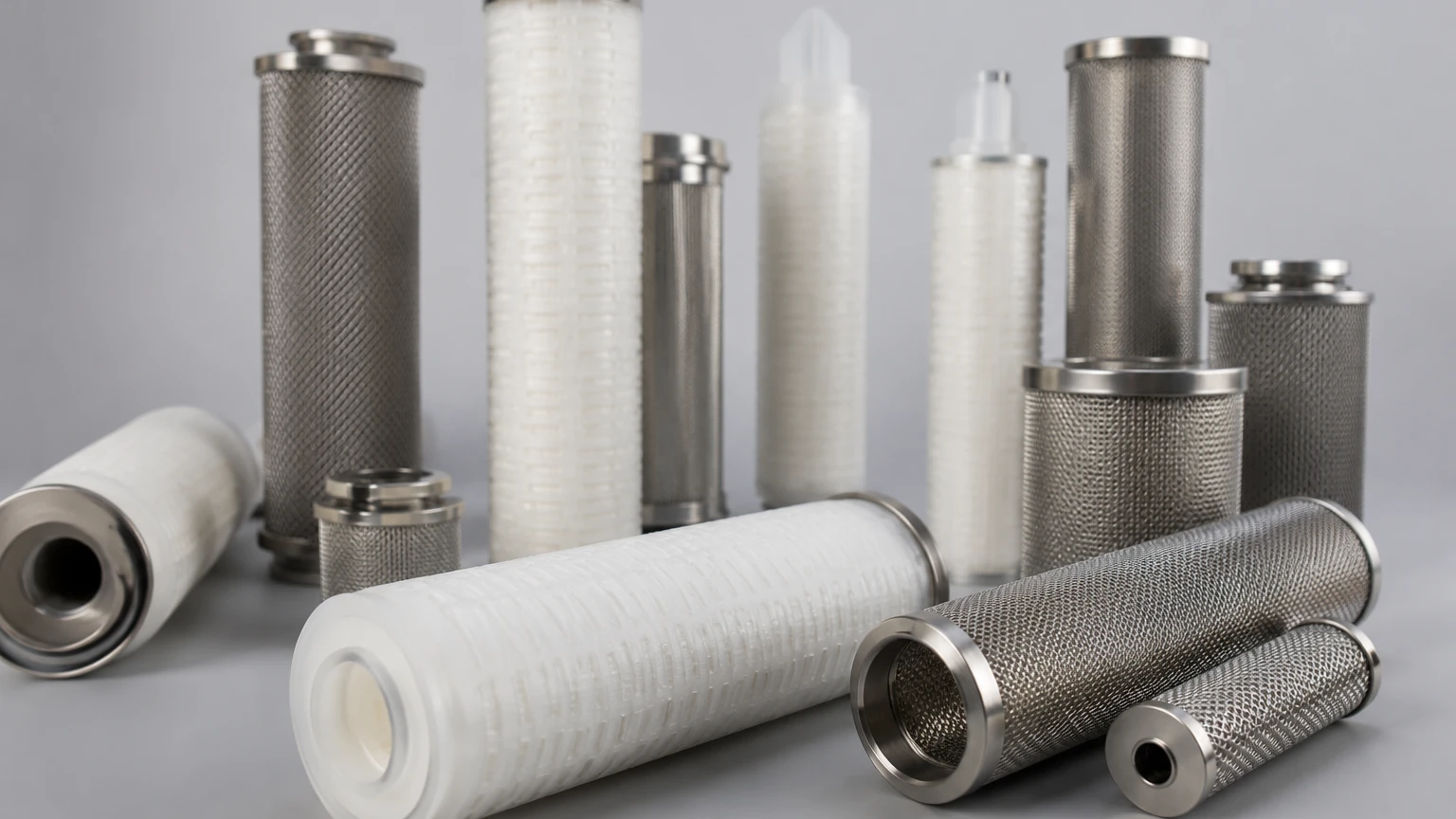
For applications requiring high flow rates in a smaller housing, pleated stainless steel cartridges are the standard. The pleating process increases the effective filtration area by 3 to 5 times compared to a cylindrical filter of the same dimensions. This configuration is commonly found in the production of specialty films and high-tenacity yarns.
Candle Filters
Candle filters consist of long, slender cylindrical elements. They are often used in polymer filtration systems where the flow path needs to be streamlined to prevent stagnant zones. Stagnant zones are a significant risk in polymer processing, as they can lead to thermal degradation and the formation of gels.
Technical Performance Metrics
When evaluating polymer filters, engineers must look beyond the nominal micron rating. The following parameters are critical for optimizing the filtration process:
Absolute vs. Nominal Micron Rating
In polymer processing, an absolute micron rating is usually required. This ensures that 99.9% of particles above a certain size are captured. A nominal rating can be misleading, as the high pressure of the melt can force deformable particles through the pores of a nominally rated filter.
Dirt Holding Capacity (DHC)
The DHC determines how much contaminant a filter can capture before the pressure drop reaches a critical limit. A higher DHC means longer intervals between filter changes, which directly impacts the total cost of ownership. Sintered metal fibers typically offer the best DHC for polymer applications.
Pressure Drop (ΔP)
The initial pressure drop is a function of the filter medium's permeability and the polymer's viscosity. As the filter clogs, the ΔP increases. In many automated systems, a high ΔP triggers a screen changer or a switch to a standby filter housing. Designing a system with a low initial ΔP provides a wider operating window.
Challenges: Gel Removal and Shear Stress
One of the most difficult tasks for polymer filters is the removal of gels. Unlike hard particles, gels are highly viscous droplets that can deform and "snake" through the pores of a filter if the pressure drop is too high.
To combat this, engineers often use depth filtration media with a graded pore structure. By using a series of layers that become progressively finer, the filter can trap gels throughout its thickness rather than just on the surface. Additionally, maintaining low shear stress through the filter media is vital. Excessive shear can actually cause polymer degradation or break apart existing gel clusters into smaller, more numerous defects.
Cleaning and Regeneration of Polymer Filters
One of the primary economic advantages of stainless steel polymer filters is their cleanability. Unlike disposable filters, metal elements can be regenerated multiple times. Common cleaning methods include:
* Pyrolysis (Burn-off): Heating the filter in a vacuum or controlled atmosphere to carbonize the polymer residues, which are then removed via ultrasonic cleaning.
* Chemical Cleaning: Using specialized solvents or hot TEG (triethylene glycol) baths to dissolve the polymer without damaging the stainless steel structure.
* Hydrolysis: Utilizing high-pressure steam to break down certain types of polymers like PET or Nylon.
Proper cleaning protocols are essential to ensure the filter returns to its original permeability. If the cleaning process is too aggressive, it can weaken the wire mesh or fiber felt, leading to premature failure in the next production cycle.
Selecting the Right Solution for Your Application
Choosing the right polymer filters requires a balance between filtration fineness, mechanical strength, and economic feasibility. Purchasing teams must consider the following when consulting with a manufacturer:
1. Polymer Type and Viscosity: High-viscosity melts require more robust support structures.
2. Operating Temperature: Standard stainless steel is suitable up to 300°C-400°C, but higher temperatures may require specialized alloys.
3. Contaminant Profile: Is the goal to remove hard particles or soft gels?
4. Housing Compatibility: Custom end fittings are often required to ensure a leak-proof seal within existing extrusion hardware.
Kaifil specializes in the custom design and production of these components, ensuring that each filter meets the specific rheological and mechanical requirements of the client's process. By utilizing advanced manufacturing techniques, Kaifil delivers filtration solutions that enhance the efficiency of industrial polymer production.
Conclusion
Polymer filters are indispensable components in the modern plastics and fiber industries. From the initial resin production to the final extrusion of high-performance films, the quality of the filter directly influences the quality of the end product. By selecting high-grade stainless steel media and optimizing the filter configuration for specific flow conditions, manufacturers can achieve superior purity, reduce waste, and improve the overall reliability of their production lines. For engineers seeking to optimize their filtration stages or develop custom OEM components, the Main Page serves as a gateway to technical expertise and high-performance metal filtration products.
