


Porous Media Corporation Filter
In the landscape of industrial fluid management, the selection of high-performance filtration components is critical for maintaining system integrity and process efficiency. The term porous media corporation filter refers to a specialized category of filtration technology designed to handle complex separation tasks in demanding environments. These filters are engineered to provide precise control over particle retention, flow rates, and pressure differentials. For engineers and procurement specialists, understanding the technical nuances of these filters is essential when evaluating replacements, upgrades, or custom OEM solutions for chemical processing, hydraulic systems, and pharmaceutical manufacturing.
At Kaifil, we specialize in the engineering and manufacturing of stainless steel filtration solutions that meet or exceed the performance standards required by industrial users of high-efficiency porous media. By focusing on material science and precision manufacturing, we provide technical alternatives that ensure long-term durability and consistent filtration accuracy.
Understanding the Technology of Porous Media Filtration
Porous media filtration operates on the principle of a controlled, interconnected network of pores within a solid matrix. Unlike simple surface filters, a porous media corporation filter often utilizes depth filtration mechanisms. This means that particles are trapped not just on the surface, but throughout the thickness of the media. This structure allows for a higher dirt-holding capacity and longer service intervals compared to standard mesh screens.
Depth vs. Surface Filtration
In industrial applications, the distinction between surface and depth filtration is paramount. Surface filtration, typically achieved through fine wire mesh, stops particles larger than the pore size at the interface. Conversely, depth filtration utilizes a tortuous path. As fluid passes through the porous matrix, particles are captured through several mechanisms:
1. Direct Interception: Particles larger than the pore throat are physically blocked.
2. Inertial Impaction: Heavier particles fail to follow the fluid streamlines around the media fibers and collide with the matrix.
3. Diffusion (Brownian Motion): Very fine particles move erratically and eventually contact the media surface, where they are held by Van der Waals forces.
When selecting a stainless steel alternative to a traditional porous media corporation filter, engineers must evaluate whether the application requires the high dirt-holding capacity of sintered metal fibers or the precise, cleanable surface of a multi-layered wire mesh laminate.
Key Engineering Considerations for Filter Selection
Selecting the correct filtration component requires a balance of several engineering variables. A mismatch in any of these can lead to premature filter failure, system downtime, or contaminated end-products.
Micron Rating: Absolute vs. Nominal
The micron rating is often the first specification considered, but it is frequently misunderstood.
* Nominal Rating: This is an efficiency figure, typically indicating that the filter will retain a certain percentage (e.g., 90% or 95%) of particles at the specified size. It does not guarantee that no larger particles will pass through.
* Absolute Rating: This refers to the diameter of the largest hard spherical particle that will pass through the filter under specified test conditions. For critical applications in the pharmaceutical or chemical sectors, an absolute rating is usually required to ensure process safety.
Pressure Drop (Delta P)
The clean pressure drop across a porous media corporation filter is a function of the media’s permeability, the fluid’s viscosity, and the flow velocity. According to Darcy’s Law, the flow rate through a porous medium is proportional to the pressure gradient. Engineers must ensure that the initial pressure drop is low enough to allow for a significant "working life" before the terminal pressure drop is reached, necessitating a cleaning or replacement cycle.
Material Compatibility and Chemical Resistance
One of the primary reasons for choosing stainless steel porous media is its exceptional resistance to harsh environments. While polymer-based filters may be cost-effective for low-temperature, non-corrosive fluids, industrial processes often involve high temperatures and aggressive chemicals.
Stainless Steel 316L and Beyond
Kaifil primarily utilizes Stainless Steel 316L due to its superior corrosion resistance and low carbon content, which prevents intergranular corrosion after welding. In environments involving high chloride concentrations or extreme acidity, specialty alloys like Hastelloy® or Monel® may be employed.
When evaluating a porous media corporation filter for a specific application, the following chemical factors must be confirmed:
* pH Levels: Extreme acidity or alkalinity can degrade certain binders or media types.
* Oxidizing Agents: High concentrations of ozone or chlorine require robust metallic structures.
* Temperature Extremes: Metallic porous media can operate at temperatures exceeding 500°C (932°F), far beyond the limits of synthetic fibers.
Performance Evaluation: Efficiency and Pressure Drop
The performance of a filter is not static; it evolves as the filter cake builds up on the media surface. In many liquid-solid separation processes, the initial layer of captured particles actually improves filtration efficiency, a phenomenon known as "cake filtration." However, this comes at the cost of increasing pressure drop.
Beta Ratio and Efficiency
For hydraulic and lubrication systems, the Beta Ratio (β) is the standard metric for performance. It is defined as the ratio of particles of a given size in the upstream fluid to the number of particles of the same size in the downstream fluid. A filter with a Beta ratio of 1000 (βx = 1000) is 99.9% efficient at that micron size. When sourcing a porous media corporation filter equivalent, matching the Beta ratio ensures that the system's cleanliness levels remain within OEM specifications.
Customization and OEM Alternatives for Industrial Systems
Many industrial systems utilize proprietary filter housings that require specific end-cap configurations, seal types, and structural reinforcements. A standard off-the-shelf filter may not provide the necessary fit or performance. This is where custom manufacturing becomes a strategic advantage.
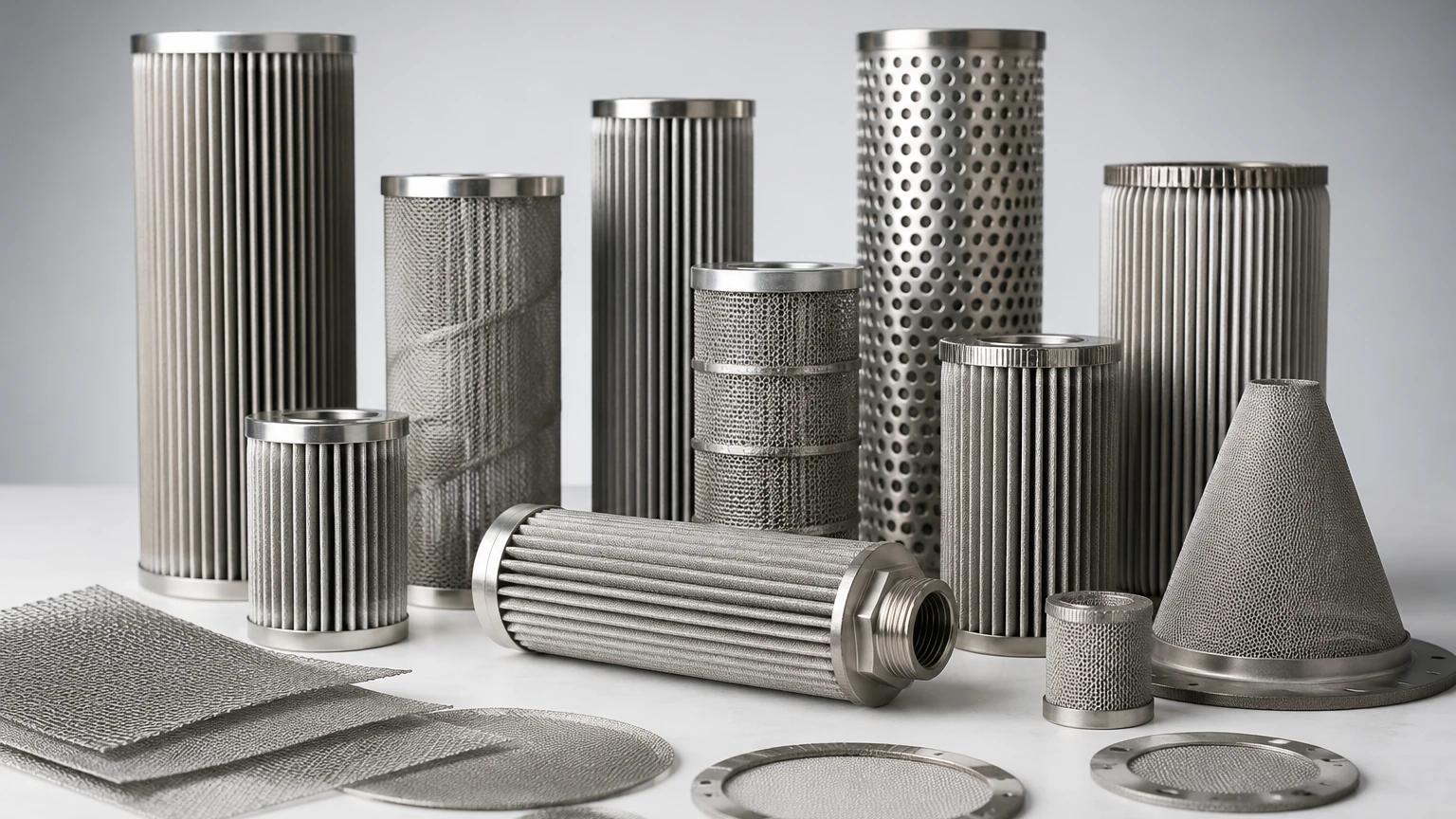
At Kaifil, we provide comprehensive OEM support to develop custom stainless steel cartridges that serve as direct replacements for specialized porous media. Our engineering team focuses on:
* Structural Integrity: Ensuring the filter can withstand high collapse pressures, especially in hydraulic return lines or high-viscosity polymer filtration.
* End-Cap Engineering: Customizing DOE (Double Open End), SOE (Single Open End) with various O-ring codes (e.g., Code 7, Code 8), or threaded connections to ensure a leak-proof seal.
* Pleating Technology: Increasing the effective filtration area through precision pleating, which reduces the flux (flow per unit area) and extends the filter's life.
For more information on our full range of capabilities and technical specifications, please visit our Main Page.
Maintenance Cycles and Total Cost of Ownership (TCO)
While the initial purchase price of a filter is a factor, the Total Cost of Ownership (TCO) is a more accurate metric for industrial operations. TCO includes the purchase price, installation labor, disposal costs, and the cost of lost production during downtime.
Cleanable vs. Disposable Media
Many porous media corporation filter products are designed as high-efficiency disposables. However, in many industrial contexts, switching to a cleanable stainless steel media can significantly reduce TCO. Stainless steel filters can be cleaned using several methods:
* Backwashing: Reversing the flow to dislodge particles from the surface.
* Ultrasonic Cleaning: Using high-frequency sound waves in a cleaning solvent to remove deeply embedded contaminants.
* Chemical Cleaning: Using acids or surfactants to dissolve organic or inorganic scaling.
* Burn-off/Pyrolysis: Removing polymer buildup in high-temperature ovens.
By selecting a durable, cleanable metallic filter, facilities can reduce their waste stream and eliminate the need for frequent replacement inventory.
Common Risks in Filter Procurement
Engineers must be wary of several common pitfalls when sourcing filtration components:
1. Bypass Leakage: Even the highest quality media is useless if the seal between the filter and the housing is compromised. Always verify O-ring compatibility with the process fluid.
2. Media Migration: In lower-quality filters, the media itself can shed fibers or particles into the downstream fluid. Sintered metal media eliminates this risk by fusing the fibers or powder particles together.
3. Inaccurate Micron Ratings: Without standardized testing (such as the Multi-pass test for hydraulic filters), micron ratings can be arbitrary. Always request technical data sheets and test reports.
Conclusion: Making Informed Filtration Decisions
The selection of a porous media corporation filter or its metallic equivalent is a technical decision that impacts the entire production chain. By focusing on the fundamental principles of fluid dynamics, material science, and structural engineering, purchasing teams can ensure they are acquiring a solution that provides the necessary protection for their equipment and the required purity for their products.
Kaifil remains committed to providing the technical expertise and manufacturing precision required to solve complex filtration challenges. Whether you are looking for a standard stainless steel cartridge or a highly customized filtration component, our focus is on delivering reliable, high-performance solutions tailored to your specific industrial environment. For a deeper dive into our product offerings and application support, review our Main Page to see how our engineering team can assist with your next project.
