


Baghouse Dust Collection Products
In industrial environments, air quality and particulate control are critical for both regulatory compliance and operational efficiency. Baghouse dust collection products represent a broad category of filtration equipment designed to remove solid particles from gas streams. These systems are used across diverse sectors, including chemical processing, metallurgy, cement production, and food processing. Selecting the appropriate filtration media and structural components is an engineering challenge that requires a deep understanding of gas chemistry, temperature profiles, and particle characteristics.
For engineers and procurement professionals, the focus is often on balancing filtration efficiency with the total cost of ownership. This involves evaluating not just the initial purchase price of bags and cages, but also the energy consumption associated with pressure drop and the labor costs of frequent replacement cycles. To explore the full range of high-performance filtration components available for industrial applications, technical teams often refer to the Main Page of specialized manufacturers to evaluate material compatibility and custom engineering options.
Understanding the Mechanics of Baghouse Filtration
Baghouse systems operate on the principle of fabric filtration, where dust-laden gas passes through a filter medium—typically a fabric bag or a pleated element. The filtration process occurs in two primary stages: initial capture and the development of a dust cake.
During the initial stage, the clean filter medium captures particles through interception, impingement, and diffusion. However, the highest filtration efficiency is achieved once a thin layer of dust, known as the "dust cake," builds up on the surface of the medium. This cake acts as a highly effective secondary filter. The engineering goal is to maintain this cake at an optimal thickness; if it becomes too thick, the pressure drop across the system increases, leading to higher energy consumption by the system's fan. Conversely, if the cleaning cycle is too aggressive and removes too much of the cake, the filtration efficiency drops temporarily, a phenomenon known as "bleed-through."
Baghouse dust collection products are categorized by their cleaning mechanisms, which fundamentally dictate the design of the filter bags and the internal support structures. The three most common types are pulse-jet, shaker, and reverse air systems. Pulse-jet systems, which use high-pressure compressed air to dislodge dust, are currently the industry standard due to their ability to clean filters while the system remains online.
Critical Components and Material Selection
The performance of a dust collection system is only as reliable as its weakest component. When specifying baghouse dust collection products, engineers must consider the synergy between the filter media and the hardware that supports it.
Filter Media and Fabrics
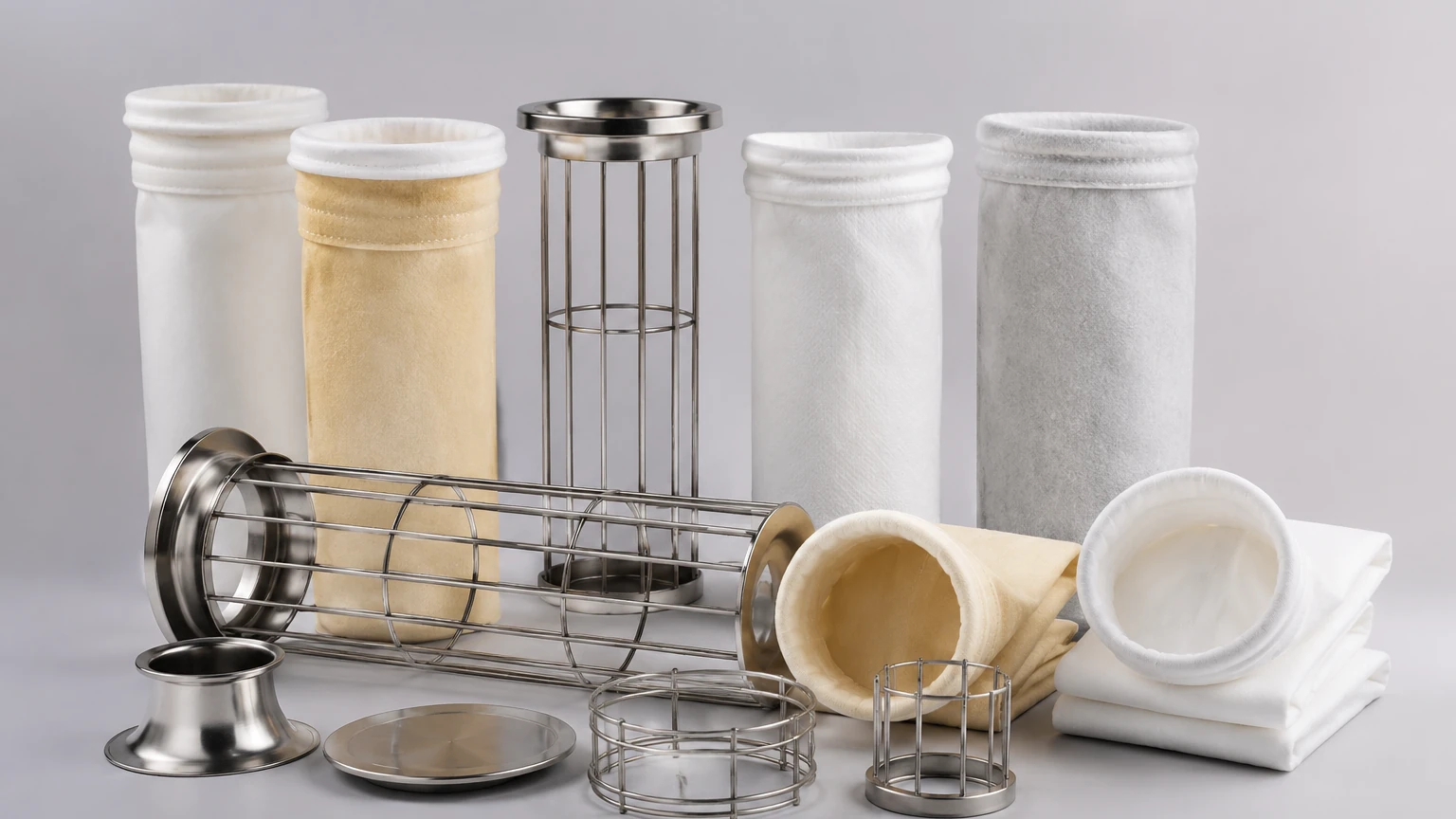
Filter bags are manufactured from a variety of synthetic and natural fibers. Common materials include polyester, polypropylene, Nomex (aramid), and PTFE (Teflon). The choice depends on the operating temperature and the chemical composition of the gas stream. For example, while polyester is cost-effective and durable for standard applications, Nomex is required for high-temperature environments reaching up to 400°F (204°C). In highly corrosive environments involving acids or alkalis, PTFE membranes are often laminated onto the base fabric to provide superior chemical resistance and cake release properties.
Support Cages and Metal Components
In pulse-jet systems, the filter bag is fitted over a metal support cage. The quality of this cage is paramount; any burrs or sharp edges on the metal can cause premature mechanical failure of the bag through abrasion. For applications involving high humidity or corrosive gases, stainless steel cages (such as Grade 304 or 316) are preferred over galvanized steel to prevent rust and ensure structural integrity over long service lives. Custom metal components, including venturis and specialized headers, are also essential for optimizing the airflow and ensuring the pulse of air is directed efficiently down the length of the bag.
Engineering Evaluation: Air-to-Cloth Ratio and Pressure Drop
When selecting baghouse dust collection products, the two most critical engineering metrics are the Air-to-Cloth (A/C) ratio and the differential pressure.
The Air-to-Cloth Ratio
The A/C ratio, also known as the filtration velocity, is the volume of gas passing through a square foot of filter media per minute (expressed in CFM/ft² or m/min). A lower A/C ratio generally leads to higher filtration efficiency and longer bag life because the velocity of the particles hitting the media is reduced. However, a lower A/C ratio requires a larger baghouse, increasing the initial capital expenditure. Engineers must find the "sweet spot" based on the dust type; fine, abrasive, or adhesive dusts require much lower A/C ratios than coarse, free-flowing materials.
Differential Pressure Management
Differential pressure (ΔP) is the difference in pressure between the clean-air side and the dirty-air side of the filter. It is the primary indicator of how well the baghouse is functioning. A steady ΔP suggests that the cleaning cycle is effectively balancing the accumulation of dust. A sudden spike in ΔP can indicate "blinding," where the pores of the filter media become permanently clogged, often due to moisture or oil in the gas stream. Conversely, a sudden drop in ΔP usually indicates a ruptured bag or a seal failure.
Performance in Demanding Industrial Environments
Standard fabric baghouses have limitations, particularly when dealing with extreme temperatures or highly abrasive materials. In these scenarios, specialized baghouse dust collection products are required.
In chemical processing and high-heat metallurgy, gas temperatures can exceed the limits of even the most advanced synthetic fibers. This has led to the development of metal fiber felt and sintered wire mesh filter elements. These stainless steel filtration solutions offer several advantages:
1. Thermal Stability: They can operate continuously at temperatures exceeding 1000°F (537°C).
2. Mechanical Strength: Metal filters are resistant to high-pressure pulses and physical abrasion from heavy dust loads.
3. Cleanability: Unlike fabric bags, which may need to be replaced when blinded, metal filters can often be cleaned through ultrasonic baths or chemical washing, extending their service life significantly.
For facilities looking to upgrade from traditional fabric media to more durable metal-based solutions, consulting technical resources on the Main Page of a specialized manufacturer can provide insights into how custom-engineered metal cartridges can be retrofitted into existing baghouse housings.
Total Cost of Ownership and Replacement Cycles
While the initial cost of baghouse dust collection products is a significant factor in procurement, the total cost of ownership (TCO) is a more accurate measure of value. The TCO includes:
* Energy Costs: High pressure drop requires more fan power. Choosing a media with better permeability can save thousands of dollars in annual electricity costs.
* Compressed Air Usage: In pulse-jet systems, the frequency of pulses directly impacts the cost of operating the air compressor. High-quality media that releases the dust cake easily requires fewer pulses.
* Downtime and Labor: Replacing a full set of bags in a large baghouse can take several days and requires significant labor. Increasing the interval between replacements from 12 months to 24 months through the use of premium materials or better-engineered support cages can drastically reduce maintenance overhead.
Engineers should conduct a periodic audit of their dust collection system to identify if the current media is the most efficient choice for their current process conditions. Changes in production volume or raw material characteristics often necessitate a change in filter specification.
Customization and OEM Integration
Every industrial facility has unique constraints, from physical space limitations to specific chemical bypass requirements. Standardized baghouse dust collection products may not always provide the optimal solution. Customization in filtration often involves the design of specific filter geometries, the use of specialized alloys for support structures, or the integration of multi-layered wire mesh for precision filtration at specific micron ratings.
OEM (Original Equipment Manufacturer) services play a vital role here. By working directly with a manufacturer that specializes in stainless steel and precision metal filtration, engineering teams can develop bespoke components that address specific failure points in their existing systems. Whether it is a custom-sized support cage to prevent bag sagging or a sintered metal filter for a high-pressure vent line, tailored solutions ensure that the filtration system supports the overall reliability of the production plant.
Conclusion for Technical Procurement
Selecting the right baghouse dust collection products requires a move away from generic specifications toward an engineering-led approach. By evaluating the chemical compatibility, thermal requirements, and mechanical stresses of the application, professionals can select components that maximize uptime and minimize environmental impact. As industrial standards for air quality continue to tighten globally, the transition toward high-durability materials and precision-engineered filtration components becomes not just a matter of efficiency, but a necessity for sustainable industrial operations.
