


Seawater Filtration
Seawater filtration is a critical process in various industrial, maritime, and energy sectors. Unlike freshwater processing, seawater presents a unique set of challenges characterized by high salinity, a diverse range of organic matter, and the presence of highly corrosive chloride ions. For engineers and procurement specialists, selecting the right filtration system is not merely a matter of particulate removal; it is an exercise in material science, fluid dynamics, and long-term operational reliability.
In industrial environments such as desalination plants, offshore oil and gas platforms, and marine cooling systems, the performance of downstream equipment depends entirely on the efficiency of the primary filtration stage. Failure to effectively manage seawater intake can lead to catastrophic equipment failure, reduced heat transfer efficiency, and significant downtime. This guide explores the technical considerations, material requirements, and engineering strategies essential for effective seawater filtration.
The Engineering Challenges of Seawater Environments
When designing or specifying a system for seawater filtration, three primary challenges must be addressed: corrosion, biofouling, and high sediment variability.
Corrosion and Material Integrity
Seawater is a highly conductive electrolyte. The presence of chloride ions promotes localized corrosion, specifically pitting and crevice corrosion, in many standard metals. For industrial filters, using lower-grade stainless steel like 304 is generally insufficient for long-term immersion. Engineers typically specify 316L stainless steel as a minimum requirement, though for high-pressure or high-temperature applications, Duplex or Super Duplex stainless steels are preferred due to their higher Pitting Resistance Equivalent Number (PREN).
Biofouling Management
Seawater is a living medium. It contains bacteria, algae, larvae, and other microorganisms that can quickly colonize filter surfaces. This biological growth, known as biofouling, can lead to a rapid increase in differential pressure and may eventually block the filter media entirely. Effective filtration solutions must account for these biological loads, often requiring specialized coatings or mechanical cleaning mechanisms to maintain flow rates.
Suspended Solids and Silt
Coastal seawater often contains high concentrations of sand, silt, and shells, which can be abrasive to filter media. The filtration system must be robust enough to handle varying turbidity levels, especially during storm events or seasonal changes that stir up seabed sediments.
Key Evaluation Criteria for Seawater Filters
Selecting a filtration solution requires a deep dive into the specific operational parameters of the application. Engineers should evaluate the following criteria to ensure the chosen component meets the project’s technical demands.
1. Micron Rating and Filtration Efficiency
The required micron rating is determined by the sensitivity of the downstream equipment. For example, pre-filtration for Reverse Osmosis (RO) membranes typically requires very fine filtration to prevent membrane fouling, whereas cooling water systems for large engines may only require the removal of larger debris (50–200 microns). It is essential to distinguish between nominal and absolute micron ratings to ensure the filter captures the necessary percentage of particles.
2. Flow Rate and Pressure Drop (ΔP)
The filter must be sized to handle the maximum required flow rate without exceeding the allowable clean pressure drop. An undersized filter will reach its terminal pressure drop too quickly, leading to frequent cleaning cycles or premature element failure. High-velocity seawater can also accelerate erosion-corrosion on certain filter geometries, making flow distribution a key design factor.
3. Structural Strength and Collapse Pressure
In high-pressure applications, such as deep-sea oil extraction or high-head desalination pumps, the filter element must withstand significant structural loads. Precision-engineered stainless steel wire mesh filters are often reinforced with internal supports or perforated cores to prevent collapse under high differential pressure conditions.
Material Selection for Longevity
Material choice is the single most important factor in determining the total cost of ownership for seawater filtration systems. While carbon steel or standard alloys might offer a lower initial capital expenditure (CAPEX), their rapid degradation in saline environments leads to high operational expenditure (OPEX) due to frequent replacements.
* 316L Stainless Steel: The industry standard for many marine applications. It offers good resistance to general corrosion but can be susceptible to pitting in stagnant seawater.
* 904L Stainless Steel: A non-stabilized austenitic stainless steel with low carbon content. It provides superior resistance to stress corrosion cracking and crevice corrosion compared to 316L.
* Duplex Stainless Steel (e.g., 2205): Offers nearly double the strength of austenitic stainless steels and significantly better resistance to chloride stress corrosion cracking.
* Titanium: Used in the most extreme seawater conditions where weight and absolute corrosion resistance are paramount, though at a significantly higher cost.
For more information on material compatibility and custom filter designs, you can visit the Main Page of our technical resource center.
Types of Industrial Seawater Filtration Media
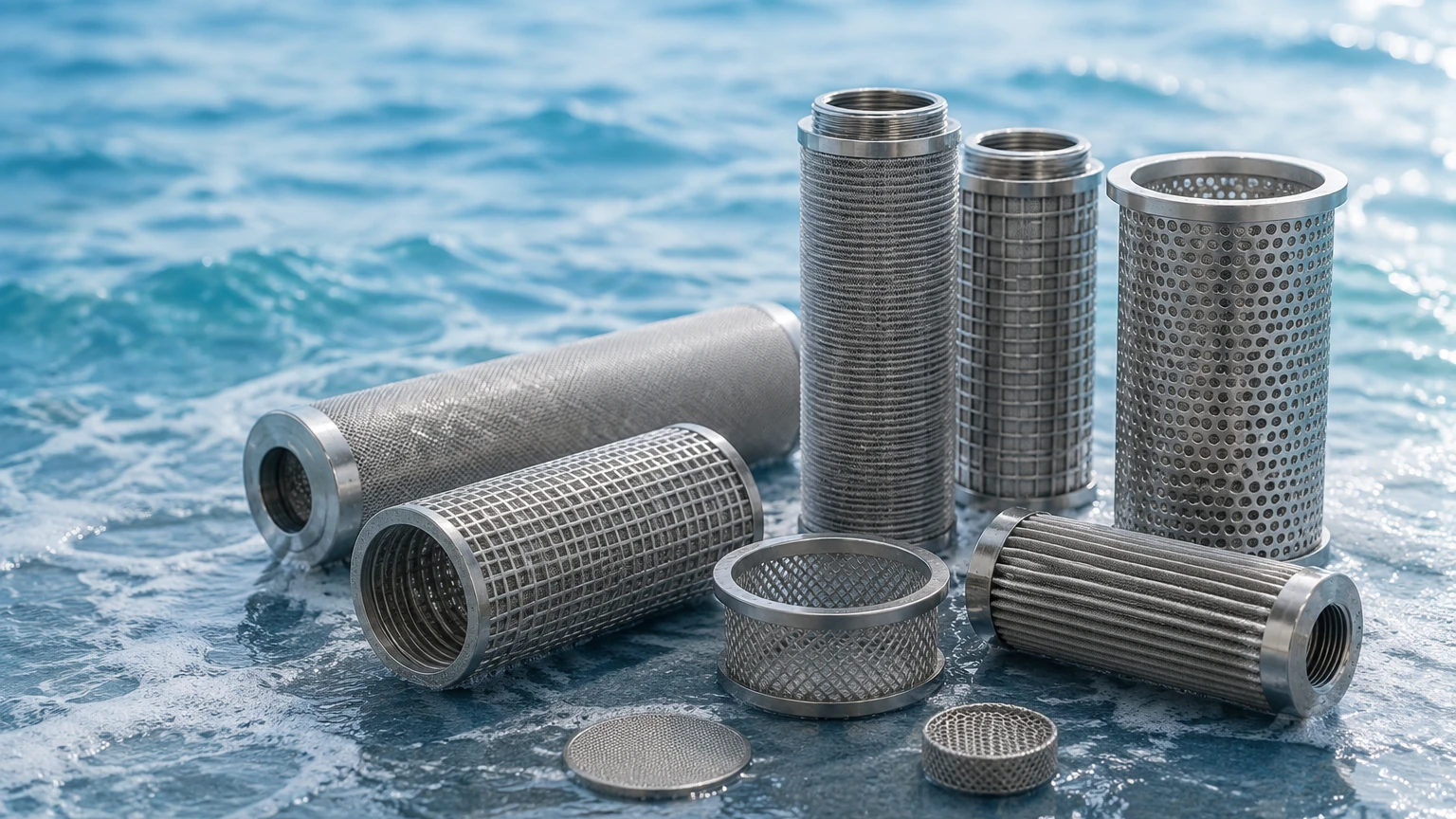
Different applications require different media structures. As a manufacturer specializing in custom solutions, we see three primary types of media used in seawater environments:
Sintered Wire Mesh
Sintered wire mesh is created by diffusion-bonding multiple layers of woven wire cloth. This process creates a robust, porous material that combines the filtration precision of fine mesh with the structural integrity of heavy-duty plates. In seawater applications, sintered mesh is highly valued for its backwashing capabilities, allowing the filter to be cleaned in situ without stopping the flow.
Wedge Wire Screens
Wedge wire is ideal for coarse seawater filtration and intake screens. The V-shaped profile of the wire prevents clogging and provides a high open-area ratio. This design is particularly effective for protecting pumps from large debris, shells, and seaweed.
Multi-Layer Filter Cartridges
For finer filtration requirements, multi-layered stainless steel cartridges provide a high surface area within a compact footprint. These are often used as secondary or tertiary filters to protect sensitive instrumentation or fine nozzles in chemical processing and pharmaceutical applications involving seawater-derived products.
Common Risks and Mitigation in Seawater Systems
Even with the correct material and filter type, certain operational risks must be managed to ensure system longevity.
* Galvanic Corrosion: When a stainless steel filter is installed in a system with dissimilar metals (like bronze or carbon steel), galvanic corrosion can occur. Engineers must ensure proper insulation or use sacrificial anodes to protect the filtration housing and elements.
* Stagnant Conditions: Corrosion is often worse when seawater is not moving. If a system is shut down for maintenance, it is recommended to flush the filtration unit with freshwater to prevent chloride concentration and localized pitting.
* Inadequate Cleaning: If a filter is not cleaned effectively during its backwash cycle, a "heel" of debris can build up, leading to permanent fouling. Monitoring differential pressure with high-accuracy sensors is vital for timing cleaning cycles correctly.
Total Cost of Ownership (TCO) Considerations
When evaluating seawater filtration solutions, the initial purchase price is often a small fraction of the lifetime cost. A factual B2B assessment must include:
1. Replacement Frequency: How long will the media last before corrosion or mechanical wear necessitates a replacement?
2. Maintenance Labor: Is the filter easy to access and clean? Does it require specialized tools?
3. Energy Consumption: A filter that operates with a lower average pressure drop reduces the energy required by the system's pumps.
4. Downstream Protection: What is the cost of damage to the RO membranes or heat exchangers if the filter fails? High-quality filtration acts as an insurance policy for the entire process line.
Technical Confirmation Before Procurement
Before finalizing a seawater filtration specification, engineers and purchasing teams should confirm the following technical details with their manufacturer:
* Exact Chemical Composition: Confirm the grade of stainless steel and ensure it matches the salinity and temperature profile of the local seawater.
* Pressure Ratings: Verify both the maximum operating pressure and the maximum allowable differential pressure before cleaning.
* Customization Options: Determine if the filter requires custom end caps, gaskets (such as Viton or EPDM for chemical resistance), or specific dimensions to fit existing housings.
* Testing and Certification: Request material test reports (MTRs) and filtration efficiency certifications to ensure compliance with industry standards.
Conclusion
Seawater filtration is a complex engineering task that demands a balance between filtration precision and material durability. By understanding the unique challenges of the marine environment—from chloride-induced corrosion to biological fouling—and selecting high-performance stainless steel components, industrial operators can achieve reliable, long-term performance. Whether for desalination, offshore energy, or industrial cooling, the right filtration strategy is the foundation of system efficiency and equipment protection.
