


Bag Filter Vessels
In industrial liquid processing, the removal of suspended solids is a critical step for protecting downstream equipment, ensuring product purity, and maintaining process consistency. Bag filter vessels serve as the pressurized housing for filter bags, providing a robust and versatile solution for high-flow applications. As a specialized manufacturer of stainless steel filtration components, Kaifil understands that selecting the correct vessel involves more than just matching pipe sizes; it requires a deep dive into fluid dynamics, material compatibility, and long-term operational costs.
Industrial bag filter vessels are designed to handle a wide range of flow rates and contaminant loads. Unlike cartridge filters, which are often preferred for fine polishing, bag filters are typically chosen for their high dirt-holding capacity and ease of disposal. This guide examines the engineering considerations, selection criteria, and technical specifications that engineers must evaluate when integrating these systems into industrial workflows.
Engineering Fundamentals of Bag Filter Vessels
The primary function of a bag filter vessel is to provide a secure environment where fluid can pass through a filter bag under pressure without bypass. The vessel must withstand the system's operating pressure while ensuring that the bag remains seated properly. Most industrial vessels are constructed from stainless steel—specifically SS304 or SS316L—due to their corrosion resistance and structural integrity.
Pressure Ratings and Standards
Engineering teams must prioritize the pressure rating of the vessel. Standard industrial vessels are often rated for 150 psi (approx. 10 bar) at a specific temperature. However, in high-temperature or high-pressure chemical processing, vessels must be designed to meet ASME (American Society of Mechanical Engineers) Section VIII standards. These standards dictate the wall thickness, welding procedures, and testing protocols required to ensure safety in demanding environments.
Fluid Path and Bypass Prevention
A critical engineering detail is the internal sealing mechanism. If the fluid can bypass the filter bag, the entire filtration process is compromised. Quality bag filter vessels utilize a precision-engineered bag restrainer basket (usually made of perforated stainless steel) and a compression seal. When the vessel lid is closed, it applies downward pressure on the bag’s collar—whether it is a plastic flange or a metal ring—to create a positive seal against the internal housing.
Key Performance Parameters for Industrial Selection
When specifying bag filter vessels, several technical parameters dictate the efficiency of the filtration system. Engineers must look beyond the initial purchase price and evaluate how these parameters affect the total cost of ownership.
1. Flow Rate (GPM or m³/h): The size of the vessel is directly related to the maximum flow rate it can handle. Overloading a vessel leads to high initial pressure drops and shortened bag life. Conversely, an oversized vessel may lead to unnecessary capital expenditure and excessive fluid loss during bag changes.
2. Viscosity: The thickness of the fluid significantly impacts the choice of vessel. High-viscosity liquids, such as resins or heavy oils, require larger surface areas and potentially higher pressure ratings to move the fluid through the filter media efficiently.
3. Operating Temperature: Temperature affects both the material of the vessel’s O-rings (seals) and the structural limits of the stainless steel. Standard EPDM O-rings may suffice for water applications, but high-temperature chemical processes may require Viton or PTFE-encapsulated seals.
4. Allowable Pressure Drop (ΔP): This is the difference in pressure between the inlet and the outlet. A well-sized bag filter vessel should start with a clean pressure drop of less than 2 psi. As the bag loads with contaminants, the ΔP increases. The vessel must be robust enough to handle the maximum allowable ΔP before the bag is changed, typically around 15–25 psi.
For a comprehensive overview of how these components integrate into broader filtration systems, technical teams can refer to the Main Page for detailed product specifications and engineering support.
Structural Configurations: Single vs. Multi-Bag Vessels
The choice between a single-bag and a multi-bag configuration is primarily driven by the required flow volume and the frequency of bag changes.
Single-Bag Filter Vessels
Single-bag housings are the workhorses of many small-to-medium industrial applications. They are compact, easier to install in tight spaces, and available in several sizes (most commonly Size 01 and Size 02).
* Top Entry: In a top-entry design, the fluid enters through the lid, which helps to distribute the flow evenly into the bag and minimizes the "dead space" where solids can accumulate. This design often provides a better seal because the lid directly compresses the bag collar.
* Side Entry: Side-entry vessels are often more cost-effective and allow for easier piping in certain layouts. However, they may require more care during bag installation to ensure the seal is not disturbed as the lid is closed.
Multi-Bag Filter Vessels
For high-capacity applications such as municipal water treatment or large-scale chemical manufacturing, multi-bag vessels are essential. These units can house anywhere from 2 to 24 bags (or more) in a single housing.
* Operational Continuity: Multi-bag units allow for much higher flow rates without increasing the footprint proportionally.
* Reduced Downtime: By spreading the contaminant load across multiple bags, the interval between change-outs is extended, which is critical for 24/7 production environments.
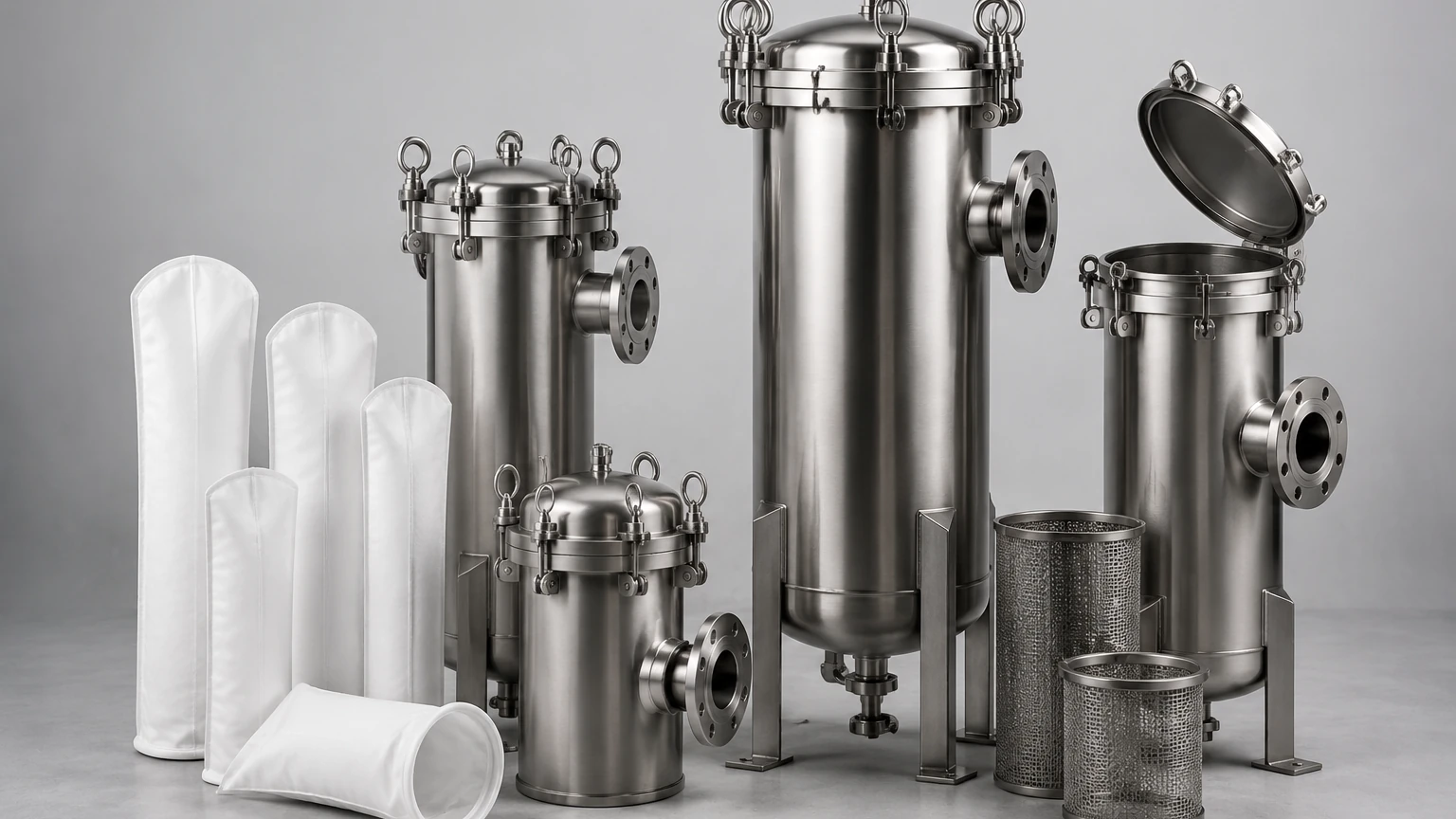
Material Compatibility and Surface Finishes
In industries like pharmaceutical and food and beverage processing, the surface finish of the bag filter vessel is as important as its structural design. Stainless steel is the preferred material because it can be treated to meet strict hygienic standards.
Corrosion Resistance
While SS304 is suitable for water and mild chemicals, SS316L is required for environments containing chlorides or high-acidity fluids. The "L" in 316L stands for low carbon, which improves weldability and reduces the risk of intergranular corrosion near weld joints.
Surface Treatment Options
* Bead Blasting: Provides a uniform, matte finish suitable for most industrial applications.
* Electropolishing: This electrochemical process removes a fine layer of the stainless steel surface, resulting in a mirror-like finish. This is essential for pharmaceutical applications as it removes microscopic peaks and valleys where bacteria or contaminants could hide.
* Passivation: A chemical treatment that enhances the protective oxide layer on the stainless steel, further increasing its resistance to rust and chemical attack.
Operational Maintenance and Replacement Cycles
To maintain the efficiency of bag filter vessels, a structured maintenance schedule is required. Engineers should focus on three main areas: seal integrity, basket condition, and pressure monitoring.
Seal Integrity and O-Rings
The O-ring is the most common point of failure in a pressure vessel. Every time the lid is opened for a bag change, the O-ring should be inspected for nicks, compression sets, or chemical degradation. It is a best practice to keep a stock of replacement O-rings on-site to prevent unplanned downtime.
Support Basket Maintenance
The stainless steel perforated basket supports the filter bag against the force of the fluid flow. If the basket becomes dented or the perforations become clogged with dried product, it can cause the filter bag to burst. Regular cleaning of the basket with appropriate solvents or ultrasonic cleaning is recommended.
Monitoring Differential Pressure
Installing pressure gauges on both the inlet and outlet of the vessel is the only reliable way to determine when a filter bag needs replacement. Relying on a fixed time schedule often leads to either premature replacement (wasting money) or late replacement (risking bag failure or pump damage). Automated systems can be set to trigger an alarm when the ΔP reaches a predetermined threshold.
Customization and Technical Support in Filtration
No two industrial processes are identical, which is why customization is a core component of the filtration industry. Standard bag filter vessels may not always meet the specific needs of a unique chemical process or a restricted floor plan.
Custom Inlet and Outlet Configurations
Engineers often face challenges with existing piping layouts. Customizing the orientation, size, and type of connections (e.g., ANSI flanges, NPT threads, or Tri-clamp fittings) can significantly reduce installation costs and fluid turbulence.
OEM Solutions
For equipment manufacturers (OEMs) who integrate filtration into their own machines, such as parts washers or cooling systems, custom-branded or specifically dimensioned vessels are often required. Kaifil works closely with these partners to develop filtration components that fit specific spatial constraints while maintaining high performance. This collaborative engineering approach ensures that the vessel is not just a component, but an optimized part of the overall machine design.
When evaluating a supplier for bag filter vessels, it is important to confirm their manufacturing capabilities and quality control processes. A reliable partner should provide material certifications, pressure test reports, and technical drawings to ensure the equipment meets the project's safety and performance standards. By focusing on engineering precision and material quality, industrial facilities can achieve reliable, long-term filtration performance that protects their products and their bottom line.
