


Prozesswasseraufbereitung
In modern industrial manufacturing, the quality of process water is a critical variable that directly impacts production efficiency, equipment longevity, and final product consistency. The term prozesswasseraufbereitung encompasses the various mechanical and chemical treatments required to bring water to a specific standard suitable for industrial use. Whether in chemical processing, food and beverage production, or pharmaceutical manufacturing, the removal of particulate matter and contaminants through high-performance filtration is a fundamental step in this cycle.
For engineers and technical procurement teams, selecting the right filtration components is not merely about finding a sieve; it is about understanding the fluid dynamics, material compatibility, and mechanical stresses involved in continuous industrial operations. As a specialized manufacturer, Kaifil provides the engineering expertise and custom stainless steel solutions necessary to optimize these systems. Detailed technical information regarding these solutions can be found on our Main Page.
Understanding the Role of Filtration in Prozesswasseraufbereitung
Prozesswasseraufbereitung is a multi-stage discipline. Depending on the source—be it municipal water, recycled process water, or well water—the treatment must address different types of impurities. Filtration serves as the primary mechanical barrier, protecting downstream equipment such as heat exchangers, spray nozzles, and sensitive membrane systems from abrasion and clogging.
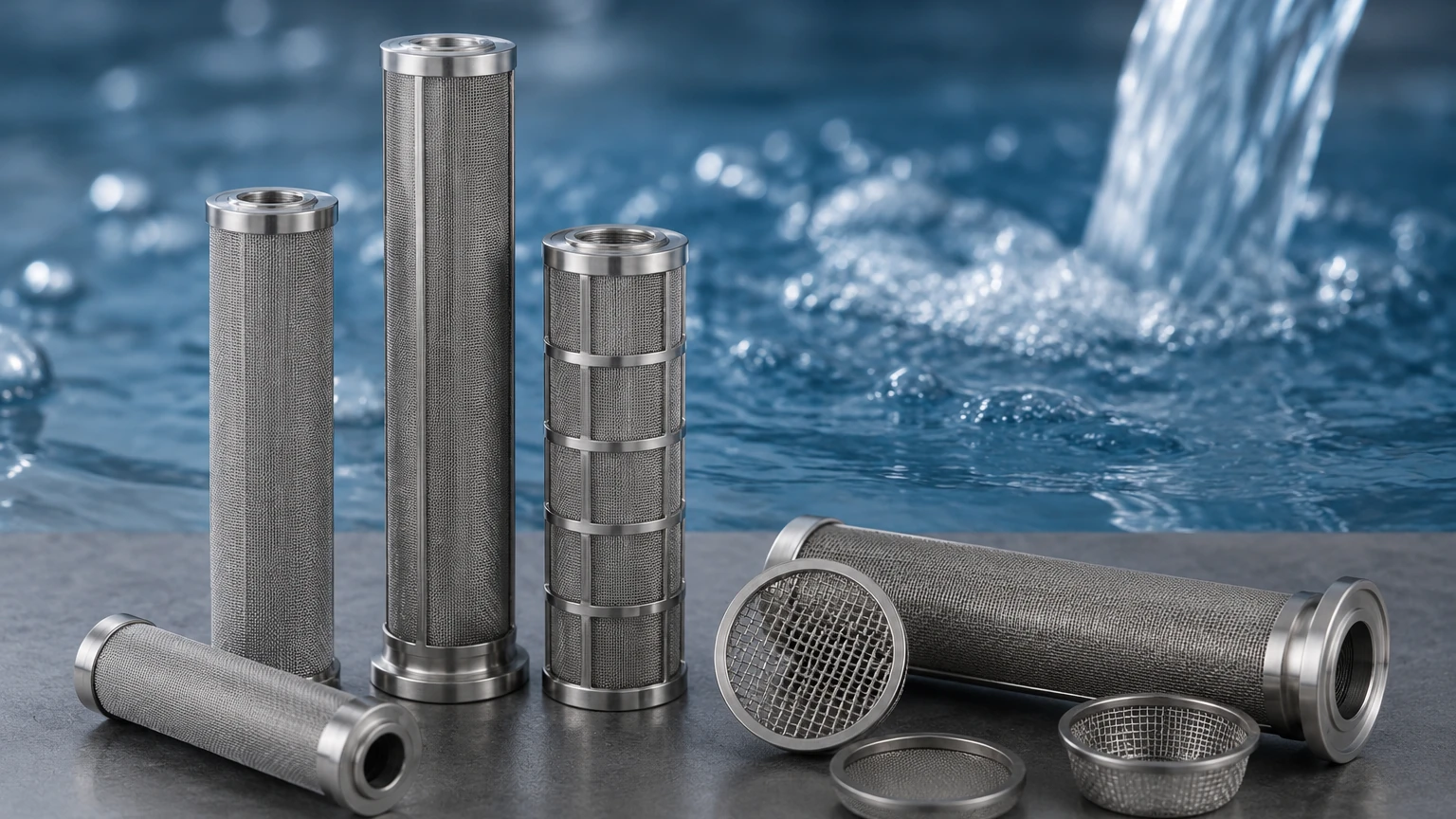
In industrial environments, filtration components must withstand high flow rates and varying pressure conditions. Unlike disposable plastic or paper filters, stainless steel filtration elements used in prozesswasseraufbereitung offer structural integrity and the ability to be cleaned and reused, which significantly reduces the total cost of ownership (TCO). These metal filters are designed to capture suspended solids, ranging from coarse sand and scale to microscopic particles, ensuring that the water meets the stringent requirements of the specific industrial process.
Material Selection for Industrial Water Filtration
When designing or specifying components for prozesswasseraufbereitung, material selection is the most critical decision an engineer will make. The chemical composition of the process water, including its pH level, chloride content, and temperature, dictates the grade of stainless steel required.
1. AISI 304 Stainless Steel: This is the standard grade for many industrial water applications. It offers good corrosion resistance and is cost-effective for systems dealing with non-aggressive process water. It is widely used in general machinery cooling and pre-filtration stages.
2. AISI 316L Stainless Steel: For applications involving high chloride concentrations or acidic environments, 316L is the preferred choice. The addition of molybdenum enhances its resistance to pitting and crevice corrosion, making it essential for chemical processing and pharmaceutical water treatment.
3. Specialty Alloys: In extreme cases where process water contains highly corrosive chemicals or operates at exceptionally high temperatures, alloys such as Hastelloy or Duplex stainless steel may be employed.
Kaifil’s manufacturing process ensures that these materials are processed to maintain their metallurgical properties, providing reliable performance in demanding environments. Choosing the correct material prevents premature filter failure and avoids the risk of metallic contamination in the process stream.
Technical Parameters: Micron Ratings and Flow Dynamics
The efficacy of prozesswasseraufbereitung is often measured by the filtration rating, typically expressed in microns (µm). Engineers must balance the need for fine filtration with the practicalities of flow rate and pressure drop.
Nominal vs. Absolute Filtration
In the context of metal mesh filters, it is important to distinguish between nominal and absolute ratings. A nominal rating indicates the ability of the filter to retain a major percentage of particles of a certain size, whereas an absolute rating refers to the diameter of the largest hard spherical particle that will pass through the filter under specified test conditions. For critical prozesswasseraufbereitung stages, absolute-rated sintered wire mesh is often required to ensure no particles above a specific size bypass the system.
Pressure Drop ($ΔP$)
Every filter element introduces resistance to the flow. As particles accumulate on the surface of the filter (the "filter cake"), the differential pressure increases. Engineers must design systems that account for the clean pressure drop and define a maximum allowable $ΔP$ before the filter must be cleaned or replaced. High-quality wire mesh designs minimize the initial pressure drop, thereby reducing the energy consumption of the pumps within the water treatment circuit.
Comparing Filter Structures: Wire Mesh vs. Sintered Cartridges
The physical structure of the filter element determines its capacity for dirt holding and its mechanical strength. In prozesswasseraufbereitung, two primary types of stainless steel filter elements are commonly used:
Woven Wire Mesh
Woven mesh filters are excellent for surface filtration. They are characterized by a precise pore size and are relatively easy to clean via backwashing. Different weave types, such as plain weave, twill weave, or Dutch weave, offer varying levels of strength and filtration fineness. Plain Dutch weave, for instance, provides a compact and firm mesh structure with high filtration accuracy, making it ideal for high-pressure water systems.
Sintered Metal Filters
Sintering involves bonding multiple layers of wire mesh or metal fibers together using heat and pressure without melting the material. This creates a robust, porous structure with high mechanical strength. Sintered cartridges are preferred in prozesswasseraufbereitung when the system face high differential pressures or when deep filtration (capturing particles within the media) is required. They are virtually immune to media migration, ensuring that the filter material itself does not contaminate the water.
Maintenance Strategies and Filter Longevity
A primary advantage of using stainless steel components in prozesswasseraufbereitung is their cleanability. Unlike synthetic media that must be discarded, metal filters can be restored to near-original performance through various cleaning protocols:
* Backwashing: Reversing the flow of water to dislodge particles trapped on the surface. This is often automated in continuous process systems.
* Ultrasonic Cleaning: Using high-frequency sound waves in a cleaning solvent to remove fine particles embedded deep within the mesh or sintered structure.
* Chemical Cleaning: Utilizing specific acids or alkalis to dissolve organic or mineral scaling, provided the filter material is chemically compatible.
Establishing a rigorous maintenance schedule based on differential pressure monitoring is essential. Over-extending the service interval can lead to "blinding" of the filter or, in extreme cases, structural deformation of the element. By selecting durable components from a manufacturer like Kaifil, facilities can ensure their prozesswasseraufbereitung systems remain operational for years with minimal replacement costs.
Custom Engineering for Complex Water Treatment Systems
No two industrial facilities have identical water treatment needs. Factors such as installation space, existing pipework, and specific contaminant profiles require customized filtration solutions. Customization in prozesswasseraufbereitung often involves:
* Custom Dimensions: Manufacturing filter cartridges or baskets to fit existing housing units from various OEM brands.
* Reinforced Structures: Adding internal support cores or external cages to filter elements that must operate under extreme hydraulic shocks or high-viscosity conditions.
* End-Cap Configurations: Providing specific fittings, such as 222, 226, or threaded connections, to ensure a leak-proof seal within the filtration vessel.
For engineers tasked with upgrading or maintaining a water treatment plant, the ability to source precision-engineered components that meet exact specifications is vital. This level of customization ensures that the filtration stage does not become a bottleneck in the overall prozesswasseraufbereitung system.
Conclusion: Selecting a Reliable Filtration Partner
Effective prozesswasseraufbereitung is a cornerstone of industrial reliability. By focusing on high-quality stainless steel filtration components, engineers can protect their equipment, reduce waste, and maintain the highest standards of production. The selection process requires a deep understanding of material science, fluid mechanics, and the specific demands of the application.
Kaifil specializes in the production of these critical components, offering the technical support and manufacturing flexibility required by global industrial sectors. From initial material selection to the final design of complex sintered structures, our focus is on delivering durability and precision. For further technical guidance or to review our full range of filtration products, please visit our Main Page. By integrating professional-grade filtration into your water treatment strategy, you ensure a robust and cost-effective solution for all your industrial process water needs.
