


Foam for Puppet Making
In the specialized field of industrial fabrication and animatronics, the selection of materials is a critical engineering decision that dictates the durability, weight, and performance of the final assembly. One of the most essential materials in this sector is foam for puppet making. While often associated with the creative arts, the production and selection of these foams involve rigorous industrial standards, material science, and precise manufacturing processes. For professionals in the industry, understanding the technical specifications of polyurethane and polyethylene foams is as vital as understanding the filtration systems used to produce them. To learn more about the engineering standards behind industrial components, you can visit the Kaifil Main Page.
The Engineering of Reticulated Polyurethane Foam
The primary material used in professional-grade foam for puppet making is reticulated polyurethane (PU) foam. Reticulation is an industrial process that removes the window membranes of the foam cells, leaving only the skeletal structure. This results in an open-cell material that is exceptionally lightweight and breathable.
There are two primary methods of reticulation used in industrial manufacturing:
1. Chemical Reticulation: The foam is immersed in a caustic solution (typically a strong alkali) that dissolves the cell membranes. This method requires precise control over temperature and concentration to ensure the structural integrity of the remaining struts is not compromised.
2. Thermal Reticulation (Explosion Reticulation): The foam is placed in a vacuum chamber filled with a combustible gas mixture. Upon ignition, a controlled explosion occurs. The heat and pressure burst the thin cell membranes but are gone too quickly to melt the thicker skeletal struts. This method is preferred for high-consistency industrial applications.
For engineers sourcing foam for puppet making, reticulated foam offers the advantage of "memory"—the ability to return to its original shape after compression—and a high strength-to-weight ratio, which is essential for large-scale animatronic structures.
Technical Specifications: PPI and Density
When evaluating foam for puppet making, procurement teams must look beyond generic descriptions and focus on technical metrics: Pores Per Inch (PPI) and Density.
Pores Per Inch (PPI)
PPI is a measurement of the porosity of the foam. In industrial filtration, PPI determines the size of particulates the foam can capture. In puppet making, PPI determines the texture and flexibility of the material.
* 10–20 PPI: Large cells, very high airflow, used for internal structural support where weight must be minimized.
* 30–40 PPI: The standard range for most professional puppets. It provides a balance of smoothness for fabric adhesion and structural stability.
* 60–100 PPI: Very fine cells, used for detailed facial features or where the foam surface will be painted directly without a fabric covering.
Density and Compression Force Deflection (CFD)
Density is measured in pounds per cubic foot (PCF). A higher density usually indicates a more durable foam with better longevity. Compression Force Deflection (CFD) measures the firmness of the foam. For puppet making, a low CFD is often required for the "mouth" mechanism to reduce operator fatigue, while a higher CFD is needed for the torso to maintain shape under the weight of costumes.
The Role of Industrial Filtration in Foam Production
The quality of foam for puppet making is directly linked to the purity of its chemical precursors. Polyurethane is formed by the reaction between a polyol and an isocyanate. Any impurities in these chemicals can lead to "voids" (large, unintended holes) or structural weak points in the foam block.
Industrial filtration plays a crucial role here. High-precision stainless steel filter cartridges and wire mesh filters are used to strain the raw chemical components before they reach the mixing head. These filtration systems, similar to the specialized solutions detailed on our Main Page, ensure that the chemical reaction occurs uniformly. Without precise filtration, the resulting foam would fail to meet the rigorous standards required for professional theatrical or film use.
Furthermore, in the production of reticulated foam, air filtration is vital. The environment must be free of dust and contaminants that could settle on the skeletal structure during the reticulation process, as these particles can interfere with the bonding of adhesives used later in the puppet assembly process.
Comparing Open-Cell and Closed-Cell Foams
While reticulated PU foam (open-cell) is the industry standard for flexible characters, closed-cell foams like Ethylene Vinyl Acetate (EVA) and Polyethylene (PE) serve distinct roles in the fabrication process.
Open-Cell (Polyurethane)
* Pros: Breathable, highly flexible, easy to glue with contact cement, excellent memory.
* Cons: Susceptible to oxidation (yellowing) and UV degradation; absorbs moisture.
* Application: Primary body structures, hand mechanisms, and head armatures.
Closed-Cell (EVA/PE)
* Pros: Waterproof, rigid, can be heat-formed (thermoforming), high impact resistance.
* Cons: Not breathable, limited flexibility, harder to bond without specialized primers.
* Application: Internal skeletons, armor pieces, and structural bases for large-scale walk-around mascots.
Engineers often use a hybrid approach, utilizing a closed-cell PE foam for the base to provide a rigid foundation and layering open-cell foam for puppet making over it to achieve the desired organic movement.
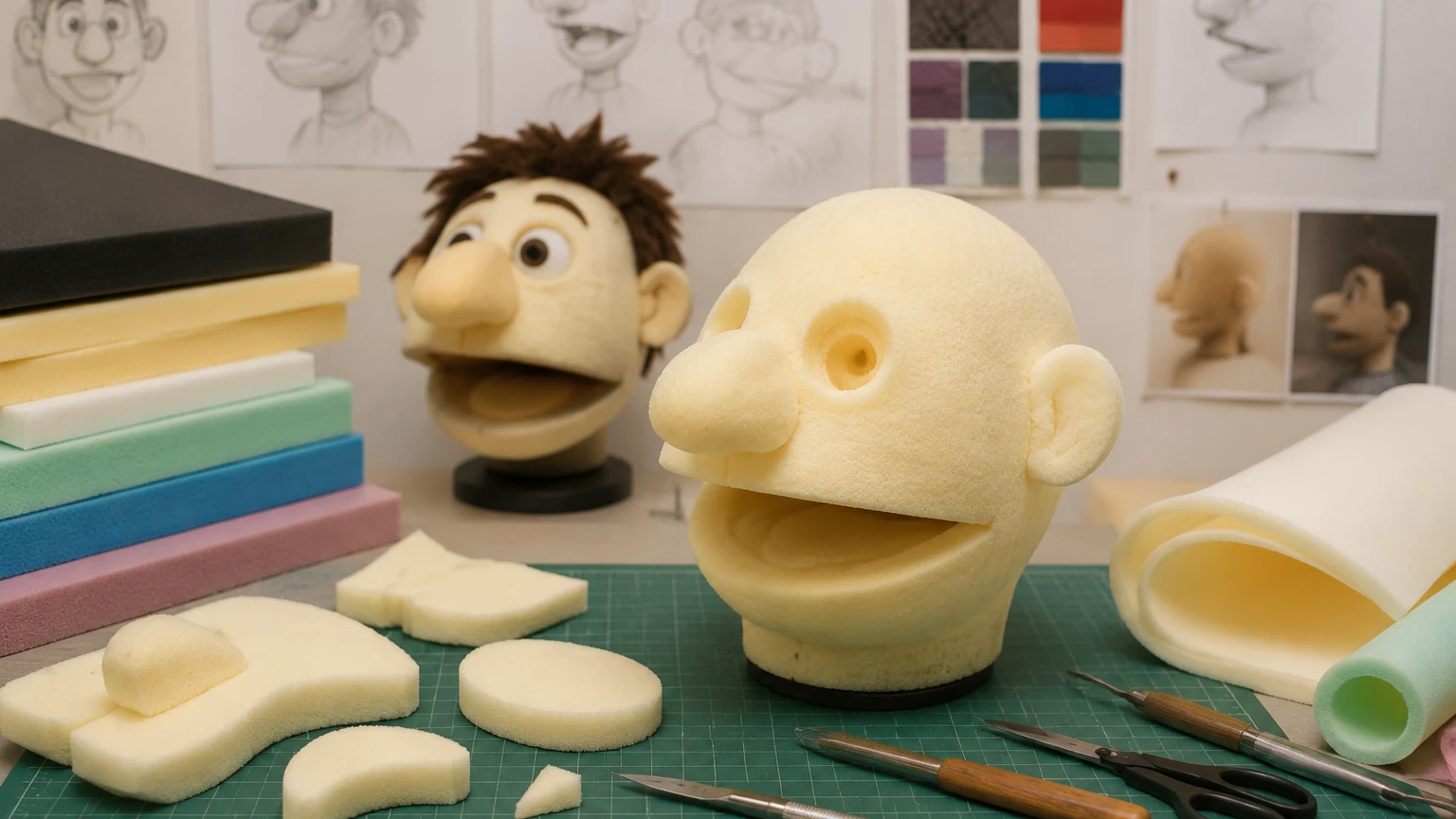
Selection Criteria for Professional Procurement
When sourcing foam for puppet making for large-scale productions, B2B buyers should confirm the following technical factors with their suppliers:
1. UV Stability: Standard PU foam yellows and becomes brittle over time when exposed to light. For long-running stage shows, specify UV-stabilized formulations.
2. Flame Retardancy: Many theatrical venues require materials to meet specific fire safety standards (e.g., CAL 117 or NFPA 701). Ensure the foam is treated or manufactured to meet these codes.
3. Outgassing: In enclosed animatronic shells, outgassing of residual chemicals can damage sensitive electronics. Sourcing high-quality, fully cured industrial foam is essential to prevent hardware failure.
4. Tear Strength: Measured in pounds per linear inch (PLI). High tear strength is critical for areas of the puppet that undergo constant stress, such as the joints and the mouth hinge.
Maintenance and Longevity: Lessons from Industrial Filtration
Just as industrial filters require regular maintenance and replacement to ensure system efficiency, foam components in puppets have a finite lifespan. Oxidation is the primary enemy of foam for puppet making. This is a chemical reaction where oxygen breaks down the polymer chains, leading to "crumbling."
To extend the life of these materials, industrial designers recommend:
* Climate-Controlled Storage: Storing puppets in dark, cool, and low-humidity environments to slow the oxidation process.
* Polyester vs. Polyether: Polyether-based foams are more resistant to moisture and humidity (hydrolysis) compared to polyester-based foams. For puppets used in humid environments or those that will be laundered, polyether is the superior engineering choice.
In industrial settings, the longevity of a system is often determined by the quality of its components. This principle applies equally to filtration and fabrication. Utilizing high-grade materials and ensuring the purity of the manufacturing process through advanced filtration—topics we cover extensively on our Main Page—is the only way to guarantee a professional result.
Conclusion
Foam for puppet making is a sophisticated material that sits at the intersection of chemistry, mechanical engineering, and creative design. Whether it is the thermal reticulation of polyurethane or the precise filtration of the raw polymers, every step of the manufacturing process must be controlled to produce a material capable of withstanding the rigors of professional performance. By focusing on technical specifications like PPI, density, and chemical base, and by understanding the industrial processes that ensure material purity, engineers and fabricators can select the optimal foam for their specific application, ensuring both performance and durability.
