


What Is an Air Tank
In industrial compressed air systems, an air tank—commonly referred to as an air receiver—is a specialized pressure vessel designed to store compressed air under pressure. While it may appear to be a simple storage container, it performs several critical functions that ensure the efficiency, reliability, and longevity of the entire pneumatic network. For engineers and facility managers, understanding the technical nuances of air tanks is essential for optimizing system performance and ensuring compliance with safety standards.
An air tank acts as a buffer between the air compressor and the end-use applications. By providing a reservoir of energy, it allows the system to meet peak demand without requiring the compressor to run constantly. This article explores the fundamental principles of air tanks, their integration with filtration systems, and the technical criteria necessary for professional selection.
The Core Functions of an Industrial Air Tank
To answer the question "what is an air tank" from a technical perspective, one must look beyond storage. In a balanced compressed air system, the receiver tank serves four primary purposes:
1. Pressure Stabilization and Pulsation Dampening
Reciprocating compressors, in particular, produce air in pulses. Without an air tank, these pulsations would travel through the piping, causing vibration, mechanical stress, and inconsistent pressure at the point of use. The air tank acts as a dampener, absorbing these pulses and providing a steady, laminar flow of air to downstream equipment.
2. Reducing Compressor Cycling
Compressors are most efficient when they run for extended periods rather than frequently starting and stopping. Frequent cycling leads to premature wear on the motor, electrical components, and the compressor block. By storing a volume of air, the tank allows the compressor to remain in the "off" or "unload" state for longer durations, significantly reducing energy consumption and maintenance costs.
3. Moisture Separation and Cooling
Compressed air is naturally hot and saturated with water vapor. As air enters the larger volume of the tank, its velocity drops, and it begins to cool through the tank's walls (radiant cooling). This drop in temperature causes water vapor to condense into liquid droplets, which collect at the bottom of the tank. This makes the air tank the first line of defense in moisture management, though it must be paired with high-quality filtration and drying systems for sensitive applications.
4. Emergency Reserve
In the event of a power failure or a sudden spike in demand that exceeds the compressor's capacity, the stored air in the tank provides a critical window of time to shut down sensitive processes safely or to maintain operation until the peak load passes.
Types of Air Tanks and Their Applications
Air tanks are categorized based on their orientation, pressure rating, and the materials used in their construction. The choice depends heavily on the specific industrial environment and the required air quality.
Vertical vs. Horizontal Tanks
* Vertical Tanks: These are the most common in industrial settings because they occupy less floor space. They are ideal for facilities where square footage is at a premium.
* Horizontal Tanks: Often used in portable units or in facilities with low overhead clearance. In some cases, the compressor and motor are mounted directly on top of a horizontal tank to create a compact, all-in-one workstation.
Primary vs. Secondary Receivers
* Primary Receivers: Located near the compressor room, these tanks handle the bulk of the storage and initial moisture separation.
* Secondary Receivers: Located near specific high-demand equipment at the end of long piping runs. They prevent local pressure drops when a specific machine cycles on, ensuring that the rest of the facility remains unaffected.
Material Selection: The Case for Stainless Steel
When evaluating what is an air tank for a specific application, material selection is paramount. While carbon steel is the standard for general industrial use, it is susceptible to internal corrosion due to the constant presence of moisture. This corrosion leads to rust scale, which can clog downstream filters and damage precision pneumatic components.
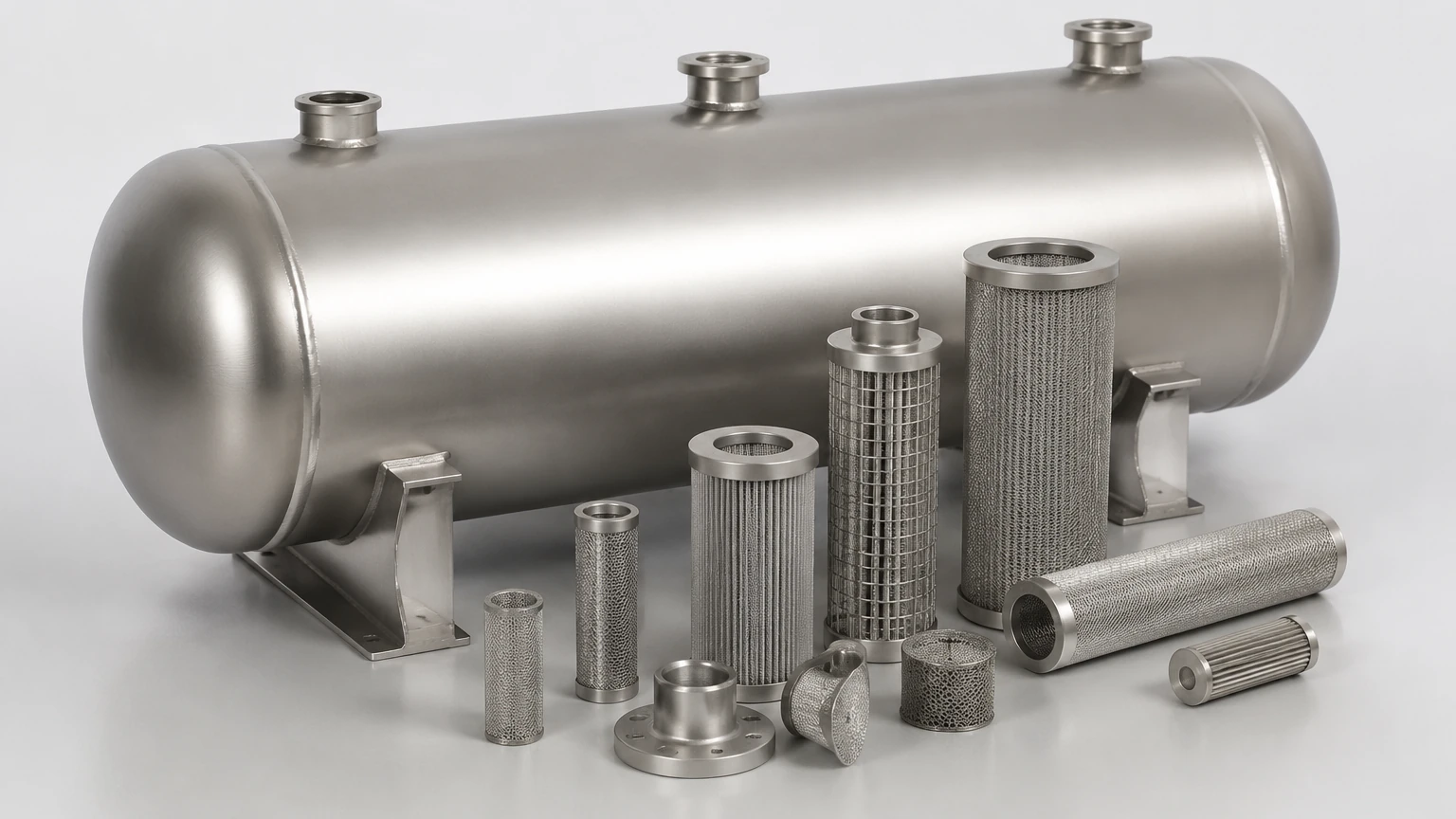
In industries such as pharmaceutical manufacturing, food and beverage processing, and chemical production, stainless steel air tanks are the preferred choice. Stainless steel offers superior corrosion resistance, ensuring that the air remains free of metallic contaminants. For organizations seeking high-performance filtration components to complement these systems, visiting the Main Page of a specialized manufacturer like Kaifil provides insights into how custom stainless steel solutions can enhance system purity.
Integration with Filtration Systems
An air tank is only one part of a comprehensive air treatment chain. To achieve the air quality classes defined by ISO 8573-1, the tank must be integrated with appropriate filtration. The relationship between the tank and filters is bidirectional: the tank helps the filters work better, and the filters protect the tank and downstream processes.
Pre-Tank Filtration
In some systems, a coarse filter or moisture separator is placed before the air tank to remove bulk liquids and large particulates. This prevents the buildup of sludge inside the tank, which can be difficult to clean and can harbor bacterial growth in food-grade applications.
Post-Tank Filtration
Since the air tank can be a source of contamination (if it is made of carbon steel and begins to rust), high-precision filters are essential at the tank's outlet. Stainless steel wire mesh filters and sintered metal cartridges are often used here to remove fine particulates and residual oil aerosols. These components must be selected based on the required micron rating and the flow rate of the system.
Technical Selection Criteria for Engineers
Selecting the right air tank involves more than just picking a volume. Engineers must calculate specific parameters to ensure the tank meets the system's needs without being over-engineered and unnecessarily expensive.
1. Volume Calculation
A general rule of thumb is to provide 1 to 4 gallons of storage for every Cubic Foot per Minute (CFM) of compressor output. However, for systems with high intermittent demand, a more precise formula is used:
**V = (t * C * Pa) / (P1 – P2)**
Where:
* V = Receiver volume (cubic feet)
* t = Time for the pressure drop to occur (minutes)
* C = Air demand (CFM)
* Pa = Absolute atmospheric pressure (PSIA)
* P1 = Initial tank pressure (PSIG)
* P2 = Minimum required pressure (PSIG)
2. Pressure Rating (MAWP)
The Maximum Allowable Working Pressure (MAWP) of the tank must exceed the maximum pressure the compressor can produce. Most industrial tanks are rated for 150 PSI or 200 PSI, but high-pressure applications may require vessels rated for 500 PSI or higher.
3. Safety Standards and Certification
In North America, air tanks must be manufactured according to the ASME (American Society of Mechanical Engineers) Boiler and Pressure Vessel Code. These tanks will carry a "U" or "UM" stamp. In Europe, the PED (Pressure Equipment Directive) governs these standards. Using non-certified tanks is a significant safety risk and a violation of most industrial insurance policies.
Maintenance and Safety Considerations
Because air tanks store a massive amount of potential energy, they require regular maintenance to prevent catastrophic failure. A neglected air tank can explode, leading to severe property damage and injury.
Condensate Management
Moisture is the primary enemy of an air tank. Every tank must be equipped with a drain valve—either manual, electronic timed, or zero-loss float drains. Regular draining prevents the volume of the tank from being displaced by water and reduces internal corrosion.
Safety Relief Valves
Every air receiver must have at least one pressure relief valve (PRV) set to open if the pressure exceeds the tank's rating. These valves must be tested periodically to ensure they are not stuck or clogged by debris.
Internal Inspection
Over time, even the best-maintained tanks can experience thinning of the walls due to corrosion. Ultrasonic thickness testing is a non-destructive method used to verify that the tank wall remains thick enough to handle the operating pressure safely.
Conclusion
Understanding what is an air tank involves recognizing its role as a multifunctional component that stabilizes pressure, saves energy, and assists in air purification. For engineers, the selection process must prioritize the correct volume, appropriate pressure ratings, and materials that suit the specific cleanliness requirements of the industry.
By integrating high-quality air tanks with precision stainless steel filtration solutions, manufacturers can ensure a reliable supply of clean, dry air. For more information on custom filtration components that support these industrial systems, explore the technical resources available at https://www.kaifil.com/. Proper integration of storage and filtration not only protects downstream equipment but also optimizes the total cost of ownership for the entire compressed air installation.
