


Gas Purification System
In industrial manufacturing, the integrity of a gas purification system is a fundamental requirement for process stability, equipment longevity, and product quality. Whether the application involves the production of high-purity chemicals, the protection of sensitive analytical instruments, or the maintenance of sterile environments in food and pharmaceutical processing, the removal of contaminants from gas streams is a complex engineering challenge. A robust gas purification system typically integrates multiple stages of filtration and separation to address various types of impurities, including solid particulates, moisture, oil vapors, and gaseous chemical contaminants.
For engineers and procurement professionals, selecting the appropriate filtration components within these systems requires a deep understanding of material science, fluid dynamics, and the specific environmental conditions of the application. Stainless steel filtration media, such as those provided on the Kaifil Main Page, play a critical role in these systems due to their exceptional durability and resistance to extreme temperatures and corrosive agents.
The Fundamental Role of Filtration in Gas Purification
A gas purification system is designed to reduce the concentration of impurities to levels specified by industry standards or internal quality protocols. The filtration stage is often the most critical mechanical component of this process. Unlike liquid filtration, gas filtration must account for the high compressibility of the fluid and the significantly higher velocities often encountered in industrial piping.
Particulate Removal
In most industrial gas streams, solid particulates are the primary concern. These can originate from pipe scale, catalyst fines, or atmospheric dust introduced during compression. If left unmanaged, these particles can cause abrasive wear on valves, clog precision orifices, and contaminate end products. Stainless steel wire mesh and sintered metal filters are frequently utilized in the primary and secondary stages of a gas purification system to provide reliable particulate capture with high mechanical strength.
Coalescing and Aerosol Separation
In systems involving compressed air or technical gases like nitrogen and hydrogen, liquid aerosols (such as oil or water droplets) must be removed. Coalescing filters within the purification train use specialized media to encourage small droplets to merge into larger ones, which then drain away. While synthetic fibers are common for low-temperature applications, stainless steel mesh components are preferred in high-temperature or chemically aggressive environments where synthetic materials would degrade.
Engineering Considerations for Filter Media Selection
When designing or specifying components for a gas purification system, engineers must evaluate several technical parameters to ensure the system operates efficiently over its intended lifecycle. The choice of filter media is not merely a matter of micron rating; it involves a balance of permeability, dirt-holding capacity, and structural integrity.
Material Compatibility
Stainless steel is the industry standard for demanding gas purification applications. AISI 304 and 316L are the most common alloys used. 316L, in particular, offers superior resistance to pitting and crevice corrosion, making it essential for systems handling sour gas, acidic vapors, or gases in marine environments. For ultra-high temperature applications, specialized alloys may be required, but for the majority of industrial gas purification tasks, stainless steel provides the necessary thermal stability up to 500°C (932°F) or higher, depending on the structural design.
Filtration Accuracy: Nominal vs. Absolute
In the context of a gas purification system, understanding the difference between nominal and absolute filtration ratings is vital.
- Nominal Rating: Indicates the ability of the filter to retain a major percentage (usually 60% to 90%) of particles of a specific size.
- Absolute Rating: Refers to the diameter of the largest hard spherical particle that will pass through the filter under specified test conditions.
For critical gas purification, such as protecting a gas chromatograph or a semiconductor fabrication tool, absolute-rated sintered metal or fine wire mesh filters are required to ensure no particles above a certain threshold bypass the system.
Pressure Drop and Energy Efficiency
The "Delta P" or pressure drop across a filter element is a direct indicator of the energy required to move gas through the purification system. High initial pressure drops lead to increased compressor load and higher operational costs. Engineers must select media that offers high porosity—allowing for high flow rates—while maintaining the required filtration efficiency. Sintered metal fiber felt, for example, provides a highly porous structure that facilitates lower pressure drops compared to traditional woven mesh of the same micron rating.
Types of Metal Filter Elements in Gas Purification
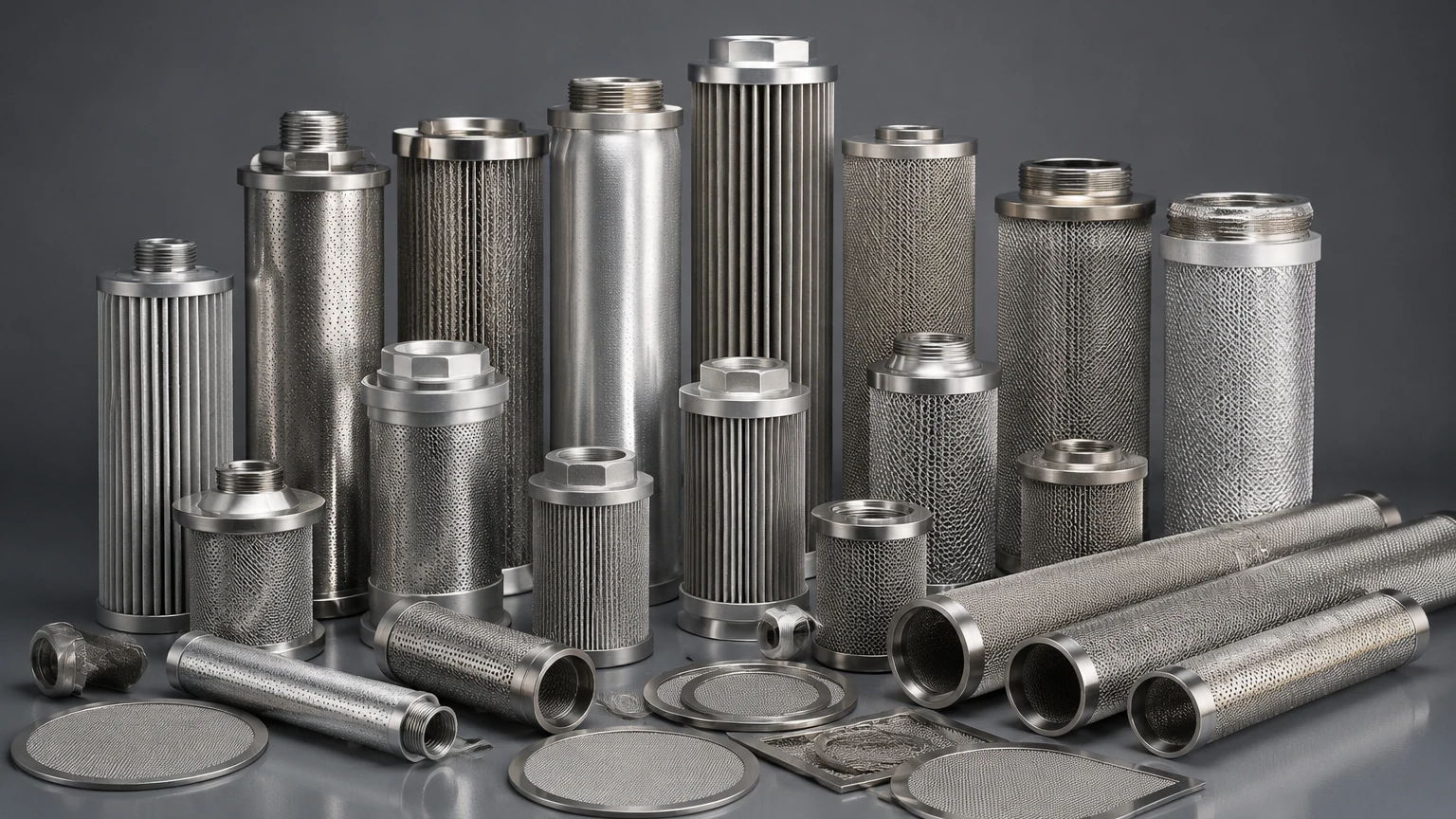
To achieve the desired purity levels, different structures of stainless steel filter elements are employed within the gas purification system. Each has specific advantages based on the nature of the gas and the contaminants involved.
Woven Wire Mesh Filters
Woven mesh is characterized by its precise pore size and uniform structure. It is available in various weave patterns, including plain, twill, and Dutch weaves. In gas purification, Dutch weave is often favored for its superior strength and ability to handle high differential pressures. These filters are surface-media filters, meaning particles are trapped on the surface, making them relatively easy to clean via back-pulsing or ultrasonic cleaning.
Sintered Metal Mesh
By laminating multiple layers of wire mesh and bonding them through a high-temperature sintering process, manufacturers create a rigid, porous material that combines the precision of mesh with enhanced mechanical strength. In a gas purification system, sintered mesh elements are used where high pressure and high flow rates might otherwise deform a single-layer mesh. They are particularly effective in high-pressure gas distribution manifolds.
Sintered Metal Fiber Felt
This medium is composed of non-woven stainless steel fibers that are sintered together. It functions as a depth-filtration medium, providing a tortuous path for gas molecules. This structure allows for a very high dirt-holding capacity and exceptionally low pressure drop. It is an ideal choice for gas purification systems where the gas contains a high concentration of very fine particulates.
Application-Specific Requirements
The configuration of a gas purification system varies significantly across different industrial sectors. Understanding these nuances is essential for effective system design.
Chemical and Petrochemical Processing
In these environments, gas purification often involves the removal of catalyst fines from process streams. The filters must withstand not only high temperatures but also the chemical reactivity of the process gas itself. Stainless steel filter cartridges are the preferred choice here due to their inert nature and ability to be integrated into high-pressure housings.
Food and Beverage Industry
Gas purification is essential for gases that come into direct contact with food products, such as the CO2 used in carbonation or the nitrogen used for blanketing. Here, the system must ensure the removal of bacteria and fine particulates. Stainless steel filters are advantageous because they can withstand Steam-In-Place (SIP) and Clean-In-Place (CIP) sterilization cycles without losing structural integrity.
Pharmaceutical Manufacturing
For pharmaceutical applications, the gas purification system must meet stringent regulatory standards (such as FDA or EMA requirements). The filtration media must be non-shedding and capable of achieving sterile-grade filtration. Precision-engineered stainless steel components ensure that no metallic fragments or fibers migrate into the purified gas stream.
Evaluating Total Cost of Ownership (TCO)
When purchasing components for a gas purification system, the initial purchase price is only one factor. A technical evaluation should focus on the Total Cost of Ownership (TCO), which includes:
1. Service Life: How long can the filter operate before it reaches the maximum allowable pressure drop? Stainless steel filters generally offer a much longer service life than disposable synthetic filters.
2. Cleanability: Can the filter be cleaned and reused? The ability to regenerate stainless steel media through ultrasonic cleaning or chemical washing significantly reduces the long-term cost of consumables.
3. Energy Costs: As mentioned, a lower pressure drop translates directly to lower energy consumption at the compressor or blower.
4. Downtime: High-quality metal filters are less prone to catastrophic failure (such as media migration or bursting), which reduces the risk of unplanned system shutdowns.
Customization and OEM Integration
Many industrial gas purification systems require bespoke filtration solutions that cannot be met by off-the-shelf products. Customization may involve specific dimensions to fit existing housings, specialized end-cap configurations (such as NPT, flange, or quick-connect), or unique combinations of filter media to achieve a specific performance profile.
Manufacturers like Kaifil specialize in working with engineering teams to develop these custom components. By providing detailed specifications regarding flow rates, operating temperatures, and target particle sizes, purchasing teams can ensure that the filtration elements they procure are perfectly matched to the demands of their specific gas purification system.
Conclusion: Ensuring System Integrity
The effectiveness of a gas purification system is defined by the quality of its individual components. For industrial applications where reliability is non-negotiable, stainless steel filtration media provide the necessary performance characteristics to handle high pressures, extreme temperatures, and corrosive environments. By focusing on technical specifications such as absolute micron ratings, material grade, and pressure drop characteristics, engineers can optimize their purification processes for both performance and cost-effectiveness.
For those seeking to explore specific product options or requiring technical support for their filtration challenges, visiting the Main Page provides access to a range of professional stainless steel filtration solutions designed for modern industrial requirements.
