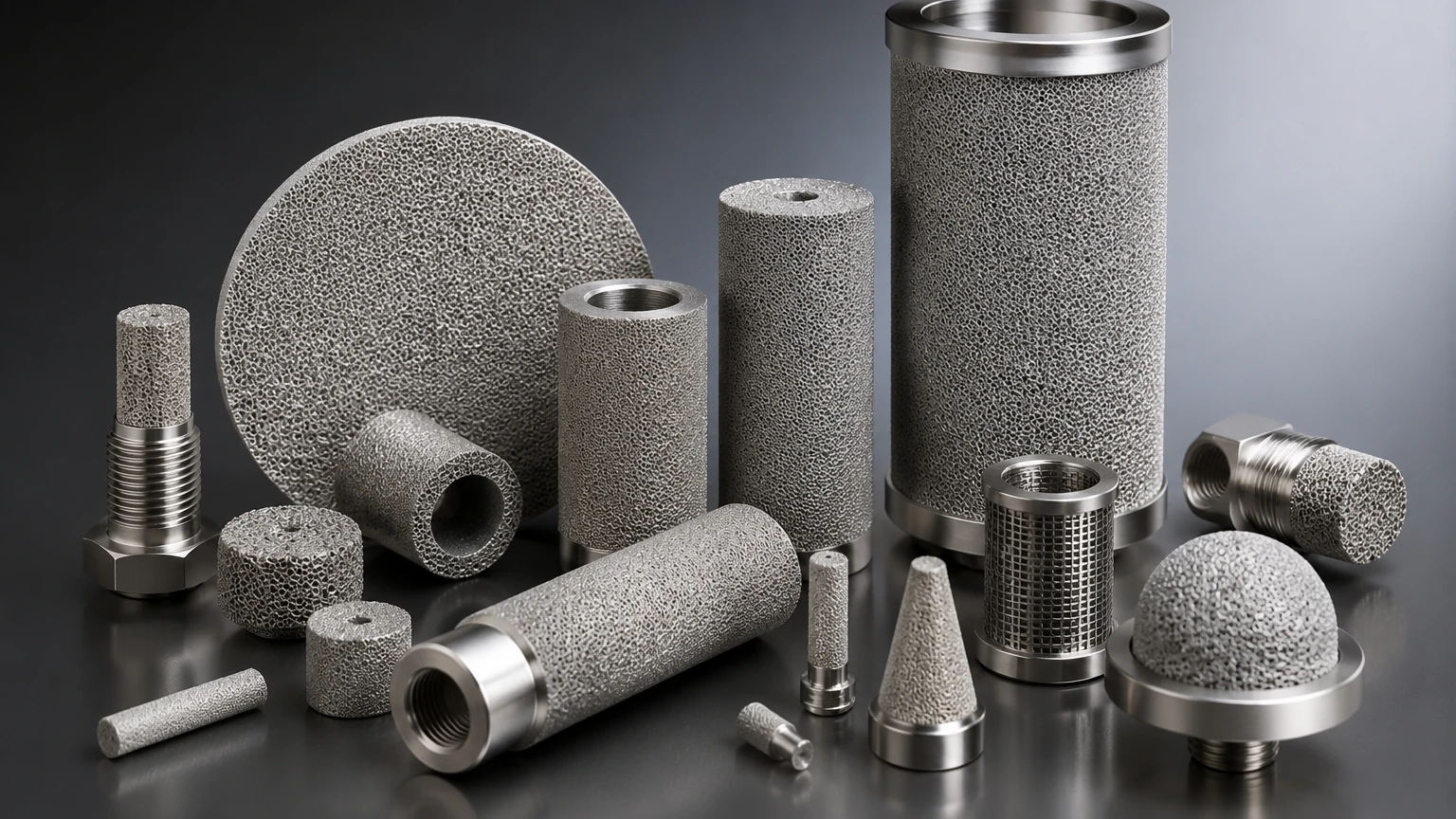
Porous Metal Filters
In industrial process engineering, the selection of filtration media is a critical decision that impacts product purity, equipment longevity, and operational safety. Porous metal filters represent a specialized category of filtration technology designed to withstand conditions where conventional polymer, paper, or fabric media would fail. These filters are engineered through a process called sintering, where metal powders or fibers are fused under heat and pressure to create a rigid, porous structure. For engineers and procurement teams, understanding the technical nuances of these components is essential for optimizing system performance in demanding environments.
Understanding Porous Metal Filtration Technology
Porous metal filters are primarily distinguished by their manufacturing method and the resulting structural integrity. Unlike woven wire mesh, which consists of individual wires interlaced in a pattern, sintered porous metal is a monolithic structure. This structure is achieved by taking metallic particles—often stainless steel 316L, though other alloys like Hastelloy or Monel are used for specific chemical resistances—and heating them to just below their melting point. This causes the particles to bond at their contact points, creating a stable network of interconnected pores.
The resulting media offers a "tortuous path" for the fluid or gas being filtered. As the process stream passes through the filter, contaminants are trapped not just on the surface (surface filtration) but also within the depth of the porous matrix (depth filtration). This dual-action capability allows for high dirt-holding capacity while maintaining precise micron ratings. Because the structure is metallic, it maintains its pore geometry even under high differential pressure, a common failure point for soft filtration media.
Key Performance Criteria for Selection
When evaluating porous metal filters for a specific application, engineers must look beyond simple dimensions. Several technical parameters dictate how a filter will perform over its operational lifespan.
1. Filtration Rating: Absolute vs. Nominal
In industrial filtration, the distinction between absolute and nominal ratings is vital. A nominal rating refers to a filter's ability to retain a major percentage (usually 60% to 90%) of particles of a specific size. However, for critical applications in the pharmaceutical or semiconductor industries, an absolute rating is required. An absolute rating indicates that 99.9% or more of particles above a certain micron size will be captured. Porous metal filters excel in providing absolute filtration in the sub-micron to 100-micron range.
2. Permeability and Pressure Drop
Permeability defines how easily a fluid can pass through the filter media. A high-permeability filter allows for higher flow rates at lower differential pressures (Delta P). Engineers must calculate the initial clean pressure drop to ensure the system’s pumps or compressors can handle the load. As the filter accumulates debris, the Delta P will increase; understanding the terminal pressure drop—the point at which the filter must be cleaned or replaced—is essential for system design.
3. Mechanical Strength and Thermal Stability
One of the primary reasons for selecting porous metal filters is their ability to operate at extreme temperatures, often exceeding 450°C (842°F) in oxidizing environments and even higher in reducing environments. Furthermore, their high collapse pressure allows them to survive hydraulic shocks or high-viscosity fluid processing that would deform or burst other filter types.
Engineering Considerations for Customization
Off-the-shelf filtration solutions rarely meet the specific requirements of complex industrial systems. Customization is often necessary to integrate the filter into existing piping or specialized housings. When working with a manufacturer like Kaifil, engineers should consider the following customization variables:
* Geometry and Form Factor: Porous metal can be fabricated into seamless tubes, flat discs, conical shapes, or pleated cartridges to increase surface area within a compact footprint.
* End Cap Configurations: Standard fittings such as 222, 226, NPT, or BSP threads, and custom flanges are used to ensure leak-proof seals. The method of joining the filter media to the end caps—typically TIG welding—must be performed to high standards to prevent bypass.
* Alloy Selection: While 316L stainless steel is the industry standard due to its corrosion resistance and cost-effectiveness, highly corrosive environments (such as those involving wet chlorine or strong acids) may require exotic alloys like Titanium or Inconel.
Operational Efficiency and Total Cost of Ownership
While the initial capital expenditure (CAPEX) for porous metal filters is higher than for disposable cartridges, the total cost of ownership (TCO) is often significantly lower in the long term. This is primarily due to the cleanability and reusability of metal media.
Cleaning and Regeneration
Porous metal filters can be regenerated using several methods, depending on the nature of the contaminant:
* Backpulsing/Backwashing: For gas and liquid systems, reversing the flow can dislodge surface cakes and flush out particles trapped in the pores.
* Ultrasonic Cleaning: Using high-frequency sound waves in a cleaning solvent to break down fine particulate matter deep within the matrix.
* Chemical Cleaning: Utilizing acids, caustic solutions, or specialized solvents to dissolve organic or inorganic deposits without damaging the metal structure.
* Thermal Burn-off: Heating the filter in a controlled atmosphere to oxidize organic contaminants.
By implementing a structured cleaning protocol, the service life of a single porous metal element can extend to several years, drastically reducing the frequency of procurement cycles and the environmental impact of disposing of used filter elements.
Common Risks and Mitigation in Filtration Systems
Failure to properly specify a filter can lead to significant operational risks. One common risk is "media migration," where bits of the filter material itself break off and enter the process stream. High-quality sintered metal filters mitigate this risk through their rigid, fused structure, unlike fiber-shedding felt or paper filters.
Another risk is chemical incompatibility. Even stainless steel can succumb to pitting or stress corrosion cracking if exposed to certain halides or temperatures beyond its rating. Engineers should always confirm the chemical composition of the process fluid, including trace elements, and consult with the manufacturer’s technical team to verify material suitability.
Furthermore, bypass leakage is a frequent issue in poorly designed systems. If the filter element does not seat perfectly within the housing, or if the seals (O-rings/gaskets) fail, the fluid will take the path of least resistance, bypassing the filtration media entirely. Ensuring precision machining of the filter’s connection points is as important as the quality of the porous media itself.
Evaluating the Manufacturer and Technical Verification
Before finalizing a purchase, the intended project audience—typically engineers and technical buyers—should confirm specific technical details with the supplier. A reliable manufacturer should be able to provide documentation and verification for the following:
1. Material Certification: Mill test reports (MTRs) that verify the chemical composition of the alloy used.
2. Bubble Point Testing: A non-destructive test used to verify the maximum pore size and the integrity of the filter element.
3. Flow-Pressure Curves: Data showing the expected pressure drop across the media at various flow rates for specific fluids (air, water, oil).
4. Welding Standards: Confirmation that all joints are welded by certified technicians to ensure structural integrity and prevent bypass.
For those seeking comprehensive technical specifications or to discuss custom engineering requirements, visiting the Main Page of the manufacturer’s site provides access to detailed product catalogs and engineering support. This initial technical consultation is vital for ensuring that the selected porous metal filters align with the specific hydraulic and chemical demands of the application.
Application-Specific Requirements
The versatility of porous metal filters allows them to be deployed across diverse industries, each with its own set of standards:
* Chemical Processing: Used for catalyst recovery and the filtration of aggressive solvents. The primary concern here is chemical resistance and the ability to handle high-temperature vapors.
* Food and Beverage: Requires 3-A or FDA-compliant materials. Filters must be capable of withstanding Clean-in-Place (CIP) and Steam-in-Place (SIP) sterilization cycles.
* Pharmaceuticals: Demands high-precision absolute filtration to ensure product purity and sterile air venting. Documentation and traceability are paramount in this sector.
* Hydraulics: Used in high-pressure circuits to protect sensitive valves and actuators from particulate wear. The focus is on high collapse pressure and fatigue resistance.
Conclusion
Porous metal filters are an engineered solution for the most challenging industrial filtration tasks. By offering a combination of mechanical strength, thermal stability, and precise filtration performance, they provide a level of reliability that disposable media cannot match. When selecting these components, engineers must take a holistic view—considering not only the initial micron rating but also the long-term cleanability, material compatibility, and the manufacturer's ability to provide customized, high-precision components. Through careful specification and maintenance, these filters become a cornerstone of efficient and cost-effective industrial processing.