


Rotary Drum Filter Belts
In industrial solid-liquid separation, the efficiency of a continuous filtration process often hinges on the performance of the filter media. Rotary drum filter belts are critical components in vacuum filtration systems, serving as the interface where the actual separation occurs. These belts must withstand significant mechanical tension, chemical exposure, and varying thermal conditions while maintaining precise filtration accuracy. For engineers and procurement teams, selecting the appropriate belt is not merely a matter of dimensional fit but a complex decision involving material science, weave geometry, and operational parameters.
As a professional manufacturer of custom stainless steel filtration solutions, Kaifil provides the technical expertise required to navigate these variables. Understanding the engineering nuances of rotary drum filter belts ensures that industrial operations can achieve higher throughput, lower moisture content in filter cakes, and extended component lifecycles.
The Role of Rotary Drum Filter Belts in Solid-Liquid Separation
Rotary vacuum drum filters (RVDF) operate on the principle of continuous vacuum-assisted separation. The drum rotates through a trough containing the slurry. As the drum moves, a vacuum is applied to the internal chambers, drawing the liquid through the filter belt while the solids are retained on the surface to form a "cake."
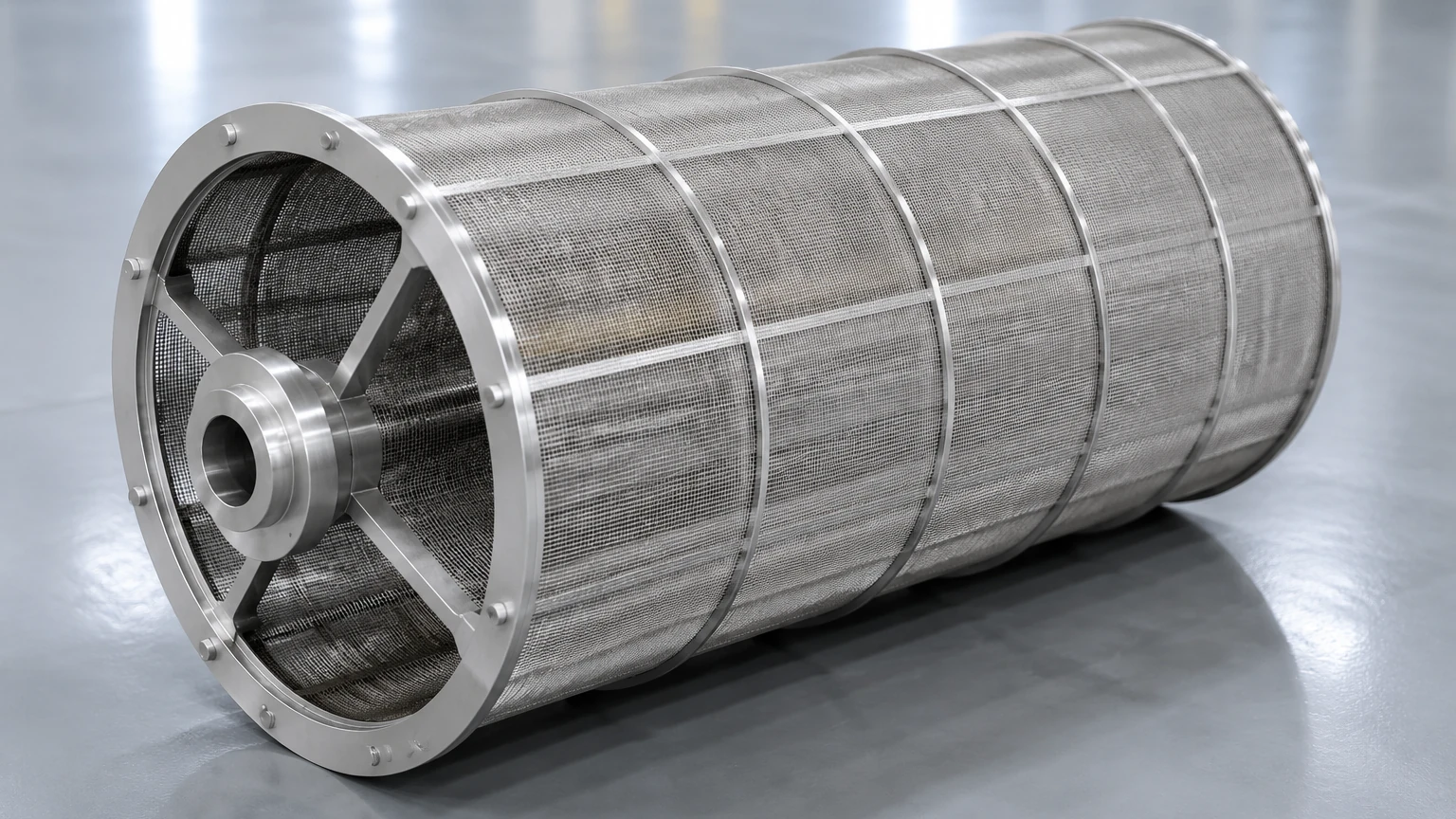
The rotary drum filter belt is the continuous loop of media that wraps around the drum. Unlike fixed-plate filters, the belt must be flexible enough to navigate the drum's curvature and various rollers while remaining rigid enough to resist stretching under vacuum pressure. The performance of the belt directly influences the clarity of the filtrate and the dryness of the discharged cake.
The Filtration Cycle
1. Cake Formation: The submerged portion of the drum uses vacuum pressure to pull the slurry toward the belt. The belt’s micron rating determines which particles are captured.
2. Drying and Washing: As the drum rotates out of the slurry, the vacuum continues to pull air through the cake to remove residual moisture. In many applications, wash nozzles spray the cake to remove impurities.
3. Discharge: The belt travels away from the drum over a discharge roller. Depending on the cake's stickiness, a scraper blade, air blow-back, or a simple change in belt direction facilitates cake removal.
4. Cleaning: Before returning to the slurry trough, the belt typically passes through a wash station where high-pressure sprays remove embedded particles to prevent "blinding."
Material Selection and Engineering Considerations
Material choice is the most significant factor in determining the longevity and chemical compatibility of rotary drum filter belts. While synthetic fibers like polyester and polypropylene are common, stainless steel wire mesh belts are often preferred for demanding industrial environments involving high temperatures, abrasive solids, or aggressive chemical solvents.
Stainless Steel Alloys
Stainless steel provides superior mechanical strength and resistance to thermal expansion. At Main Page, we emphasize the selection of the correct alloy based on the specific chemistry of the filtrate:
* Type 304: Suitable for general industrial applications with low corrosive requirements.
* Type 316L: The standard for pharmaceutical and food-grade applications due to its excellent resistance to pitting and crevice corrosion, especially in chloride-rich environments.
* 904L and Duplex Alloys: Utilized in highly acidic or specialized chemical processing where standard austenitic steels might fail.
Synthetic vs. Metal Mesh
Synthetic belts offer high flexibility and are cost-effective for low-temperature, non-abrasive applications. However, they are prone to stretching and can be damaged by sharp particles. Stainless steel belts, produced through precision weaving, offer fixed pore sizes that do not distort under vacuum pressure, ensuring consistent filtration accuracy over the entire life of the belt.
Key Performance Metrics for Filter Belts
When evaluating rotary drum filter belts, engineers must look beyond the initial purchase price and focus on technical specifications that impact the Total Cost of Ownership (TCO).
Micron Rating and Filtration Accuracy
The micron rating defines the size of the particles the belt can reliably retain. In rotary vacuum systems, the "nominal" rating is often used, as the initial layer of the filter cake itself begins to act as a secondary filter medium. However, the belt must have a precise enough weave to prevent the initial "bleed-through" of solids that can clog the internal vacuum infrastructure of the drum.
Air and Liquid Permeability
Permeability is measured by the volume of air or liquid that can pass through a specific area of the belt at a given pressure drop. High permeability allows for faster cake formation and drying but may sacrifice filtration fineness. Engineering the balance between flow rate and particle retention is essential for optimizing drum rotation speed.
Mechanical Tensile Strength
Rotary drum filter belts are subjected to constant tension to keep them aligned on the drum. If a belt has low tensile strength, it will stretch over time, leading to tracking issues, wrinkles, and premature failure. Stainless steel mesh provides a high modulus of elasticity, meaning it maintains its shape even under the combined stresses of vacuum pressure and mechanical tension.
Customization and Design Specifications
Industrial filtration is rarely a one-size-fits-all process. Customization is necessary to ensure the belt integrates seamlessly with the existing rotary drum hardware. Kaifil specializes in OEM and customized filtration solutions, addressing several critical design areas:
Seam Integrity
The seam is often the weakest point of a rotary drum filter belt. Common seam types include:
* Clipper Seams: Utilizing metal hooks for easy installation and replacement.
* Spiral Seams: Providing a smoother profile to prevent scraper blade interference.
* Welded/Endless Seams: Used in stainless steel belts where a continuous, seamless surface is required for high-precision pharmaceutical or chemical applications.
Edge Reinforcement
To prevent fraying and improve tracking, the edges of the belt are often reinforced. For stainless steel belts, this might involve plasma-welded edges or the application of specialized coatings. For synthetic belts, heat-sealed or resin-coated edges are standard. Proper edge treatment prevents the belt from snagging on the drum's side plates.
Weave Patterns
The choice of weave—Plain, Twill, or Dutch Weave—affects both the strength and the cake release properties. A Plain Dutch Weave, for example, offers high strength and a smooth surface, which is ideal for applications requiring efficient cake discharge via a scraper blade.
Managing Operational Risks and Maintenance
Even the highest quality rotary drum filter belts will fail prematurely if operational risks are not managed. Engineers should be aware of the following common issues:
Blinding and Clogging
Blinding occurs when fine particles become lodged within the pores of the mesh, reducing permeability and slowing down the filtration cycle. This is often caused by improper cleaning or a mismatch between the particle size distribution and the belt's micron rating. Regular high-pressure washing and the selection of a weave with better "release" characteristics can mitigate this risk.
Tracking and Alignment
If the belt is not perfectly aligned, it will migrate toward one side of the drum, causing edge damage and vacuum leaks. Automatic tracking systems are common in modern RVDF units, but the belt itself must be manufactured with high dimensional stability to respond correctly to tracking adjustments.
Mechanical Wear and Abrasion
In mining or mineral processing, the slurry can be highly abrasive. This constant friction wears down the wires of the mesh. Selecting a belt with thicker wire diameters or specialized surface hardening treatments can significantly extend the replacement cycle in these environments.
Industry Applications and Selection Guidance
Rotary drum filter belts are utilized across a diverse range of sectors, each with unique requirements:
* Chemical Processing: Requires high resistance to solvents and extreme pH levels. Stainless steel 316L or exotic alloys are typically the standard here.
* Food and Beverage: Belts must be FDA-compliant and easy to sanitize. Smooth surfaces are required to prevent bacterial growth in the mesh interstices.
* Pharmaceuticals: Precision is paramount. Belts must provide consistent filtration for high-value active pharmaceutical ingredients (APIs), often requiring mirror-finish stainless steel mesh.
* Mining and Metallurgy: Focuses on durability and high-volume throughput. Belts must handle heavy, abrasive cakes without tearing.
Selection Checklist for Engineers
Before finalizing a specification for a rotary drum filter belt, confirm the following data points:
1. Slurry Characteristics: Particle size distribution, solids concentration, and viscosity.
2. Chemical Environment: Full list of chemicals present and the operating temperature range.
3. Vacuum Levels: Maximum vacuum pressure the belt will experience.
4. Discharge Method: Scraper, roller, or air-assisted discharge.
5. Dimensional Requirements: Exact width, length, and required seam type.
Conclusion
Rotary drum filter belts are more than simple consumables; they are engineered components that define the efficiency of the entire filtration plant. By focusing on material integrity, weave precision, and application-specific customization, industrial operators can minimize downtime and maximize filtrate quality.
At Kaifil, we combine advanced manufacturing capabilities with deep engineering knowledge to support the most demanding filtration applications. Whether you are looking for replacement belts for existing equipment or developing a new filtration process, our team provides the technical support needed to ensure optimal performance. For more information on our range of stainless steel filtration solutions and custom manufacturing capabilities, visit our Main Page to review product options and application support.
