


Plate Clarifier & Filter Press
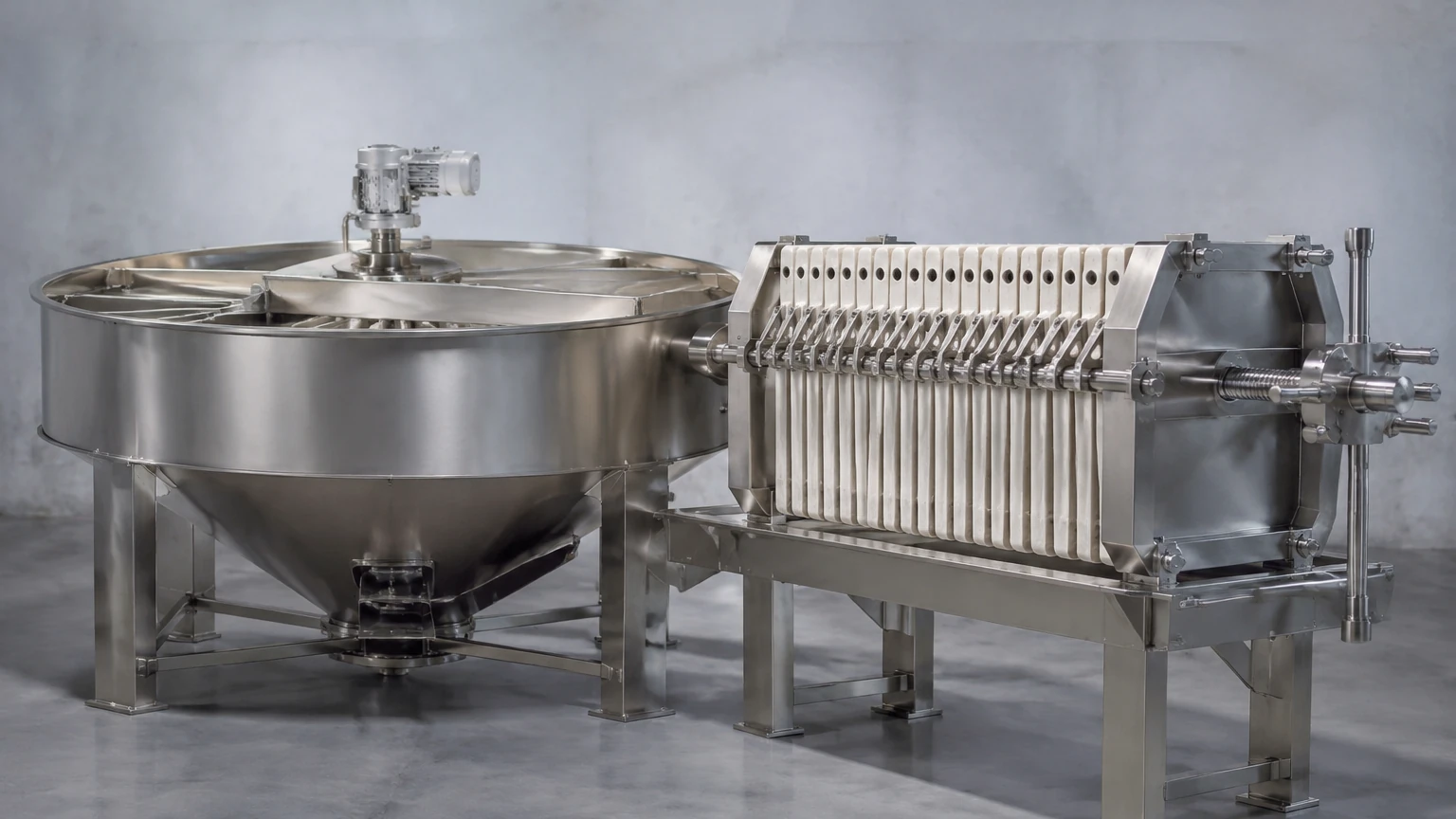
In industrial liquid-solid separation, the selection of equipment is dictated by the physical properties of the slurry, the required clarity of the filtrate, and the desired dryness of the recovered solids. Two of the most prevalent technologies used in large-scale industrial wastewater treatment, chemical processing, and mining are the plate clarifier and the filter press. While both systems aim to separate solids from liquids, they operate on fundamentally different physical principles: gravity sedimentation and mechanical pressure filtration.
Understanding the engineering nuances between a plate clarifier & filter press is essential for technical professionals tasked with optimizing process efficiency. This guide examines the technical specifications, application suitability, and critical evaluation criteria for these systems, with a particular focus on the role of high-performance metal filtration components in ensuring long-term reliability.
Understanding the Plate Clarifier: Gravity-Driven Sedimentation
A plate clarifier, often referred to as a lamella clarifier or inclined plate settler, is designed to remove particulates from liquids using gravity. The core principle relies on the settling velocity of particles. In a traditional vertical settling tank, the footprint required to achieve sufficient settling time can be massive. The plate clarifier solves this by utilizing a series of inclined plates.
Engineering Principle
By angling plates (usually at 45° to 60°), the effective settling area is significantly increased compared to the physical footprint of the unit. As the influent flows upward through the plate pack, solids settle onto the plates and eventually slide down into a collection hopper at the bottom. The clarified liquid continues upward to the discharge launders.
For engineers, the critical calculation involves the Hazen-Williams equation or similar settling velocity models. The efficiency of a plate clarifier is highly dependent on:
* Total Projected Surface Area: The sum of the horizontal projections of all inclined plates.
* Surface Loading Rate: The flow rate per unit of effective settling area (typically measured in gpm/ft² or m³/h/m²).
* Particle Characteristics: Specific gravity, size, and the use of flocculants or coagulants to increase settling speed.
Understanding the Filter Press: Pressure-Driven Separation
Unlike the clarifier, which is a continuous process, a filter press is a batch operation device that uses mechanical pressure to force a slurry through a filter medium. The solids are captured within chambers formed between a series of plates, while the liquid (filtrate) passes through the medium and exits the system.
The Role of the Filter Medium
The performance of a filter press is heavily dictated by the choice of filter media. While polypropylene cloths are common, many high-temperature or chemically aggressive applications in the pharmaceutical and chemical sectors require stainless steel wire mesh or precision metal filter components. These materials offer superior mechanical strength and resistance to blinding under high pressure.
As the cycle progresses, the solids build up into a "cake." Once the chambers are full, the pressure rises, further dewatering the cake until the desired moisture content is reached. The press is then opened, and the solid cakes are discharged.
Comparative Analysis: Plate Clarifier & Filter Press
Choosing between a plate clarifier & filter press—or determining if they should be used in tandem—requires a comparison of their operational characteristics.
| Feature | Plate Clarifier | Filter Press |
| :— | :— | :— |
| Process Type | Continuous | Batch |
| Primary Force | Gravity | Mechanical Pressure |
| Solids Concentration | Best for low solids (under 2-5%) | Best for high solids (5-40%+) |
| Filtrate Quality | Dependent on settling time/flocculants | Highly precise; depends on mesh/cloth rating |
| Solid Dryness | Thickened sludge (pumpable) | Compressed dry cake (stackable) |
| Footprint | Moderate (compacted by lamella design) | Large (relative to batch volume) |
| Maintenance | Low (no moving parts in the settling zone) | Moderate (plate cleaning, cloth replacement) |
Synergistic Applications
In many industrial waste treatment plants, these two technologies are used sequentially. The plate clarifier acts as a primary treatment stage to handle high-volume flow with low solids, producing a clarified overflow and a thickened underflow. That thickened underflow is then fed into a filter press to achieve maximum dewatering, reducing the volume of waste for disposal and recovering more process water.
Engineering Considerations for Material Selection
In both systems, the durability of internal components is a primary concern for maintenance engineers. Standard materials often fail when exposed to corrosive chemicals, high temperatures, or abrasive particles. This is where the integration of stainless steel filtration solutions becomes critical.
Corrosion and Temperature Resistance
In chemical processing and pharmaceutical manufacturing, fluids may have extreme pH levels or operate at temperatures exceeding 100°C. Stainless steel (specifically 304 or 316L grades) is preferred for plate supports, feed pipes, and filtration media within these systems. Unlike plastic components, stainless steel does not warp or degrade under thermal stress, ensuring that the filtration accuracy remains consistent over thousands of cycles.
Precision Filtration Accuracy
For applications requiring specific micron ratings, such as the recovery of expensive catalysts or the purification of food-grade oils, the filter medium must be manufactured to exact tolerances. Kaifil specializes in providing these high-precision components. By utilizing advanced manufacturing for stainless steel filter cartridges and wire mesh, engineers can achieve a level of separation that standard filter cloths cannot match. You can Review product options and application support on our Main Page to see how custom metal filters enhance these industrial processes.
Common Risks and Performance Pitfalls
Technical teams must be aware of several risks that can compromise the efficiency of a plate clarifier & filter press setup:
1. Media Blinding: In filter presses, if the pore size of the mesh or cloth is incorrectly matched to the particle size distribution, particles can become lodged within the media. This leads to increased pressure drops and shorter cycle times. Periodic backwashing or ultrasonic cleaning of metal filters can mitigate this.
2. Short-Circuiting in Clarifiers: If the influent flow is not properly distributed across the lamella plates, "channels" of high-velocity flow can form. This prevents particles from settling, leading to high turbidity in the effluent.
3. Chemical Incompatibility: Using standard carbon steel or low-grade plastics in a system handling chlorides or acids will lead to rapid pitting and structural failure. Always verify the compatibility of the filter housing and internal mesh with the process fluid.
4. Improper Flocculation: Plate clarifiers often rely on chemical polymers to aggregate small particles. If the dosing is incorrect, the settling velocity will not meet the design specifications, and the unit will underperform.
Evaluation Criteria for Purchasing Decisions
Before selecting or upgrading a filtration system, engineers should evaluate the following technical parameters:
* Total Suspended Solids (TSS): Determine the average and peak TSS of the influent. High TSS typically favors a filter press or a clarifier-press combination.
* Particle Size Distribution (PSD): This dictates the micron rating required for the filter mesh. A narrow PSD allows for more precise filter selection.
* Filtrate Clarity Requirements: If the liquid is being reused in a closed-loop system, high-precision stainless steel cartridges may be necessary as a polishing stage after the primary separation.
* Operational Footprint: Assess the available floor space. While plate clarifiers save space vertically, filter presses require significant horizontal clearance for plate shifting and cake discharge.
* Automation Level: Modern filter presses can be fully automated with PLC controls for plate shifting and cloth washing, whereas clarifiers are generally passive systems requiring less control logic.
Pre-Purchase Confirmation Checklist
To ensure the selected filtration solution meets the specific demands of your industrial environment, confirm the following with your technical partner:
1. Micron Rating and Efficiency: Is the filtration accuracy absolute or nominal? For critical applications, absolute ratings are required.
2. Material Certifications: Ensure that all stainless steel components come with material test reports (MTRs) to verify the alloy grade.
3. Pressure Ratings: For filter presses, confirm the maximum operating pressure and the safety factor of the plate assembly.
4. Customization Capabilities: Can the filter cartridges or wire mesh be customized to fit existing housings or unique flow geometries? Customization is often the key to resolving bottleneck issues in older plants.
5. Total Cost of Ownership (TCO): Look beyond the initial purchase price. Factor in the cost of replacement media, energy consumption (for pumps and hydraulics), and the labor required for cleaning and maintenance.
The Kaifil Advantage in Industrial Filtration
As a professional manufacturer specializing in custom stainless steel filtration solutions, Kaifil understands that no two industrial processes are identical. Whether you are managing the sludge from a plate clarifier or optimizing the performance of a high-pressure filter press, the quality of the filtration components determines your uptime and product purity.
Our expertise in wire mesh filters and stainless steel filter cartridges allows us to support demanding applications in chemical processing, hydraulic systems, and water treatment. By focusing on precision engineering and durable materials, we help technical teams achieve reliable separation results in the most challenging environments.
For more information on our technical capabilities and to explore our range of custom metal filtration components, visit our Main Page at https://www.kaifil.com/. Our engineering team is ready to assist you in selecting the right filtration accuracy and material specifications for your next project.
